
A magic mug is a drinking mug with an exterior thermochromic coating that needs hand washing and avoidance of dishwasher cycles to keep the reveal effect and surface finish intact, because commercial dishwashing programs commonly run around 60–65°C for washing and 80–85°C for rinsing, which is harsh on decorative polymer layers.
The reveal is triggered at a defined activation point used in thermochromic systems, and a published leuco-dye example reports a 45°C activation temperature, which matches why these mugs are built around hot-drink use rather than “warm” liquids.
Most products keep the coating on the outside and leave the beverage-contact surface as the interior glaze, so the safety logic is separation between the reactive layer and the liquid-contact area.
In custom printing, many magic mugs use coating-compatible print workflows, including dye sublimation on polymer-coated surfaces, so the design sits under the heat-reactive layer and becomes visible when the coating turns clear.
Everyday formats stay close to standard mug sizing, especially 11 oz (325 ml) and 15 oz (444 ml), but durability limits are different: abrasion can scratch the coating, and microwave heating can create local hot spots that damage the colour-changing layer, which is why some makers advise heating the drink first and then pouring it into the mug. (Food Standards Australia New Zealand)
This reliance on interactive surface chemistry marks a distinct branch within our theme-based mug types gallery, where the utility is defined by visual transformation. To understand the specific appeal of these heat-reactive vessels, one must first identify magic mug fundamental traits.
What is a magic mug?
A magic mug is a drinking mug with an exterior thermochromic coating that switches from an opaque “resting” look to a transparent “reveal” look when the mug wall warms, showing artwork printed underneath. Many commercial products use a black outer layer that hides the image until heat makes the coating clear. This behaviour is built for gift retail because it produces a visible change during normal use with hot drinks, while the mug still functions like standard drinkware in size and handling.
What is a heat reactive surface on a mug?
A heat reactive surface on a mug is a thermosensitive barrier applied to the outside of the mug, typically as a polymer coating that carries thermochromic pigments. It differs from standard ceramic glaze because glaze is fired into the ceramic for hardness and chemical durability, while a thermochromic layer is an add-on film designed to change optical properties with temperature. That difference is why the reactive layer is treated more like a “decorative coating” than a permanent glaze in care and wear.
What makes a magic mug change colour when it gets hot?
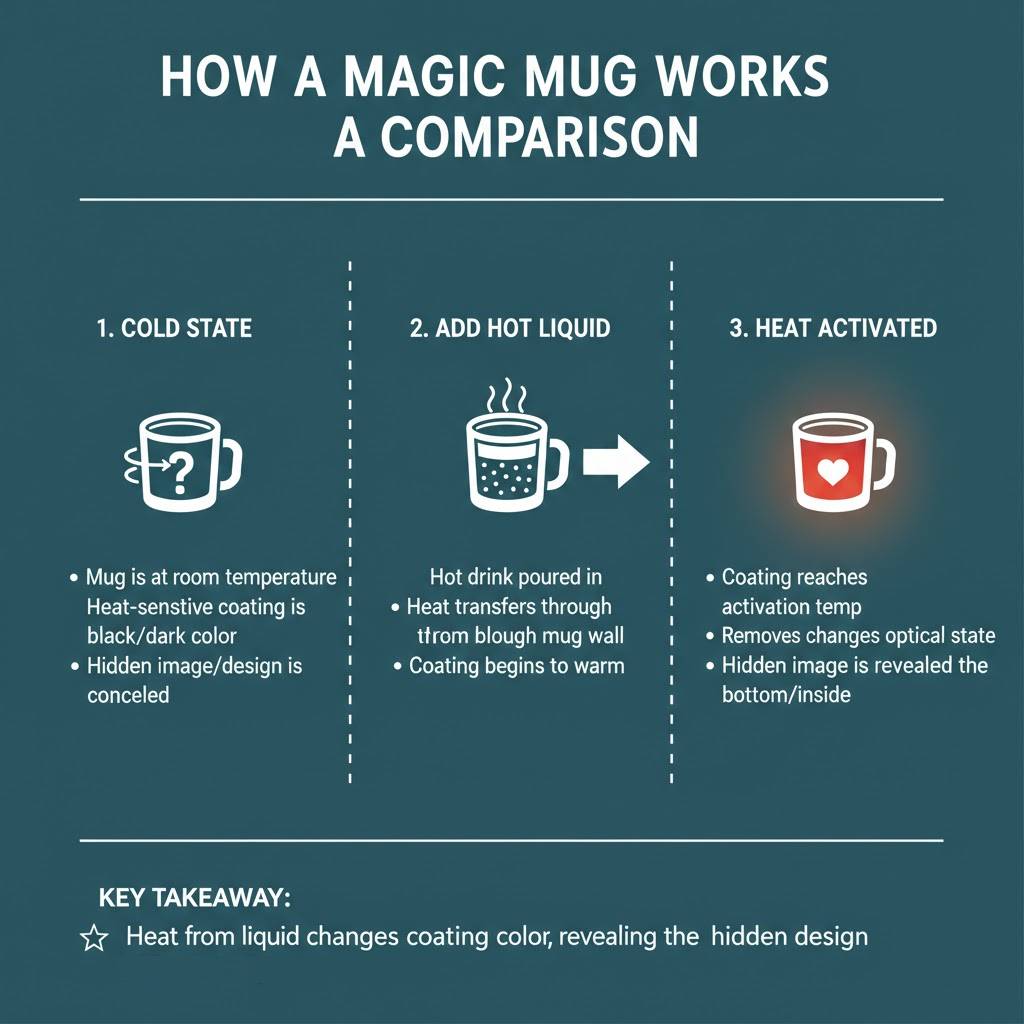
Heat makes the thermochromic layer change its optical state, so the surface shifts from opaque to transparent and the hidden print becomes visible. In practice, the “colour change” most people see is a reveal effect, not a full recolouring of the underlying ceramic. The trigger is temperature, so the change starts where the mug wall warms first and then spreads as heat moves through the ceramic.
What’s the difference between a magic mug and a mood mug?
A magic mug is built around a binary reveal, where the coating turns clear above a set temperature and returns opaque as it cools. Mood products usually aim for multi-colour gradients and may use thermochromic liquid crystals that show different colours across a wider temperature band. Liquid-crystal systems are common in temperature indicators because they can display multiple hues across a broad range, roughly −30°C to 90°C in typical formulations.
Do magic mugs use thermochromic ink, paint, or a special coating?
Most magic mugs use a special thermochromic coating system rather than ordinary “paint” in the household sense. The thermochromic material is formulated to sit as a uniform layer on the mug exterior so it can hide and then reveal the printed artwork underneath. The application is usually described as coating or spraying because consistency and coverage control the cold-state opacity and the clarity of the reveal.
Do magic mug coatings use leuco dyes or thermochromic liquid crystals?
Most commercial “reveal” mugs use leuco-dye thermochromic systems because they are designed to switch between a visible and a hidden state at a chosen activation point. A controlled example of a leuco-dye thermochromic ink reports an activation temperature of 45°C, with a colour change on heating (green below the threshold and yellow above it), which matches the idea of a manufactured “trigger temperature” that flips appearance.
That supports the same design logic used in magic mugs: choose a threshold near hot-drink temperatures so the reveal happens during normal pouring and returns as the mug cools. (MDPI)
How does a magic mug work?
A magic mug works by transferring heat from the hot liquid through the mug wall until the outside coating crosses its activation temperature and changes optical state. The practical result is a predictable reveal that starts where the wall warms first and expands as heat spreads. This is why the reveal is tied to both drink temperature and the mug’s heat-transfer behaviour.
What is thermochromism in the context of drinkware?
Thermochromism is a temperature-driven colour or transparency change, from the Greek roots for heat and colour. In drinkware, it is engineered into an exterior coating so the user sees a change without the coating needing to contact the beverage. This separation matters because the mug’s food-contact surface is the interior glaze, while the thermochromic system is a decorative outer layer.
What temperature does a magic mug need to start changing?
A magic mug is typically engineered to activate around hot-beverage temperatures, and a documented leuco-dye thermochromic ink example uses 45°C as the activation point.
This activation temperature is a manufacturing choice, not a fixed law of chemistry, because different thermochromic formulations can be tuned to different trigger points. A common product strategy is to set the threshold so a freshly poured hot drink produces a full reveal, while a lukewarm drink produces a partial change.
Will a magic mug change with warm drinks?
A warm drink can trigger a partial reveal if the mug wall does not reach the coating’s activation threshold uniformly. The reveal becomes complete when enough of the exterior surface crosses the activation temperature and the coating becomes broadly transparent. In practice, the difference between “warm” and “hot” shows up as a weak, patchy reveal versus a full, high-contrast reveal.
Does a magic mug change with cold drinks or ice water?
Most magic mugs are designed as cold-to-hot reactive systems, meaning the cold state is opaque and heat drives the reveal. Cold drinks and ice water keep the coating below its activation point, so the mug stays in the resting state. Cold-reactive products exist in the wider thermochromic market, but they use a different threshold strategy and are not the standard “black-to-reveal photo mug” format.
How does thermal conductivity affect the speed of the reveal?
Thermal conductivity affects how quickly heat travels from the liquid to the exterior coating through the mug wall. The reveal usually starts near the liquid level because that section of the wall receives heat first, then climbs as heat spreads upward. Wall thickness and the ceramic’s thermal properties set the delay between pouring and full reveal because they control the rate of heat transfer.
Why does my magic mug show the image when it’s cold?
Cold-state “ghosting” happens when the outer layer is not fully opaque, so high-contrast artwork beneath becomes faintly visible even without heating. If the hidden image uses bright, high-contrast shapes, it can visually bleed through an opaque layer that is not perfectly blocking light. Ghosting is a coating-opacity issue, so it shows up more with strong whites and yellows than with muted colours.
What are magic mugs made of?
Magic mugs are made by pairing a mug substrate with an exterior thermochromic coating system, then placing the design layer under that coating for the reveal effect. The substrate determines how the mug handles heat, while the coating controls the visual transition. Most consumer products in this category are ceramic because ceramic gives stable shape, good thermal mass, and a smooth surface for coating.
Are magic mugs ceramic or plastic?
Magic mugs are sold in ceramic and plastic formats, but ceramic is the common standard for classic “photo reveal” mugs. Ceramic holds heat and spreads it through the wall in a way that supports a clean reveal. Travel versions also exist in other materials, but they behave differently because insulation and wall construction change how fast the outside surface warms.
Why is ceramic commonly used for magic mugs?
Ceramic is commonly used because it provides thermal mass that helps the mug wall reach and hold the activation temperature long enough for a full reveal. Ceramic also offers a smooth, stable surface that supports even coating thickness, which matters for both cold-state opacity and reveal clarity. A consistent wall and surface finish reduce patchiness in the reveal effect.
What sizes do magic mugs come in?
Magic mugs commonly come in the same sizes as standard coffee mugs, especially 11 oz (325 ml) and 15 oz (444 ml) formats.
Those sizes matter at the H2 level because capacity changes the volume of hot liquid available to warm the wall, which affects how quickly the mug reaches full reveal during typical use.
Are magic mugs insulated like travel mugs?
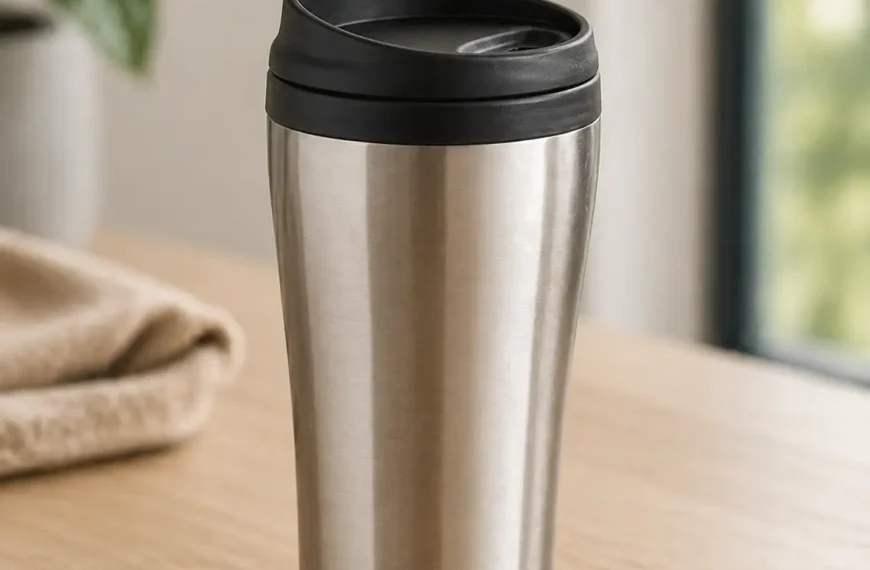
Most classic magic mugs are single-wall ceramic, not vacuum insulated. Vacuum insulation reduces heat transfer to the outer wall, which can slow or weaken a thermochromic reveal that depends on the exterior surface warming. That design tradeoff is why the most dramatic “black-to-photo” reveals are usually on non-insulated ceramic bodies.
How are custom magic mugs printed?
Custom magic mugs are produced by combining a print layer with a thermochromic topcoat so the artwork sits under the heat-reactive barrier. The workflow focuses on image quality, colour management, and coating uniformity because the coating acts like an optical filter in the cold state. The most common consumer output is a personalised photo or text design that becomes visible when heat activates the coating.
Can you make a custom photo magic mug?
A custom photo magic mug is made by printing the photo as an underlying design layer and then applying the thermochromic coating over it. The photo is not printed on top of the black layer; it is placed beneath so the coating can hide it when cold and reveal it when warm. This layered structure is what makes it different from a normal printed mug.
What kind of photo works best on a magic mug?
A photo with strong contrast and clear midtones works best because the coating reduces clarity and brightness during the reveal. High-resolution images with clean edges hold up better because the coating can soften fine detail. In practice, portraits with good lighting and simple backgrounds reveal more clearly than low-light images with heavy shadows.
Why does my photo look dull or blurry when the mug reveals it?
The thermochromic layer acts like a visual filter, so it can reduce sharpness and saturation compared with a standard glossy print. Matte coatings scatter light more than glossy finishes, which makes detail look softer at typical viewing distance. The effect is strongest on designs that rely on fine lines and small text rather than bold shapes.
What printing method is used for custom magic mugs?
Custom mugs use printing techniques designed for durable adhesion to ceramic and compatibility with topcoats. The chosen method must produce a design layer that remains stable under heat cycles and stays visually consistent when viewed through the thermochromic film. The production choice is usually tied to throughput, colour control, and how well the design layer integrates with the coating system.
Can you sublimate a magic mug?
A magic mug can be produced with dye sublimation when the mug has an appropriate polymer coating that can accept sublimation dyes. Sublimation is defined by the dye turning from solid to gas under heat and bonding into polymer-coated surfaces instead of sitting on top.
That matters for magic mugs because the print is meant to sit within or under a coating layer that then gets hidden and revealed by the thermochromic topcoat.
Are magic mugs safe to drink from?
A magic mug is safe to drink from when the beverage-contact surface is a food-suitable interior glaze and the thermochromic coating is restricted to the exterior. The safety logic is separation: lips and liquid stay on the inner surface, while the heat-reactive system stays outside. This is also why many manufacturers leave a rim gap so the mouth does not contact the coated area.
Is the heat-changing coating on a magic mug food-safe?
The heat-changing coating is designed for the exterior, so it is not part of the liquid-contact surface when the mug is manufactured correctly. A common production approach is to keep the coating off the rim and interior so the mouth and drink stay on the glazed ceramic. That separation is the core safety design feature for thermochromic drinkware.
Do magic mugs contain lead or other harmful chemicals?
Lead risk is tied to ceramic mug materials and decorative treatments, which is why testing and sourcing matter for any ceramic mug category, including magic mugs. A pilot study measuring lead in beverages from ceramic mugs reported 0.2 to 8.6 μg/L in coffee and <0.2 to 1.6 μg/L in tea, showing that leaching can occur under routine hot-drink use in some mugs. (Springer)
That finding supports a practical buying rule: treat “lead-free” claims as meaningful only when backed by credible manufacturing controls and compliance testing, because the interior surface is the true beverage-contact risk zone.
Can a magic mug crack from sudden temperature changes?
A magic mug can crack from thermal shock, which is mechanical stress caused by rapid temperature change across the ceramic body. Thermal shock is defined as stress in ceramics created by sudden temperature shifts that drive uneven expansion and can trigger fracture.
The highest-risk scenario is extreme change, such as moving the mug from very cold storage to very hot liquid in one step.
Can you put a magic mug in the freezer?
A magic mug can be placed in a freezer, but the main risk is damage to the coating and micro-cracking from temperature cycling rather than triggering the reveal effect. Freezing keeps the coating in its cold, opaque state and does not “activate” the reveal. The practical concern is durability: repeated extremes increase stress on ceramic and coatings over time.
Are magic mugs dishwasher and microwave safe?
Most magic mugs fail in appliances because the thermochromic coating is a functional decorative layer, not a fired ceramic glaze. Dishwashers combine hot water, detergents, and mechanical spray that accelerate wear. Microwaves can create uneven heating, which stresses coatings and can damage the visual performance.
Are magic mugs dishwasher safe?
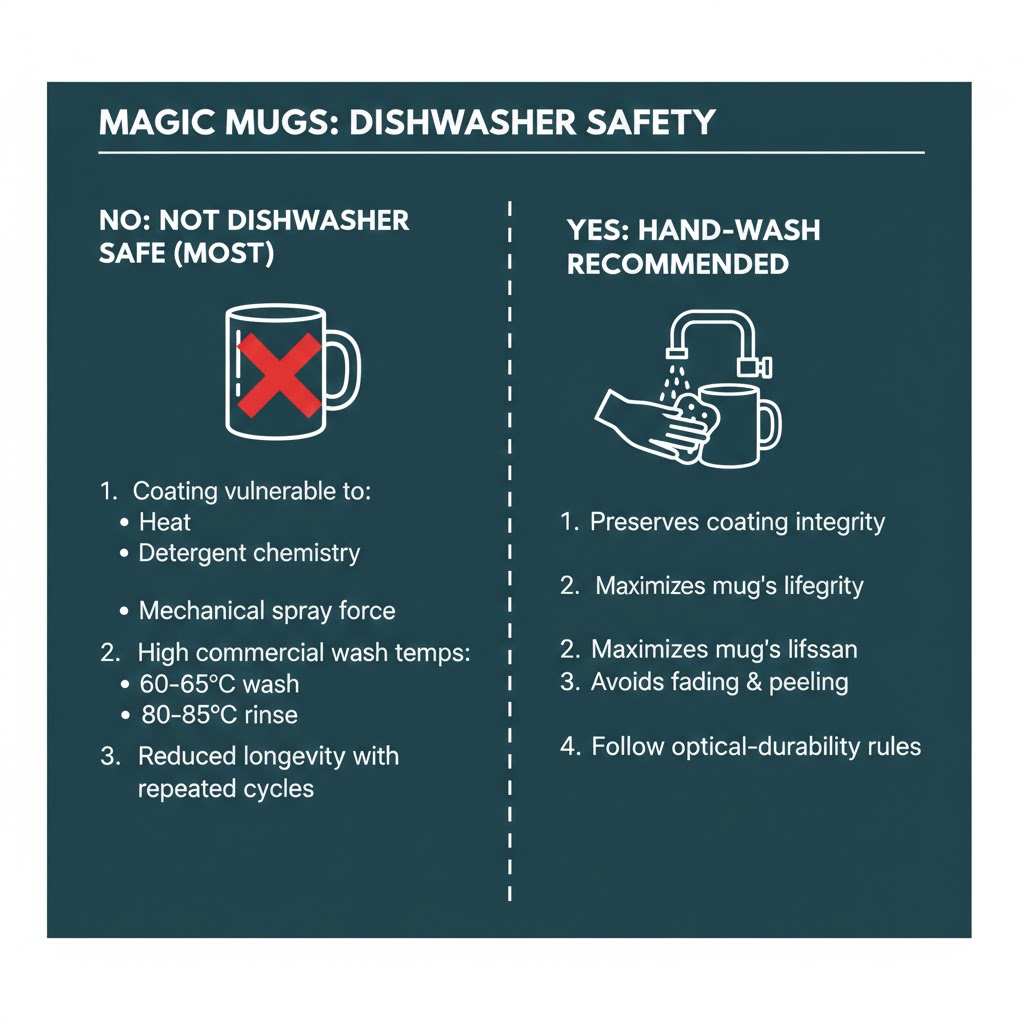
Most magic mugs are not dishwasher safe because the coating is vulnerable to the heat, detergent chemistry, and mechanical force of spray. Commercial dishwashing standards describe wash temperatures of 60–65°C and rinse temperatures of 80–85°C in some systems, which are harsh conditions for decorative polymer layers.
Even when a product label claims dishwasher compatibility, coating longevity usually drops under repeated cycles compared with hand washing.
Can you put a magic mug on the top rack of the dishwasher?
Top-rack placement does not eliminate the key failure factors: heat, detergent chemistry, and water jet impact. The coating is still exposed to high-temperature water and strong cleaning agents, and repeated cycles can dull or peel the surface. The top rack may reduce direct spray intensity in some machines, but it does not change the fact that the thermochromic layer is not a fired glaze.
Are magic mugs microwave safe?
A ceramic mug body is commonly microwave compatible, but the thermochromic coating is the weak point because microwaves can create local hot spots that stress films and prints. Some manufacturers explicitly warn that microwaving can damage the colour-changing coating and recommend heating the drink separately, then pouring it into the mug for the reveal.
That practice also produces a cleaner reveal because the heat arrives through the liquid-wall contact instead of uneven surface heating.
How do you clean a magic mug without damaging the coating or print?
Cleaning a magic mug safely means protecting the thermochromic coating from abrasion, harsh chemistry, and prolonged soaking. The goal is to remove oils and residue while keeping the polymer surface intact, because micro-scratches reduce cold-state opacity and make the reveal look dull. There are 5 cleaning rules that preserve coating durability:
- Use hand washing as the default
- Keep water warm, not scalding
- Use mild dish soap
- Avoid abrasives
- Dry fully before storage
Should you hand wash a magic mug?
Hand washing is the standard care method because it limits heat exposure and mechanical abrasion. A gentle sponge, warm water, and mild soap remove residue without stripping the coating. This directly protects colour fastness because the thermochromic system works best when the surface stays smooth and intact.
Can you use abrasive sponges on a magic mug?
Abrasive sponges should not be used because the thermochromic coating is softer than fired ceramic glaze and can scratch at the surface level. Micro-scratches scatter light, reduce the cold-state “black” opacity, and make ghosting more visible. A non-scratch sponge is the practical standard for keeping the reveal crisp.
How do you stop a magic mug design from peeling or scratching off?
Peeling prevention is controlled by three behaviours that reduce mechanical and chemical stress:
- Avoid soaking for long periods
- Keep metal utensils away from the exterior surface
- Store the mug so it does not rub against hard objects
These habits matter because the coating is a functional film, and edge damage often spreads once a peel starts.
Are magic mugs scratch-resistant?
Magic mugs are less scratch-resistant than standard glazed ceramic mugs because the active layer is a polymer coating rather than a fired glassy glaze. A fired glaze is designed for hardness and chemical durability, while a thermochromic film is designed for optical switching. That difference explains why everyday abrasion that a normal mug tolerates can visibly degrade a magic mug’s finish.
How long does the colour-changing effect last?
The colour-changing effect lasts as long as the thermochromic system retains its switching performance and the coating stays physically intact. Failure usually shows up as fading, a weak reveal, patchy transparency, or a permanently “half-revealed” look. The lifecycle is shaped by heat cycling, UV exposure, dishwasher chemistry, and abrasion.
Do magic mugs fade over time?
Thermochromic systems degrade under UV and harsh chemical exposure, which is why sunlight and aggressive cleaners shorten the visual lifespan. A published study on thermochromic prints reports that reversible thermochromic colour change can last for tens of years when protected from direct sunlight, very high temperatures, and aggressive solvents, which frames UV and chemicals as the main durability threats.
For mugs, the practical translation is simple: store away from window sun, avoid dishwashers, and keep cleaners mild. (PMC)
Why is my magic mug not changing colour anymore?
A magic mug stops changing when one of three failure modes dominates:
- Heat damage from microwaving or repeated overheating
- Chemical damage from dishwashers or strong cleaners
- Physical wear from abrasion and scratches
Each mode either disrupts the thermochromic chemistry or ruins the coating’s ability to switch cleanly from opaque to transparent.
Does the beverage type affect the magic mug?
Beverage type matters mainly through temperature, not through whether the drink is coffee, tea, or cocoa. The reveal depends on the mug wall crossing the activation threshold, so any liquid hot enough will work. The category still connects back to core mug usability because drink choices affect how long heat stays in the cup and how often the mug gets reheated.
Do magic mugs work the same with coffee, tea, and hot chocolate?
Coffee, tea, and hot chocolate trigger the reveal the same way when the liquid temperature is high enough to warm the wall past the activation point. Differences show up in cooling rate because thicker drinks can hold heat differently and because people often sip cocoa more slowly than coffee. The mug is not insulated like a vacuum travel mug, so it loses heat at the rate of a normal ceramic mug, which means the reveal fades as the drink cools.
What intellectual property risks apply to custom magic mugs (copyright, trademark, and takedowns)?
Custom magic mugs often involve printing photos, characters, logos, and quotes, so IP rules can decide whether a design can be sold, listed, or shipped by print services and marketplaces. The risk is practical: a listing can be removed if it uses protected characters or brand marks without permission. For sellers, the safest path is to use original artwork, licensed graphics, or content you own with clear proof.
What content is typically restricted in custom printing (copyrighted characters, logos, and “brand look”)?
Restricted content includes copyrighted characters, brand logos, and artwork copied from films, games, or creators without a licence. Many print services block these designs at the file-review stage because they carry legal risk. The clean rule is ownership: if there is no licence or documented right to use it, it is treated as restricted.
How do takedown systems work on major marketplaces (DMCA notices, counter-notices, and listing removal)?
Marketplace takedowns usually follow a complaint process where the rights holder claims infringement and the platform removes or disables the listing. A counter-notice is used when the seller claims the content is lawful, but it requires confidence and documentation because it escalates the dispute. This system is common in high-volume custom products like mugs because designs are easy to copy and resell.
Practical compliance checklist for sellers and buyers (proof of licence, model releases for photos, and artwork ownership).
There are 5 checklist items that prevent most IP problems:
- Keep proof of licence for any commercial graphics
- Use original artwork files you created or commissioned
- Get permission for photos of identifiable people when selling publicly
- Avoid logos, team marks, and brand trade dress without written rights
- Archive source files and order records for dispute response
This checklist reduces takedowns and also helps print partners approve files faster.
The simple way to buy, use, and keep the reveal looking sharp
A good magic mug choice comes down to three things: a clear activation reveal at hot-drink temperatures, a coating that stays opaque when cold, and a care routine that avoids heat-and-detergent abuse. The fastest way to extend lifespan is hand washing and keeping the mug out of dishwashers and microwaves. The practical standard is treating the outer layer like a functional coating, not like permanent glaze. When the coating stays smooth and protected from UV and abrasion, the mug keeps its clean black resting look and a high-contrast reveal. Adopting these specialized maintenance habits ensures that even the most reactive vessels maintain the structural and aesthetic integrity expected of high-performance mugs.