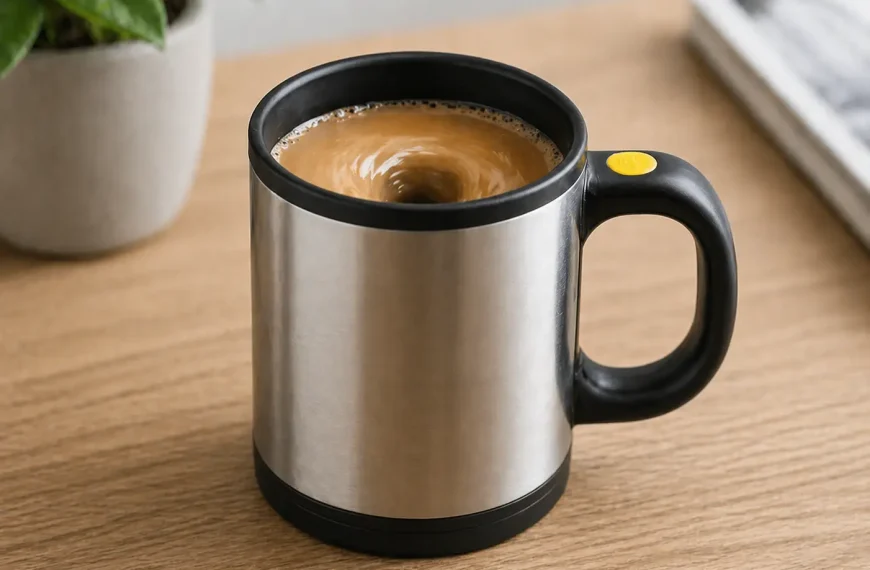

Mug insulation refers to the engineered reduction of thermal exchange between a liquid and the surrounding air by controlling how heat moves through the mug’s walls and opening. The job is mechanical: slow conduction through solids, suppress convective air movement near the drink, and limit radiative loss from the hot liquid surface. In practical terms, the goal is temperature stability in degrees Celsius over time, not just “warmth.”
Vacuum insulation is the top-performing construction because removing air between two walls removes the medium that enables most conduction and convective looping through the gap. Double-wall designs that keep air (not a vacuum) still slow heat loss, but they do it with a less effective barrier; material choice then becomes a bigger part of the outcome. For example, 304-grade stainless steel, commonly used for vacuum walls, has a thermal conductivity reported around 14 to 17 W/m·K, while borosilicate glass is reported around 1.14 W/m·K, which helps explain why “double-wall” can mean very different real-world results depending on the wall system and what sits between the layers. (AZoM)
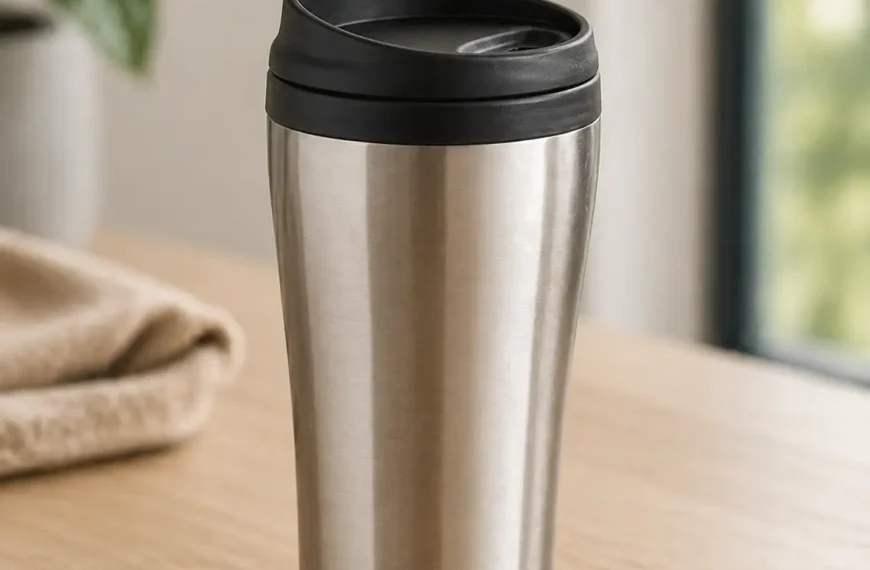
Peak thermal stability depends on construction efficiency and material science working together. A reliable vacuum system needs a wall material that can be formed, welded, and sealed under stress, which is why 18/8 stainless steel is the industry baseline; “18/8” refers to about 18% chromium and 8% nickel in the alloy. But even a strong wall system can lose performance through the opening, because the lid is the weakest link in the thermal envelope: once air can freely exchange at the mouth, heat loss accelerates through convection and evaporation. In controlled testing, one insulated tumbler kept a drink hot for 5.5 hours with the lid closed, but stayed warm for only a bit over 3 hours with the lid left open, which shows how lid sealing can dominate the outcome even when the body is well insulated. This thermal envelope is just one variable in the broader matrix of mug features that dictate how a vessel survives daily use and environmental stress.
To understand why certain designs outperform others, one must first examine the physics of how a vessel interacts with thermal energy.
What are the fundamental mechanics of mug insulation?
Mug insulation works by creating barriers that slow heat transfer from the liquid to the environment through conduction, convection, and radiation. The mug wall mainly controls conduction, the air space and lid control convection, and reflective surfaces and coatings can reduce radiative exchange. The “insulated” part is not a single feature; it is a thermal envelope made of three zones: the inner wall, the gap between walls, and the opening at the top. The best-performing designs attack all three zones at once by reducing heat flow through solids, reducing heat flow through gases, and reducing heat loss from the exposed liquid surface. In practice, any mug that leaves the top fully open will bleed heat quickly because the dominant losses shift to air exchange and evaporation.
What is “thermal conductivity,” and why does it matter for mug insulation?
Thermal conductivity is the material property that sets how fast heat energy moves through a solid when there is a temperature difference across it. When a mug is single-wall metal, heat can move from the hot liquid to the outside surface quickly because the wall provides a continuous solid path for conduction. In contrast, double-wall systems break that path by forcing heat to cross an air gap or a vacuum gap, and that gap becomes the main resistor. Material still matters inside that system because the walls are real solids: type 304 stainless steel is listed at 16.2 W/m·K (0 to 100°C) in an ASM-backed MatWeb data sheet, which is high enough that wall thickness and contact points (like the welded base and rim) affect performance. The point of the vacuum is that it removes the gas-phase pathway, so you are mostly left with conduction through the thin walls and a smaller radiative component.
What is temperature stability, and how is it different from “heat retention time”?
Temperature stability is the rate at which the drink’s temperature decays, while heat retention time is how long the drink stays above a chosen threshold temperature. Stability is about slope; retention time is about duration. Two mugs can claim the same “hours hot” but behave differently: one can drop quickly at first and then level off, while another can decay more evenly. Liquid properties matter because the drink’s heat capacity and mass set how much energy must be removed to change the temperature; a fuller mug with more liquid mass will usually show better stability than the same mug half-filled under identical conditions. Any claim about “ideal retention time” depends on the chosen threshold, because a coffee held above 60°C is a different target than a soup held above 50°C, and those thresholds change the measured “time” even when the mug is identical.
Which insulation constructions are most effective for mugs?
Insulation construction performance is defined by what fills the gap between walls and how well that gap prevents convective looping and conductive bridging. There are three core constructions used in mugs: double-wall air gap, double-wall foam-filled, and double-wall vacuum insulated. Vacuum-insulated designs dominate because the gap is not just “empty space”; it is a sealed low-pressure cavity engineered to remove the gas-phase pathway that enables convection and much of conduction. Foam-filled designs sit in the middle because foam blocks convective loops but still contains a solid polymer network that conducts heat. Air-gap designs sit at the bottom because air still supports convection and its thermal conductivity stays non-zero.

What does “double wall” construction mean in practice?
Double-wall construction means the mug has two separate walls with a space between them that acts as a thermal barrier. That barrier can be one of three things: air, foam, or a vacuum. Glass double-wall mugs often rely on trapped air, which improves comfort and slows heat loss compared with a single-wall glass cup, but the gap still allows gas-phase heat transfer. A vacuum double-wall mug uses a sealed cavity so the gap is not just “air” but an engineered low-pressure zone. The label “double wall” does not guarantee vacuum insulation, so the correct reading is to treat “double wall” as a structural description and then look for the filler type.
What is vacuum insulation, and why is it usually the top performer?
Vacuum insulation is a double-wall construction where the air between walls is removed and the cavity is sealed so the gas-phase heat-transfer pathway is suppressed. A vacuum-flask heat analysis that modeled coffee temperature over 10 hours reports a baseline design reaching about 55°C at the 10-hour mark, while alternative insulation choices in the same study held substantially higher temperatures, including a case reported around 72.3°C at 10 hours. That result supports the core mechanism: once convection through the gap is removed, the remaining losses are concentrated at the opening and through smaller solid bridges, so design details and materials become the deciding factors. A mug does not need a lid to “contain a vacuum,” but it needs a lid to prevent the top opening from becoming the dominant heat-loss route. (ResearchGate)
What is a vacuum seal, and how does it affect long-term performance?
A vacuum seal is the airtight boundary that keeps the inter-wall cavity at low pressure so the vacuum layer stays functional. In a vacuum-insulated mug, the cavity is created and sealed at manufacture, typically by welding and sealing the evacuation point, so the performance depends on that seal staying intact. There are three common signs of failure that reliably indicate loss of insulation: the outside wall becomes noticeably warm with a hot drink inside, the mug loses hot or cold retention dramatically compared with its earlier behavior, and condensation behavior changes because the outer wall temperature shifts closer to the drink temperature. Once the vacuum is breached, the cavity fills with air and the performance drops to something closer to a basic double-wall air-gap mug. Consumer repair is not a realistic pathway because restoring a vacuum requires specialized evacuation equipment and a re-seal process at the factory level.
What is insulation foam, and when is it used instead of vacuum insulation?
Insulation foam is a polymer-based filler placed between walls to reduce convective air movement and add mechanical robustness. Foam designs are used when impact resistance and cost control are prioritized, because a foam-filled cavity is less sensitive to dents than a precision vacuum gap and does not require a vacuum sealing process. Foam is inferior to a high-quality vacuum cavity for pure heat retention because it still provides a continuous solid network for conduction, and the polymer itself has a measurable thermal conductivity. Foam-filled designs show up more often in larger coolers and budget-tier plastic insulated mugs because they are easy to mold and assemble. When comparing foam to vacuum, the correct interpretation is that foam is a durability-and-cost choice, while vacuum is a performance choice.
How do materials and linings change thermal performance?
Material and lining choices change thermal performance by changing conduction pathways, structural integrity of the vacuum cavity, and radiative behavior inside the mug. Stainless steel dominates vacuum-insulated mugs because it can be welded and sealed reliably while resisting corrosion and maintaining shape under use. Ceramic and copper elements appear as linings or layers because they change surface behavior: ceramic shifts taste neutrality and cleaning behavior, and reflective metallic layers can reduce radiative loss. The most practical way to compare materials is to separate the mug into two roles: the structural wall material that must hold the vacuum and survive mechanical stress, and the inner surface material that sets taste interaction and surface heat exchange.
Why is stainless steel the industry standard for insulated mugs?
Stainless steel is the industry standard for insulated mugs because it supports durable double-wall fabrication and reliable sealed cavities. Type 304 stainless steel is widely used, and an ASM/MatWeb data sheet lists its thermal conductivity at 16.2 W/m·K (0 to 100°C), which is high enough that the insulation performance is not “from the steel” but from the vacuum gap that interrupts the conduction path. (asm.matweb.com) The steel’s main value is mechanical: it can be formed into thin, strong walls and welded to create an airtight boundary that keeps the vacuum layer stable. In practice, stainless steel also tolerates repeated thermal cycling and washing better than brittle materials. The most common shorthand “18/8” is an alloy family marker for austenitic stainless compositions used in food contact equipment, and many manufacturers explicitly label insulated drinkware as 18/8 stainless.
What is a ceramic lining, and what does it change about taste and heat behavior?
A ceramic lining is an interior coating layer applied to reduce metallic taste transfer and change how the drink contacts the mug surface. The thermal role of ceramic lining is secondary because most ceramic-lined travel mugs still rely on a vacuum gap for real insulation, and the coating itself is thin compared to the wall system. A ceramic lining can become a thermal bridge if it is paired with a non-vacuum construction and creates continuous contact points or thicker conductive paths. The main practical changes are sensory and maintenance-related: ceramic surfaces often resist flavor carryover and can feel more “neutral” than bare metal to many users. The correct expectation is that ceramic lining changes the inner-surface experience more than it changes the insulation class.
What is copper lining, and what is it trying to improve in thermal performance?
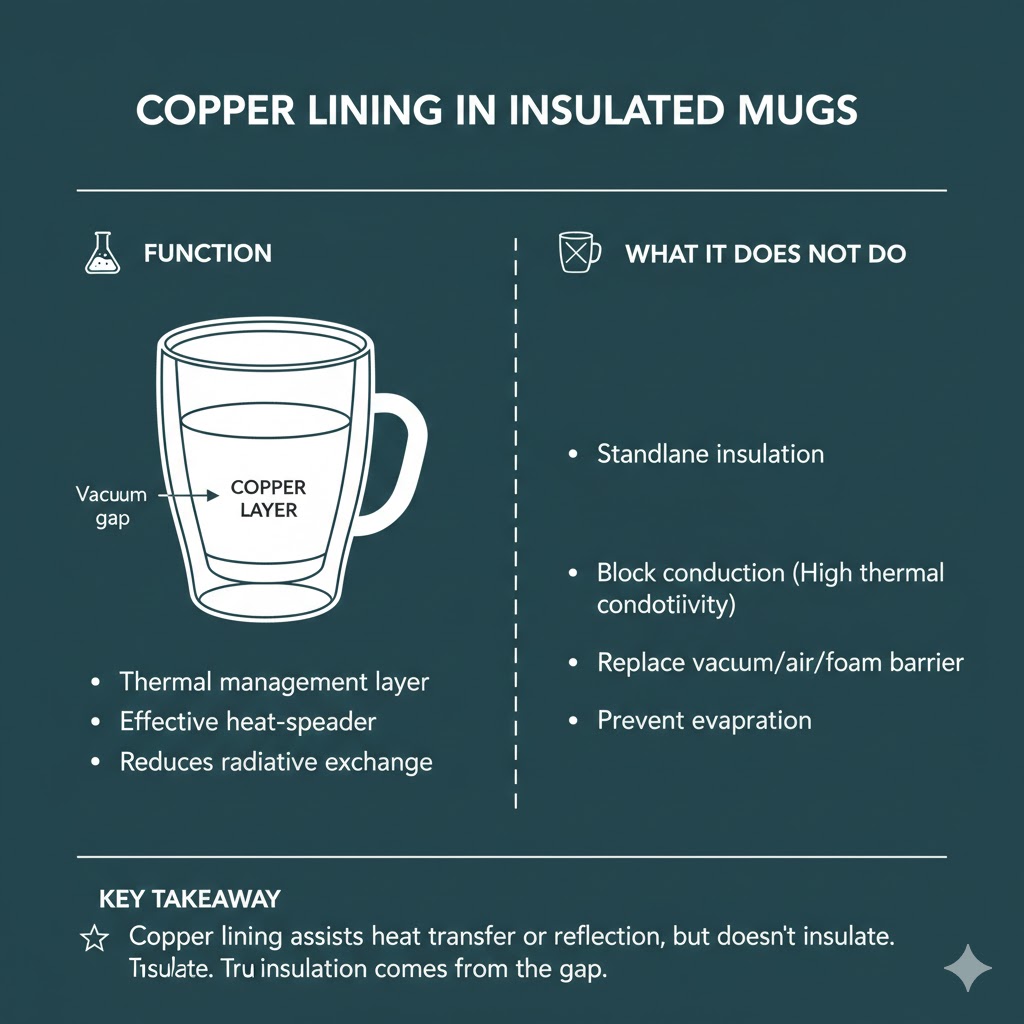
Copper lining in insulated drinkware is typically used as a thermal management layer, not as a standalone insulation method. An ASME-published “smart travel mug” design used a double-wall structure with an outer steel cylinder and an inner copper cylinder, and reported a performance change of about 30°C with an added thermoelectric thermal system in their testing context. (ResearchGate) That supports the correct interpretation: copper is often present because it is an effective heat-spreader within an active system or a designed thermal layer, not because it “insulates.” For passive insulation, copper’s high thermal conductivity means it does not block conduction; the insulation still comes from the vacuum gap or the air/foam barrier. When copper is used as a reflective layer, the intended mechanism is reducing radiative exchange, which is a supplemental effect compared with stopping convection through the gap and evaporation through the opening.
How do lids influence insulation more than most people expect?
The lid determines how much heat escapes through the opening, which is often the dominant loss pathway after the wall system has been improved. In an insulated mug, the body mainly controls conduction, but the opening controls convection and evaporation at the liquid surface. A strong lid reduces air exchange, reduces vapor escape, and reduces the mixing of cool ambient air into the headspace. Without a lid, a vacuum-insulated mug can still have excellent wall performance and still cool quickly because the top behaves like an exposed cup. In practice, improving the lid seal can outperform small upgrades in wall materials because the lid targets the largest uncontrolled boundary.
Which lid style keeps heat best: flip lid, slider, screw cap, or sip hole?
The best heat-retaining lid is the one with the smallest open area during use and the tightest seal when closed. There are four lid behaviors that matter most: the effective opening area, the time the opening is exposed, the quality of the gasket seal, and whether the lid vents steam continuously. A physics-focused coffee-cup study that revisits Newton’s cooling model highlights that evaporative cooling can play a major role versus convection and radiation in real situations, which supports treating “sip-hole exposure” as a high-impact design variable. A drink-through sip hole increases heat loss because it allows continuous mass transfer of water vapor and continuous air exchange at the surface. A screw cap that stays closed until drinking usually performs better than a slider lid that leaks air across the opening even when “closed,” because the slider design often leaves a persistent gap.
There are 4 practical rules for choosing a lid based on thermal loss:
- Prefer a lid that fully covers the opening and seals with a gasket
- Prefer the smallest drink-through opening that still matches the drinking use case
- Prefer a design that stays closed between sips without “resting open”
- Avoid lids with permanent vents unless pressure release is required for a specific use
Are “leak-proof” lids also better for insulation?
A leak-proof lid is also a better insulation lid because airtight sealing blocks convective air exchange at the opening. A gasketed seal reduces the flow of warm moist air out and cool dry air in, which reduces both convection and evaporation-driven loss. Leak-proof mechanisms vary, but they usually rely on gasket compression and a locking interface, which also improves thermal sealing. The limitation is that “leak-proof” describes spill behavior and does not guarantee a small sip opening, so a leak-proof lid with a large drink port can still lose heat quickly when in use. The correct reading is that leak-proof is a strong positive signal for insulation, but opening size and closure behavior still decide the outcome during drinking.
How can you maximize insulation performance in daily use?
Maximizing insulation performance is about controlling the drink’s initial energy loss, limiting top-opening losses, and keeping the mug operating in its strongest geometry. The biggest gains come from three actions: preconditioning the mug walls, minimizing headspace, and keeping the lid closed between sips. Small changes in behavior can produce large changes in perceived heat retention because they change the early temperature drop and the evaporation rate. The most reliable approach is to treat the mug as a thermal system with two reservoirs, the liquid and the wall, and reduce energy flow between them at the wrong times. This section focuses on methods that change measurable heat loss, not lifestyle preferences.
How much difference does preheating an insulated mug make?
Preheating improves performance by reducing the initial temperature drop caused by the mug walls absorbing heat from the drink. When a hot drink hits a cooler inner wall, heat flows into the wall until the wall and liquid move toward thermal equilibrium, and that “first-minute drop” is often the part people notice most. Preheating works because it raises the wall temperature closer to the drink temperature before filling, so less energy is pulled out of the liquid. The practical method is simple: fill the mug with hot water, close the lid, wait long enough for the wall to warm, then discard and fill with the drink. The measurable outcome is a higher starting temperature after pouring and a slower early decay. The tradeoff is that preheating can keep drinks above comfortable drinking temperature longer, which is a predictable result of reducing early heat loss.
How much does mug size and fill level affect heat retention?
Fill level affects retention because it changes the ratio of liquid volume to exposed surface area at the top and changes the size of the headspace. More headspace increases the area where evaporation and convection can exchange heat with the air, and it increases the amount of air that can circulate under the lid when the lid is opened. A fuller mug also has more thermal mass, so the same heat loss rate produces a smaller temperature change per minute. The practical rule is that a larger mug filled halfway often cools faster than a smaller mug filled nearly to the top, even when the wall system is similar, because the top-surface geometry dominates. When comparing “hours hot” claims, the fill volume used in the test is a hidden variable, so real-world performance can deviate if the mug is routinely underfilled.
What is anti-sweat design, and why does condensation happen on cold mugs?
Anti-sweat design means the outer surface stays warm enough that it does not fall below the dew point of the surrounding air, so water vapor does not condense on the exterior. Condensation happens when a surface temperature drops below the dew point, which the U.S. National Weather Service defines as the temperature at which water vapor will turn into liquid water droplets. Vacuum-insulated mugs reduce exterior cooling because the cold liquid is thermally isolated from the outer wall, so the outside surface stays closer to room temperature. That is why a well-functioning vacuum mug can hold iced drinks with minimal exterior sweating. If the outer wall becomes cold enough to reach the dew point, sweating appears, and that can be a sign of either extreme ambient humidity or reduced insulation performance. (National Weather Service)
What maintenance and safety factors affect insulated mug performance?
Performance durability depends on keeping the vacuum layer intact, protecting seals and gaskets, and avoiding damage that creates conductive bridges or seal leaks. Dents matter most when they deform the inner and outer walls enough to create contact points, because direct contact creates a solid conduction bridge across the gap. Lid gaskets matter because they control air exchange and leakage at the opening, and gasket wear reduces both spill resistance and thermal sealing. Freezing is a material-stress issue: if a mug is filled and the liquid freezes, expansion can stress seals and components, so the safer practice is to avoid freezing a filled insulated mug. Maintenance for insulated mugs is less about “keeping it clean” and more about keeping the thermal envelope functioning as designed.
What does dishwasher safe mean for insulated mugs, lids, and gaskets?
Dishwasher safe means the manufacturer has tested the product for dishwasher cleaning without unacceptable damage under their defined conditions, but that claim differs across brands and components. YETI states that Rambler drinkware is dishwasher safe and gives placement guidance for bodies, lids, and gaskets, which indicates that at least some vacuum-insulated stainless systems are designed to tolerate dishwashing. The practical risk is not “dishwasher use destroys all insulation,” but that repeated high-heat cycles and detergents can shorten the life of lid parts and gaskets, and a compromised gasket reduces thermal sealing at the opening. The most reliable rule is to follow the specific brand’s instructions for the body and for the lid assembly, because lids often contain polymers and seals that have stricter placement and temperature constraints than the metal body. If a mug is not explicitly rated dishwasher safe by its maker, handwashing is the conservative approach for preserving coatings, gaskets, and fit.
Can you put a vacuum-insulated mug in the microwave?
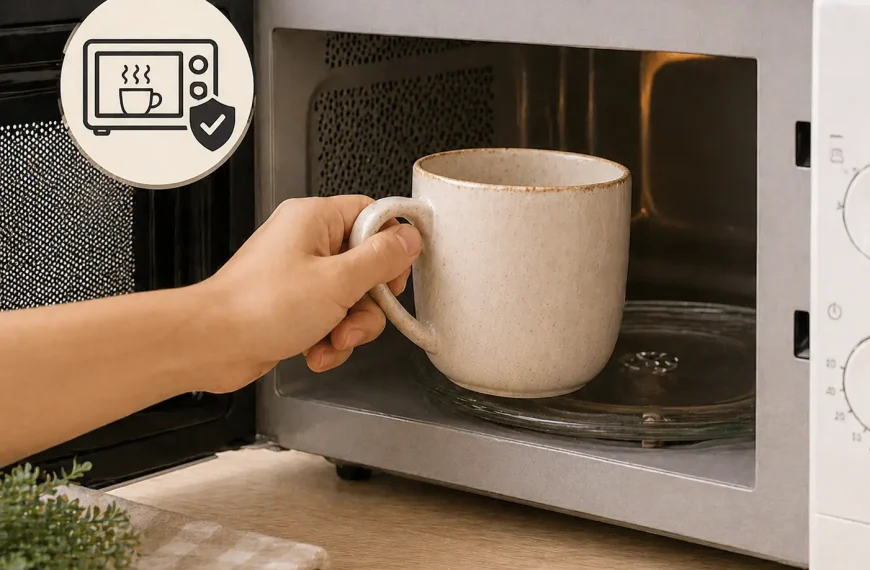
A vacuum-insulated metal mug must not be put in the microwave because metal can arc and create a fire hazard. Fire and Rescue NSW explicitly warns not to use metal or metal-edged items in microwave ovens because the metal can cause arcing that can lead to a fire. That rule applies directly to stainless steel vacuum-insulated drinkware because the body is metal and the cavity is a sealed structure. The definitive answer is no for metal-based insulated mugs. If a mug has any metal body, metal rim, or metallic coating, microwave heating is a safety error, not a performance choice. (fire.nsw.gov.au)
How do you choose an insulated mug for your specific needs?
Choosing an insulated mug is a specification problem that starts with the insulation class and ends with opening control and geometry. The highest-performance class is vacuum insulation, followed by foam-filled insulated designs, followed by simple double-wall air-gap designs. After class, the second decision is the lid system because it controls top losses and real-world performance during sipping. The third decision is geometry, especially mouth width, because wide openings increase heat escape at the top while narrow openings reduce surface-area losses. The correct selection logic is to pick the best wall system that fits the use case, then choose the lid that keeps the opening closed most of the time, then choose a shape that matches cleaning and drinking needs without sacrificing the thermal envelope.
There are 3 specification priorities that decide real-world performance:
- Insulation class: vacuum, foam, or air gap
- Lid sealing quality and opening size
- Opening geometry: narrow vs wide mouth
What should you look for in specs: “hours hot/cold,” wall type, or lid design?
Specs should be read as a system description, not as a single number. “Hours hot/cold” claims are test-dependent, so the most useful spec is the wall type stated clearly as “double-wall vacuum insulation” rather than “double wall.” Wall type sets the performance ceiling, and lid design sets how close real use gets to that ceiling. Mouth width matters because it changes the top surface area and the rate of heat and vapor exchange, so narrow-mouth designs generally retain heat better under the same lid behavior. The most honest reading is that duration claims are best used for comparing two mugs tested under the same method, not for predicting exact drinking temperatures in an open-close daily pattern.
How does insulation quality define the modern drinking vessel?
Insulation quality defines whether a mug behaves like an open cup or like a controlled thermal container. A high-quality vacuum cavity and a sealed lid convert a simple drinking vessel into a temperature-control system that limits conduction through walls and limits convection and evaporation at the opening. That shift changes what the mug is used for: commuting, long-duration holding, and cold-drink condensation control become normal behaviors instead of edge cases. This is why travel mugs rely on insulation quality as a core buying factor, not just as a comfort feature. The defining feature is not the logo or the wall thickness, but the integrity of the thermal envelope across walls, gap, and lid. When that envelope is intact, the mug’s exterior can stay comfortable to hold while the drink stays closer to its starting temperature for longer.
How do “smart” mugs use active temperature control instead of passive insulation?
Smart mugs use active control by adding sensors and energy input or removal so the drink is held near a chosen temperature instead of simply cooling more slowly. Passive insulation only reduces heat flow; it does not stop cooling, it only stretches the timeline. Active systems add a control loop that measures temperature and adjusts heating or cooling power, which changes the physics from “delay heat loss” to “manage heat balance.” The core tradeoff is that active control needs power, electronics sealing, and careful cleaning constraints, while passive insulation can run indefinitely without power.
Passive insulation vs active control: vacuum/double-wall slows heat flow, while thermoelectric (TEC) systems add or remove heat to hold a setpoint
Passive insulation works by suppressing conduction and convection pathways, but it cannot maintain a fixed setpoint without adding energy back into the system. Active control systems use a temperature sensor plus a thermal mechanism, often a thermoelectric module in portable designs, to move heat in or out of the drink wall system. The defining difference is that passive insulation performance depends on wall construction and lid behavior, while active control performance depends on control stability and available power. Active control can hold a target temperature longer, but only until battery capacity and heat-transfer limits are reached. Passive vacuum insulation remains the baseline because it reduces the workload of any active system by lowering the passive heat-loss rate.
What should you look for in smart-mug specs?
Smart-mug specs should be read as four measurable capabilities, not as a single “keeps it hot” promise. There are 4 spec categories that matter:
- Temperature sensing and display accuracy
- Control stability, including overshoot and cycling
- Battery capacity and runtime at the chosen setpoint
- Lid behavior and opening losses, because an open top defeats both passive and active systems
A smart mug that cannot keep the opening sealed will waste energy maintaining temperature because evaporation and convection dominate at the top. Control stability matters because a mug that oscillates around the setpoint produces inconsistent drinking temperatures. Battery claims are only meaningful when paired with a temperature target and ambient conditions. Without those parameters, runtime numbers do not transfer cleanly between products or use cases.
Safety and durability considerations
Smart mugs add failure modes that passive mugs do not have, so durability depends on both thermal design and electronics protection. The most important durability limits are liquid ingress protection for electronics, long-term gasket performance, and charging safety. Cleaning constraints tighten because electronics and seals often limit dishwasher exposure and high-heat drying. Battery systems add end-of-life considerations: capacity fades and charging ports can corrode if not protected. The reliable safety rule is to follow the manufacturer’s cleaning and charging instructions exactly because the electronics enclosure is part of the functional design, not a decorative add-on.
The temperature-control checklist that actually predicts performance
Insulated mug performance is predictable when the thermal envelope is evaluated as walls, gap, and opening. Vacuum insulation sets the ceiling, lid sealing controls the real-world outcome, and fill level controls the speed of decay. A mug with a strong vacuum gap and a weak lid will cool like a cup, while a mug with a modest wall system and a tightly sealed small opening can outperform expectations. The quickest way to judge performance is to verify wall type, verify lid seal and opening behavior, and then use preheating and minimal headspace as the operating method. When those variables are aligned, the result is stable temperature control that behaves consistently across hot and cold use cases. Mastering these thermal variables is essential for optimizing the long-term utility and performance standards expected of modern mugs.