
Food contact material regulations for drinking mugs serve as the primary framework for controlling the migration of hazardous substances, especially lead and cadmium leaching from ceramic glazes, from the vessel into the beverage. In the United States, the FDA’s compliance guidance for ceramics sets a lead leaching guideline for cups and mugs of 0.5 micrograms per mL, and a cadmium guideline for hollowware of 0.5 micrograms per mL under standardized extraction testing. In the EU, the baseline legal layer is Regulation (EC) No 1935/2004 supported by GMP Regulation (EC) No 2023/2006, with ceramics also governed through lead and cadmium release limits that appear in EU technical and scientific references.
The regulatory scope is broad: Regulation (EC) No 1935/2004 lists 17 material groups that can have specific measures, and plastics use a migration framework that includes an overall migration limit of 10 mg per dm², which is commonly expressed as 60 mg per kg for a 1 kg food equivalence case. In the U.S., compliance often points back to substance permissions and conditions of use in 21 CFR, including 21 CFR 175.300 for coatings and 21 CFR Part 177 for polymers. State-level rules can add pressure through warning and enforcement risk; California Proposition 65 settlements for consumer products often reference exposure levels such as 0.5 micrograms/day for lead and 4.1 micrograms/day for cadmium, and enforcement can involve civil penalties of up to $2,500 per violation per day. Chemical compliance also sits alongside performance claims seen on mugs, including labels like “microwave safe” and “dishwasher safe,” which raise separate safety and durability questions. These legal safeguards form the technical foundation of our Care & Safety guidelines, which unify the rules for material safety with best practices for long-term vessel hygiene.
To navigate the compliance requirements for any drinking vessel, one must first master the legal distinctions between the vessel’s bulk material and the chemical substances that comprise its glazes and linings. We begin by defining the core terminology used by the FDA and EU commission to categorize these articles, including the difference between Food Contact Materials (FCM) and Food Contact Substances (FCS).
(U.S. Food and Drug Administration)
(European Parliament)
(eCFR)
What are the fundamental definitions of Food Contact Materials (FCM)?
Food contact materials cover any material or article intended to touch food or drink during making, serving, storing, or consuming. Under U.S. law, the key regulatory unit is often the food contact substance (FCS), meaning a substance used as a component of materials that contact food, regulated mainly through premarket authorisation pathways like the food contact notification process.
Food-contact rules also separate the bulk material (glass, ceramic, steel, plastic) from functional layers (glazes, coatings, linings, inks, adhesives) because migration risk typically sits in the surface chemistry rather than the core body.
What does “food safe” or “food grade” mean for drinkware in the U.S.?
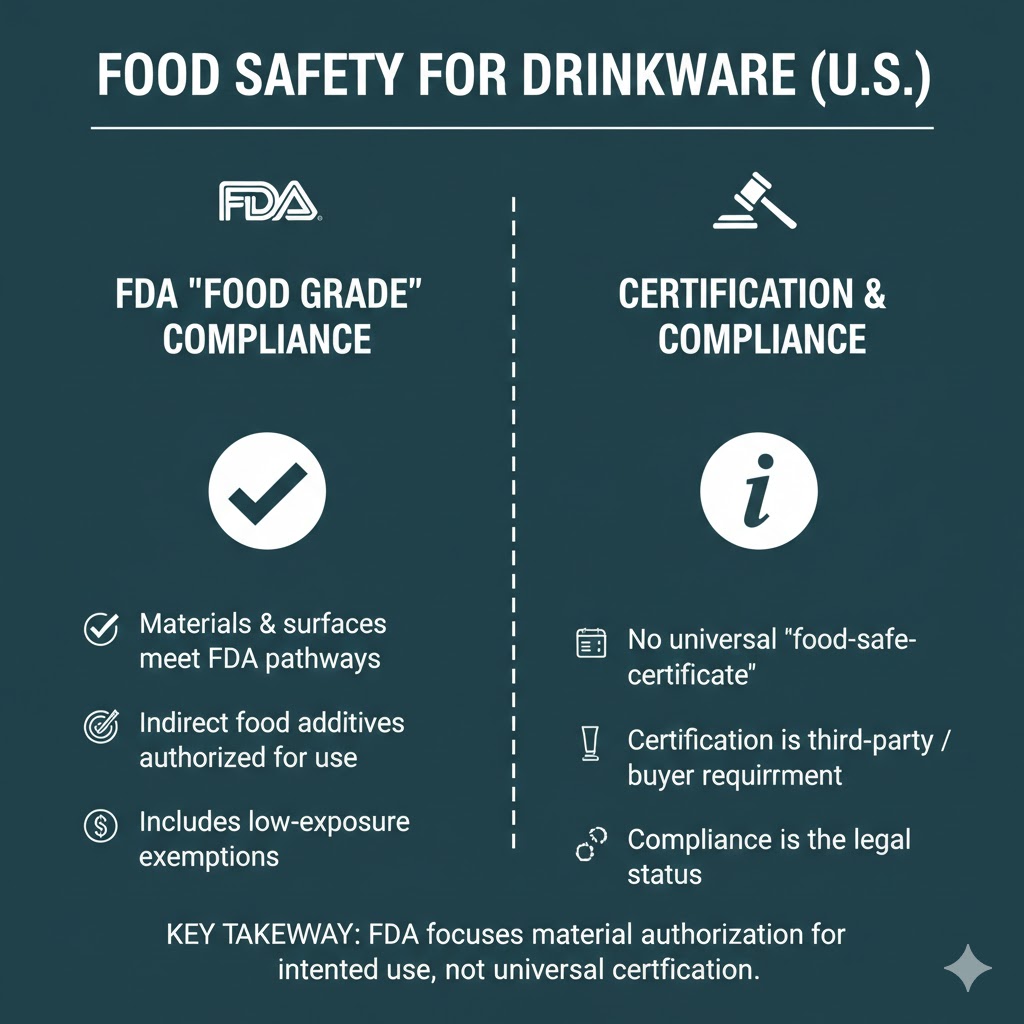
“Food grade” for mugs means the materials and surface substances used in the contact zone align with applicable FDA pathways for indirect food additives and authorised uses, not that a mug carries one universal “food-safe certificate.” FDA’s system centres on whether components are authorised for the intended use, including low-exposure exemptions and listings of effective notifications.
Certification, when it appears in the market, is usually a third-party test programme or buyer requirement; compliance is the underlying legal status.
What are the main regulatory frameworks for FCMs in the EU and UK?
The EU framework sets a harmonised baseline principle: food-contact articles must not release constituents at levels that endanger health, must not unacceptably change food composition, and must not harm taste or odour. This baseline is complemented by manufacturing controls through EU GMP requirements. (Legislation.gov.uk)
In practice, the EU combines a general framework with material-specific measures (plastics are the most fully harmonised), while several non-plastics rely on member-state rules and market enforcement patterns.
What does “LFGB certified” mean for mugs and cups?
“LFGB certified” in mug listings usually means a product was tested to meet German market expectations tied to the German food-contact legal framework and common German test practices. It is not a single EU-wide mark, but it is used as a shorthand signal for strict testing culture, especially around sensory neutrality and chemical release expectations aligned with the EU baseline principle.
When a seller claims LFGB, the practical check is to ask for the test scope, methods, and the lab’s accreditation evidence rather than relying on the label alone.
What are the main UK food-contact rules after Brexit?
In Great Britain, food-contact rules largely mirror the EU baseline through retained law and aligned enforcement expectations, while future divergence remains possible through UK amendments. What matters for a mug seller is that buyers still expect the same core proof: migration safety, traceability, and documentation that links the finished product back to its compliant inputs.
Marks like UKCA and CE generally relate to product categories with specific safety marking regimes; plain drinkware typically relies on food-contact compliance evidence rather than a conformity mark.
How does REACH compliance relate to drinkware and food-contact materials?
Food-contact rules focus on migration into food and drink; REACH focuses on chemical restrictions across products and supply chains. That means REACH can restrict a substance in the total product even if a manufacturer claims the food-contact surface is designed to be a barrier. The practical result is two checklists: one for migration performance in use, and one for restricted substances in materials and additives.
What are the main regulatory frameworks for FCMs in the United States?
In the U.S., FDA generally authorises specific substances and specific uses, rather than “approving” an entire finished mug as a single unit. The food contact notification pathway and related mechanisms are built around the definition of an FCS as a component substance in contact materials, when it has no intended technical effect in the food.
This matters for mugs because coatings, polymer linings, and surface treatments often drive the regulatory question more than the base material.
How do I know if a mug material is compliant with FDA food-contact regulations?
To check FDA alignment, match the mug’s food-contact surface chemistry to the relevant CFR listings for indirect food additives. For many coatings, a core reference point is 21 CFR 175.300 for resinous and polymeric coatings, which sets conditions for safe use as a food-contact surface.
For polymers, FDA organises authorisations under 21 CFR Part 177 (Indirect Food Additives: Polymers), and compliance is typically documented through supplier statements, formulation control, and traceability to the authorised chemistry and conditions of use.
Do state laws like California Proposition 65 add requirements beyond the FDA?
Yes. California’s Proposition 65 is a disclosure-focused law built around listed chemicals and exposure thresholds, not a product-approval system. For lead, the safe-harbor list includes a maximum allowable dose level (MADL) of 0.5 μg/day for reproductive toxicity, which often drives stricter internal limits, testing, and warnings even when federal pathways are satisfied.
Packaging can also be pulled into the compliance net through heavy-metal model laws and clearinghouse enforcement; the common model approach sets a 100 ppm combined limit for lead, cadmium, mercury, and hexavalent chromium in packaging.
How do rules differ by the specific material used in mugs?
Rules differ by material because each material category has its own dominant hazard pattern: ceramic glazes can leach metals, plastics can migrate additives, and metals can contribute alloy-related constituents under certain conditions. Compliance also depends on whether the same article is used for hot drinks, acidic drinks, repeated washing, or long dwell times, because time and temperature shift migration rates.
Testing frameworks reflect this by fixing “conditions of use” and using standard simulants rather than real coffee or tea, so results are comparable and legally defensible.
What are common lead and cadmium limits for ceramic mugs?
Ceramic mug limits focus on how much lead and cadmium can be released from the food-contact surface into an acidic test solution under controlled conditions. In the EU ceramics directive, articles that can be filled (the category that includes mugs) are tested with 4% acetic acid under defined time/temperature conditions, with limits stated in mg/L for lead and cadmium release.
In the U.S., FDA compliance guidance uses leach testing and sets enforcement guidance levels for cups and mugs in μg/mL, which is equivalent to mg/L when converted.
Study note: A 2025 pilot study measured metals that leached into hot drinks prepared in ceramic mugs and reported lead in coffee from 0.2 to 8.6 μg/L and lead in tea from below 0.2 to 1.6 μg/L. Those numbers support why glaze formulation, firing control, and surface durability sit at the centre of ceramic mug compliance.
What are the compliance concerns for glass and metal drinkware?
Glass is often treated as low-migration in normal use, but decoration layers and speciality glass compositions still matter because the lip-contact and rim zones can include pigments or metallic decoration. Metal drinkware raises a different question: the alloy and any internal coating define performance, and corrosion resistance under acidic drinks becomes a compliance-relevant use condition rather than a purely aesthetic quality feature.
For unlined aluminium vessels, acidic beverages can increase dissolution, so compliance decisions often hinge on whether the internal surface is coated and whether the intended use includes acidic drinks and hot-fill conditions.
How are phthalates and BPA regulated in plastic or melamine mugs?
Plastic and melamine mug compliance hinges on which additives are present, whether each is authorised for food contact, and whether migration stays below relevant limits under the intended time and temperature. In the U.S., the practical starting point is confirming the food-contact surface aligns with applicable CFR authorisations for coatings and polymers, including 21 CFR 175.300 for coatings and the polymer authorisations in 21 CFR Part 177.
“BPA-free” and “phthalate-free” are marketing claims that still require evidence; a claim does not replace a compliance file that ties the finished mug back to authorised chemistry, supplier declarations, and use-condition testing.
Study note: A 2007 study on BPA migration found that heating sharply increased BPA release, including about a 55-fold increase after boiling versus room-temperature conditions. That single numeric jump is why regulators and buyers keep pushing “conditions of use” into the compliance definition, especially for hot drinks and repeated-use drinkware. (OEHHA)
What regulations or standards apply specifically to food-contact silicone products?
Silicone compliance is often tested through “volatile content” and migration behaviour under high-temperature conditions because silicone elastomers can contain volatile residues and oligomers. Under German BfR Recommendation XV, silicone elastomers have a well-known volatile release expectation, and the testing condition is often framed as 4 hours at 200°C with a 0.5% limit used as a practical suitability checkpoint.
In the U.S., silicone-like elastomer articles often get evaluated through the rubber articles framework in FDA rules, where repeated-use food contact is addressed through formulation and extractives controls.
What are SML and OML and why do they matter for migration?
SML and OML are the two central numeric lenses used to decide whether a material’s chemical transfer stays within legal bounds. Overall migration limit (OML) caps the total mass of non-volatile substances that can migrate, while specific migration limit (SML) caps the migration of a named substance with a toxicological basis. Under the EU plastics regulation, the OML is set at 10 mg per 1 dm², commonly expressed as equivalent to 60 mg/kg under the standard surface-area-to-food convention.
Study note: A 2024 study on melamine food-contact products found migration outcomes varied dramatically across items, including up to a 132-fold range in measured migration. That spread supports why SML/OML compliance depends on standardised methods and strict control of simulant, temperature, and contact time rather than one-off “real beverage” tests.
What are food simulants and why are they used in testing?
Food simulants are standard liquids used to represent categories of foods and drinks so labs can run repeatable migration tests. EU rules assign simulants by food type, including Simulant A (water-like), Simulant B (acidic), and Simulant C (alcoholic), and those assignments are spelled out in the plastics framework’s annexes.
For mugs, acidic simulants matter because many beverages sit in an acidic range and because acid conditions are a known stressor for ceramic glazes and some coatings.
How is compliance verified and documented in practice?
Compliance is verified through a documentation chain that ties the finished mug back to controlled inputs, controlled manufacturing, and current test evidence under the intended conditions of use. A solid file usually includes supplier declarations for contact materials, traceability records, and a testing plan that matches the product’s real-world use, such as hot-fill, acidic beverages, repeated washing, and contact time.
The most common failure pattern is not “one bad test” but a broken chain: missing traceability, outdated reports, or tests that do not match the marketed claim.
What is an EU Declaration of Compliance (DoC) for mugs?
An EU Declaration of Compliance is the supplier’s formal statement that a material meets the applicable EU food-contact rules that require such a declaration, especially in harmonised areas like plastics. EU materials policy discussions consistently treat DoC as a core tool for enforcement and supply-chain accountability, backed by supporting evidence such as lab results.
For non-plastics, requirements can depend on the material category and national rules, so buyers often ask for a compliance statement plus the supporting test reports even when the legal form differs.
What is a “letter of guaranty” for FDA food-contact compliance?
A “letter of guaranty” is a commercial compliance statement used in supply chains to document that food-contact components match authorised uses and are manufactured under control. FDA’s public guidance emphasises determining the regulatory status of components, checking authorisations or exemptions, and keeping evidence that the intended use stays within the authorised scope.
In practice, buyers use guaranty letters as the quick-check document, but the real protection is the underlying traceability and formulation control that makes the letter true.
Is “microwave safe” or “dishwasher safe” a regulated claim for mugs?
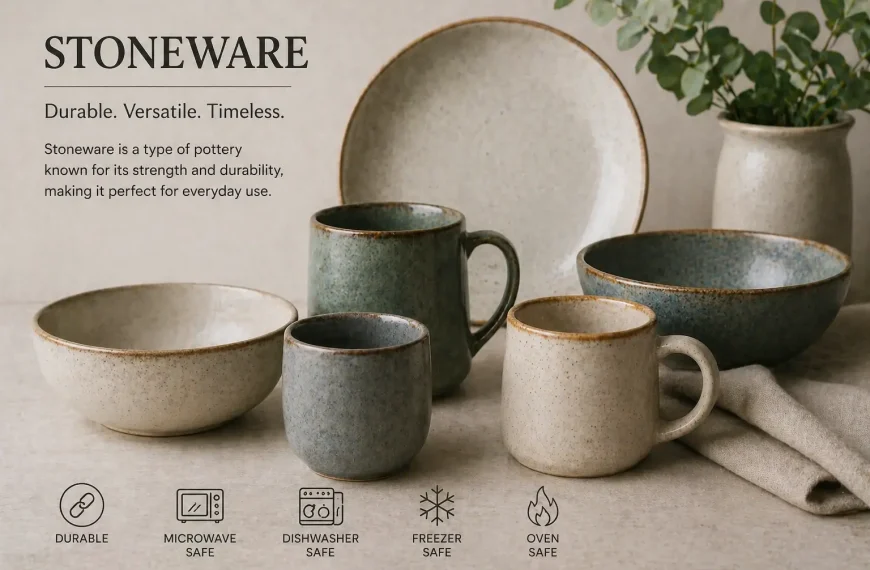
“Microwave safe” and “dishwasher safe” function as performance-and-safety claims that still need evidence because these use cases can change the mug’s surface over time and shift migration behaviour. A defensible support package links the claim to test conditions that reflect real use, including repeated cycles and the temperatures and detergents that can stress glazes and coatings.
For plastics and coatings, the same logic that drives migration regulation applies: the compliance question is not only what the material is, but how it behaves after repeated exposure under the claimed conditions. (foodstandards.gov.au)
What are the global requirements for international mug trade?
International trade compliance usually expects the importer to hold a coherent compliance pack and present it quickly when a buyer, marketplace, or regulator asks. In the U.S., the practical reality is that documentation and product descriptions must align with FDA’s component-based approach for food-contact substances, and import scrutiny can focus on whether the materials used match authorised pathways and intended uses.
The most reliable strategy is to prepare one master dossier that can be mapped to region-specific expectations rather than trying to rebuild proof country by country.
What are Japan, Australia, and India’s main food-contact rules?
Japan has moved toward a positive-list approach for some food-contact materials, which means the compliance question becomes “is the substance on the list for this use.” Australia and New Zealand publish technical guidance on chemical migration, including the standard EU-style convention of 6 dm² surface area per 1 kg (or 1 L) of food used for exposure estimates and the equivalent 60 mg/kg overall migration framing used in food-contact migration discussions.
A commonly cited Australian test standard for plastics is AS 2070, but the authoritative text is not reliably accessible for direct quoting here, so the safe route is to rely on official regulator guidance plus accredited test reports that state the method and limits used.
How do these regulations connect back to the quality of a drinking mug?
Regulatory compliance sets the minimum line: the mug must not contaminate the drink or ruin taste and odour, and it must be backed by traceable proof. Real quality starts where compliance stops: stable glazing that stays within limits after years of washing, coatings that hold up under heat, and materials that match the drink style and temperature the user actually serves.
For brands, the direct business link is simple: the compliance file protects health and reduces recalls, while the material and finish choices shape the daily experience that drives trust and repeat buying.
How does the environmental footprint of a mug’s material compare across its life cycle?
Environmental footprint is related to food-contact regulation because material choices that reduce chemical risk also shape durability, reusability, and end-of-life outcomes. LCAs consistently show the same pattern: a reusable cup’s impact depends on how many times it is reused and how it is washed, with washing often dominating the use-phase burden.
What do life cycle assessments (LCAs) say is the break-even point for reusable cups?
Break-even points vary widely because assumptions vary, but major reviews report ranges from about 10 to 670 uses depending on cup material, single-use comparator, and washing scenario.
Older energy-focused comparisons also show large differences by cup type, including break-even numbers like 39 uses for a ceramic cup versus a disposable paper cup in one matrix-style analysis.
Why do washing method and water temperature dominate a reusable mug’s footprint?
Washing is repeatedly identified as a major driver because it adds energy and water impacts every time the mug is reused. A global review for beverage cups states washing reusable cups is often the most significant contributor to environmental impacts, with manufacturing usually second.
The practical takeaway is behavioural: efficient dishwashing and consistent reuse are what turn a durable mug into an environmental win.
How do reuse behaviour and breakage rates change the outcome in real kitchens and cafés?
The same LCA can flip results if the mug is used a handful of times and then abandoned, or if it is used for years with efficient washing. Real-world models also include breakage and replacement, which pushes the break-even point upward when breakage is frequent.
The bottom line for safe, compliant, and trustworthy mugs
Food-contact regulation turns “safe” into a measurable standard: defined substances, defined test methods, defined limits, and a documented chain that proves the mug stays within those limits under its intended use. The fastest way to lose compliance is to treat it as a one-time test instead of an ongoing system that tracks inputs, glazes, coatings, and manufacturing controls over time.
The fastest way to build trust is the opposite: align material choice with real use, keep the compliance file clean, and treat migration control as the defining quality of the mugs you bring to market.