
Mugs are drinking vessels used for coffee, tea, hot chocolate, water, and other beverages, with different types of mugs defined by their material, intended use, body shape, and design or theme. Common mug materials include ceramic, glass, pottery, porcelain, and stainless steel, while functional types include travel mugs, camping mugs, and beverage-specific mugs. Mug shapes can include cylindrical, tapered, barrel, curved, and unusual/sculpture shapes. A stainless steel travel mug, for example, combines a durable material with a portable function and a particular body shape, while characteristics such as double-wall insulation, a lid, or a handle further affect how it performs.
Choosing the right type of mug depends on how these dimensions and characteristics work together. Ceramic mugs suit everyday hot drinks and offer broad design options; glass mugs provide beverage visibility; stainless steel mugs emphasize durability; and travel mugs prioritize portability and spill control. Shape affects the vessel’s overall form and handling, while features such as handles, lids, insulation, capacity, wall construction, and appliance compatibility describe how a mug is configured. Comparing mug materials, uses, shapes, designs, and functional characteristics makes it easier to select a mug for home, work, travel, camping, gifting, or other specific purposes.
The first major distinction is the material used to make the mug.
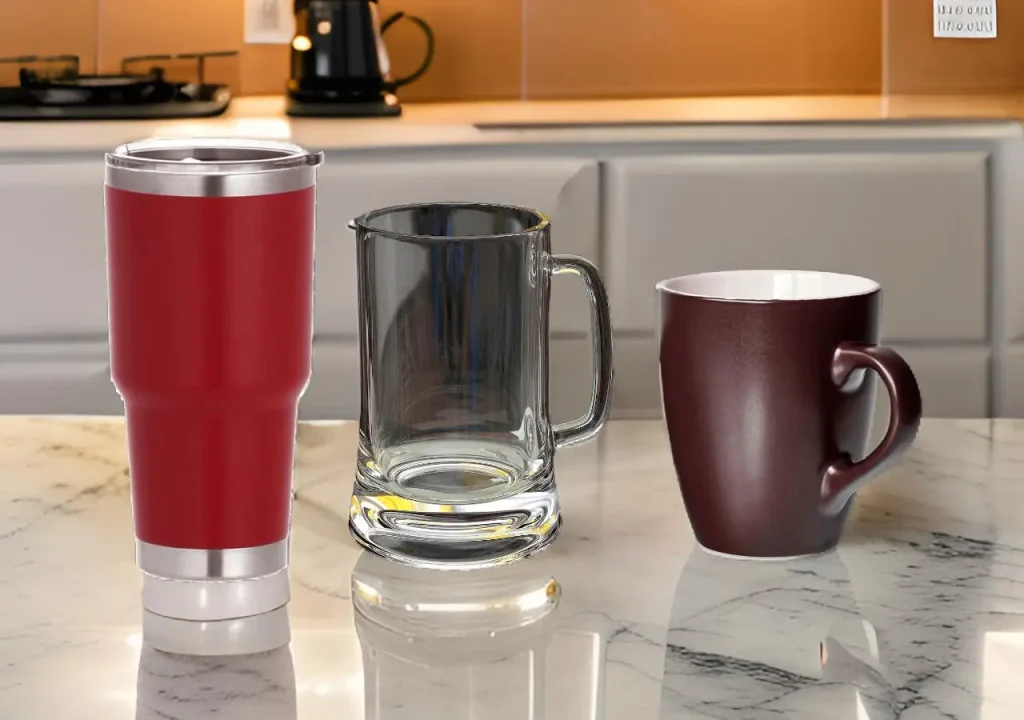
The types of mugs by materials are given below.
Material is one of the main ways mugs are classified, it identifies the main body of the mug and influences characteristics such as construction, durability, handling, appearance, and the types of features that can be incorporated.
Material does not determine every property of the finished mug. Thickness, glaze or coating, shape, decoration, wall construction, and other design choices can change how two mugs made from the same broad material behave in use. For a deeper comparison of these material families, material-based mug types can be considered separately from use and feature classifications.

Ceramic mugs are the broad ceramic-material category, with porcelain and stoneware representing more specific ceramic bodies within that family. Ceramics are inorganic, non-metallic materials that become hard after processing and firing, which makes ceramic bodies suitable for rigid drinkware.
The broad label ceramic does not identify the exact ceramic body, glaze, wall thickness, or decoration used in a particular mug. Those distinctions become important when comparing more specific ceramic types.
Porcelain mugs are ceramic mugs made from a high-fired, vitrified porcelain body. Porcelain is commonly associated with a white body and may contain kaolin, while some porcelain can also show a degree of translucency.
This makes porcelain a more specific material classification than the general term ceramic. It does not, however, mean that every porcelain mug is automatically stronger, safer, more durable, or better suited to a particular appliance than every stoneware mug. The finished construction, glaze, decoration, and manufacturer instructions still matter when evaluating a specific product.
Stoneware mugs are ceramic mugs made from a dense, high-temperature stoneware body. Stoneware becomes substantially vitrified during firing, although the degree of vitrification and remaining porosity can vary with the clay body and firing process.
Stoneware and porcelain are therefore distinct ceramic classifications rather than interchangeable names. The distinction helps identify the mug body, while the finished glaze, thickness, shape, and construction determine many of the practical characteristics of an individual mug.
Pottery mugs are ceramic mugs defined more by their ceramic-making context than by one specific material body. Pottery can be made as earthenware, stoneware, or porcelain, so the term overlaps with the more precise ceramic classifications already used in this section.
For selection, the underlying ceramic body provides more useful material information than the word pottery alone. In a handmade pottery mug, factors such as the clay body, glaze, firing, construction, and manufacturer instructions can then affect the finished mug’s practical characteristics. Pottery is therefore useful as a craft or product classification, while earthenware, stoneware, and porcelain identify the ceramic body more precisely.
Glass mugs use glass as the main vessel body, but the type of glass matters when evaluating properties such as resistance to temperature change. Borosilicate glass, for example, has relatively low thermal expansion and is valued for greater resistance to thermal shock and temperature fluctuations than many ordinary glass compositions.
That characteristic should not be applied to every glass mug simply because it is transparent. A buyer should identify the actual glass type and the manufacturer’s use instructions before assuming that a particular glass mug is suitable for rapid temperature changes, microwaving, or other demanding uses.
Stainless steel mugs use stainless steel as the main vessel material, providing a corrosion-resistant and readily cleanable metal body that is widely used in food and beverage applications. These characteristics also make stainless steel common in portable and reusable drinkware.
Stainless steel itself does not mean that a mug is insulated. A stainless steel mug may use single-wall, double-wall, or vacuum-insulated construction, and that construction has a much greater influence on thermal performance than the material name alone.
Material describes what a mug is made from; another way to classify mugs is by what they are intended to do.
The types of mugs design for different uses include the following.
Function-based mug types are distinguished primarily by where, how, or for what purpose they are intended to be used, and they can therefore require different combinations of capacity, portability, handling, closure, insulation, or presentation.
This classification overlaps with material and feature classifications because the intended use often determines which physical characteristics become important. A broader view of function-based mugs shows how different purposes create different design requirements.
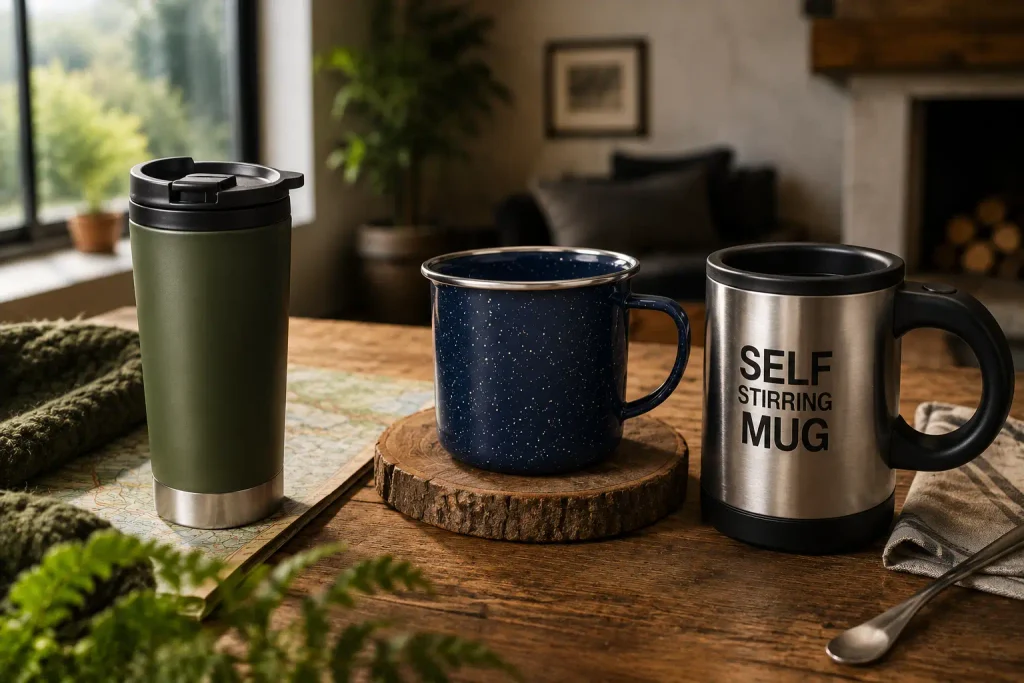
Travel mugs are mugs designed primarily for portable drinking away from a fixed table or kitchen setting. Portability creates additional requirements such as a controlled drinking opening, a fitted closure, resistance to spills during normal movement, and often some form of thermal insulation.
These supporting features vary substantially between products. A lid may be described by a manufacturer as splash-resistant, leak-resistant, or leak-proof under specified conditions, while travel mug insulation can also differ between constructions. Travel therefore describes the use category; the exact closure and thermal performance must be checked on the individual mug.
Camping and outdoor mugs are intended for portable use in outdoor environments, where weight, handling, durability, and packability may become more important than they are for an ordinary desk mug. Their use context, rather than a single material, defines the category.
Outdoor mugs may consequently be made from stainless steel, enamelled metal, ceramic, or other suitable constructions. The preferred choice depends on how the mug will be carried and used rather than on the assumption that one material automatically defines a camping mug.
Self-stirring mugs are function-based mugs with an integrated powered mechanism that mixes the drink without a separate spoon. Depending on the design, mixing may use a small motor-driven stirrer or a magnetic system, with power supplied by replaceable or rechargeable batteries.
The mechanism is useful for dispersing ingredients such as sugar, cocoa, or powdered drink mixes, but mixing performance, cleaning requirements, and microwave suitability are product-specific. These conditions should therefore be checked in the manufacturer’s instructions.
Beverage-specific mugs and cups are designed around a particular serving purpose, so the drink can influence the vessel’s capacity, proportions, rim, and presentation. Espresso, cappuccino, and latte vessels are familiar examples of drink-specific forms.
These examples do not form an exhaustive classification of mug types. They illustrate how serving purpose can influence vessel design, just as portability influences travel mugs or outdoor conditions influence camping mugs.
Because different uses create different physical requirements, mug types can also be classified based on shape.
The types of mugs by shape are listed below.
Shape describes the profile of the vessel body, including how its sides run between the base and rim, and is separate from the mug’s size or capacity.
Mug-shape labels are descriptive rather than part of one universal sizing or shape standard, so some forms can overlap. A rounded mug, for example, may also be described as barrel-shaped when its body becomes noticeably fuller through the middle. The main distinction is the overall body profile rather than an exact set of dimensions.
Cylindrical mugs have relatively straight sides, so their body width changes little between the base and rim. The sides are approximately parallel compared with tapered or strongly rounded forms, giving the mug a predominantly straight-sided profile.
Tapered mugs differ because their width changes more clearly between the base and opening.
Tapered mugs have angled sides, so the body changes width between the base and rim. Many designs widen toward the opening, while other tapered forms may narrow toward the top, so the direction of the taper depends on the particular design.
Unlike cylindrical mugs, their defining characteristic is this noticeable change in body width. Fuller profiles create another shape family in which curvature becomes more prominent than angled sides.
Barrel mugs have a broad, rounded body that becomes fuller through the middle than a straight-sided cylindrical mug. Their sides curve outward before returning toward the base or rim, creating the characteristic barrel-like profile.
Barrel is a descriptive shape label rather than a fixed dimensional standard. Other rounded mugs can use similar curves without having such a pronounced full middle.
Curved or rounded mugs use a softer, continuously curved body profile rather than predominantly straight sides. The curvature may extend through much of the vessel body, producing forms sometimes described as rounded, bulbous, or belly-shaped.
These terms can overlap with barrel-shaped mugs because mug-shape categories are not rigidly standardised. The distinction is mainly descriptive: barrel mugs emphasise a fuller middle, while the broader curved or rounded category covers mugs whose body profile is generally defined by continuous curves.
Unusual and sculptural mugs use distinctive forms that move beyond traditional cylindrical, tapered or rounded profiles. These can include asymmetrical or freeform bodies, animal-shaped mugs, abstract forms, exaggerated handles, textured surfaces, or mugs shaped like familiar objects. Their shape is often chosen as much for visual expression and novelty as for everyday function, making them especially common in artistic, handmade and collectible mug designs
Body shape describes the vessel’s overall form, while mug themes and designs often reflect decorative elements and seasonal differences, such as Christmas, and Halloween.
Mug types defined by theme or design include three broad families.
These families can overlap, and design/theme is only one classification dimension that describe its visual concept, occasion, or interaction. A themed mug may also be ceramic, handled, travel-oriented, or have a particular shape or feature set. Its theme does not by itself determine its material, construction, safety, appliance compatibility, or thermal performance. A fuller classification of mug themes and designs can cover these broader families in greater depth.
Among recurring seasonal and holiday themes, Christmas is a clear specific type whose identity comes from what the design represents rather than how the mug is constructed.
Christmas mugs are mugs whose decoration or visual theme explicitly represents Christmas holiday or associated festive imagery. Common design expressions include Christmas trees, ornaments, candy canes, gingerbread, festive patterns, and seasonal wording or typography, but none of these individual elements is required for a mug to belong to the category.
A Christmas mug may independently be ceramic, glass, handled, insulated, or designed for everyday use. The Christmas theme adds a design classification without replacing these physical or functional classifications. Therefore, Christmas mugs belong to the seasonal and holiday family, while their identities come from different recurring themes.
Halloween mugs are mugs whose visual theme, artwork, or wording is designed around Halloween. Representative designs include ghosts, pumpkins or jack-o’-lanterns, bats, skeletons, witches, potions, spooky phrases, and gothic or horror-inspired illustrations.
Halloween designs can range from playful or cute to darker or gothic styles, so no single motif, colour palette, or aesthetic defines the category. As with Christmas mugs, material, size, shape, handles, and other features remain separate classifications. Valentine’s Day mugs follow the same recurring calendar-based principle but use a different design context centred on affection and relationships.
Magic mugs, also called colour-changing or heat-reveal mugs, use an interactive design that reveals or changes visible content in response to heat from a hot drink. A hidden picture, message, or other design element may become visible as the mug responds to the temperature change.
The heat-responsive behaviour defines the mug at this classification level, rather than the detailed coating or material mechanism that produces the effect. Exact coating chemistry, activation temperatures, durability, and other technical characteristics belong to deeper product-specific or magic-mug coverage.
A magic mug can also belong to other classifications, such as ceramic, handled, or themed. Design or theme can therefore narrow a reader’s visual preference, gifting context, or desired interaction, but choosing the right mug still requires matching that preference with intended use, material, shape, size, and required features.
While themes distinguishes mugs by their appearance, mug features describe the characteristics and functional details found across different types of mugs.
Features distinguishes mug types by physical or performance attributes such as handle and grip design, wall construction and insulation, and lids or closures. These characteristics describe how a mug is configured rather than simply what material it uses or where it is intended to be used.
A mug can therefore combine several feature categories at once like the following.
A deeper examination of mug features separates these attributes and their effects more precisely.
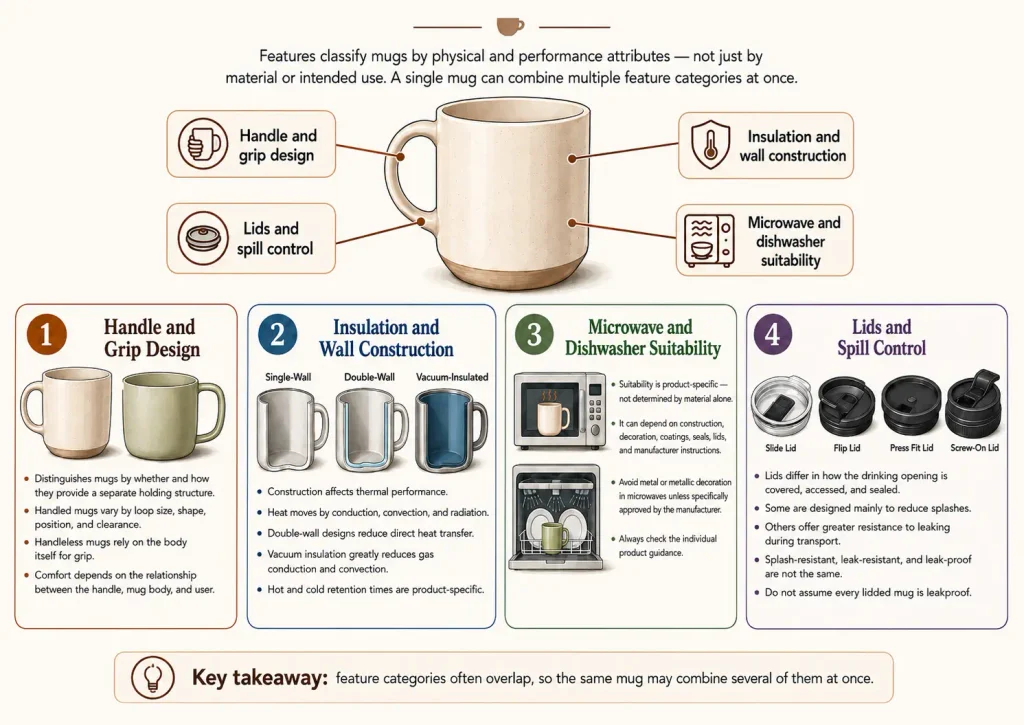
Handle and grip design distinguish mugs by whether and how the vessel provides a separate structure for holding it. Handled mugs can differ in loop size, shape, position, and clearance, while handleless mugs require the body itself to provide the gripping surface.
These differences influence how the mug is held, but detailed ergonomics depend on the complete relationship between the handle, mug body, and user. Handle design is therefore a useful classification feature without implying that one handle shape is universally more comfortable.
Wall construction distinguishes single-wall, double-wall, and insulated mug designs, and that construction changes the pathways through which heat moves between a drink and its surroundings. Heat can transfer by conduction, convection, and radiation.
Separating the inner and outer walls reduces direct thermal transfer between the beverage container and the exterior. In vacuum-insulated construction, the evacuated space between the walls greatly reduces heat transfer by gas conduction and convection, although radiation and solid structural paths can still transfer heat.
This explains why two stainless steel mugs, for example, can have very different thermal performance despite sharing the same main material. Exact hot- or cold-retention times remain product-specific and should be taken from manufacturer testing rather than inferred from the material alone.
Microwave and dishwasher suitability are product-specific characteristics that depend on material, construction, decoration, and manufacturer instructions. A broad material name such as ceramic, glass, or stainless steel is not enough by itself to confirm compatibility.
For microwave use, Fire and Rescue NSW advises using only articles approved for microwave ovens and generally avoiding metal or metal-edged items because electrical arcing can occur. An important exception is that some manufacturers produce specially engineered metallic decoration that they expressly approve for microwave use. The practical rule is therefore to avoid metal or metallic decoration unless the specific item is clearly approved by its manufacturer for microwave use.
Dishwasher suitability is similarly specific to the finished product. Decoration, coatings, seals, lids, and multi-part construction can change the recommended washing method even when two mugs use the same main material. Detailed microwave and dishwasher safety for mugs should therefore be checked against the particular product rather than assumed from category alone.
Lids and closures distinguish mugs by how the drinking opening is covered, accessed, and sealed. Some lids primarily reduce splashes, while others are designed to provide greater resistance to leaking during transport.
These terms should not be treated as universal guarantees. Manufacturers themselves distinguish between descriptions such as splash-resistant, leak-resistant, and leak-proof when closed, and the claim may depend on correct assembly, closure position, or use orientation. A lidded mug should therefore not automatically be assumed to be leakproof.
Once these overlapping categories are understood, the practical question becomes which combination is suitable for a particular user and purpose.
Choose a mug by starting with intended use, then considering material, size and shape, required features, and finally theme or design where appearance matters. No single mug type is best in every situation because different uses give different attributes more importance.
Use should come first because it determines which later criteria can affect the decision. A desk mug may prioritise comfortable handling and preferred capacity, while a travel mug places more importance on closure and insulation. Material can then be evaluated alongside the form and features required for that use.
| Primary need | Mug types or categories to compare | Features to prioritise | What to check |
| Everyday home or office drinking | Ceramic, porcelain, stoneware or glass everyday mugs | Suitable size, comfortable handling, preferred shape | Material, dimensions and care instructions |
| Commuting or portable drinking | Travel mugs | Lid, portability, insulation where required, spill control | Product dimensions, lid design and manufacturer performance claims |
| Camping or outdoor use | Camping enamel mugs | Practical handling, portability and construction suited to the setting | Material, weight, dimensions and care requirements |
| Serving a particular beverage | Espresso, cappuccino, latte or other beverage-specific vessels | Capacity and form suited to the serving purpose | Actual capacity and dimensions |
| Gift or decorative use | Themed, novelty, personalised or custom mugs | Design, decoration and personalisation | Material, finish, care and intended use |
The table is a decision framework rather than a ranking of mug types. In particular, choosing stainless steel does not automatically provide insulation, choosing glass does not automatically provide thermal-shock resistance, and choosing a lid does not automatically provide leakproof transport.
After the main use, material, form, and feature requirements are matched, secondary suitability checks can still rule an otherwise appropriate mug in or out.
Food-contact suitability, and care requirements should be checked before making the final choice because these factors can affect whether a particular mug is appropriate for the way it will actually be used.
These considerations come after the main classification decision because they do not normally define the mug type itself. Instead, they verify whether a specific product is suitable for the intended conditions. These factors define how a mug retains its safety and usability over time, as outlined in our Care & Safety guide.
Food-contact suitability depends on the mug body and any surfaces or finishes that may interact with the beverage, including glazes, coatings, and decoration. A product intended for drinking should therefore be suitable for food contact rather than being treated as safe simply because it resembles ordinary tableware.
In Australia, AS 4371-2012 Ceramic tableware is a current Australian Standard that specifies maximum permissible release of lead and cadmium from ceramic tableware and includes related performance and marking requirements within its scope. Food Standards Australia New Zealand also applies the broader principle that food-contact materials used by food businesses should be fit for their intended purpose and should not contaminate food.
These controls do not mean that every decorative ceramic object is automatically suitable for drinking. Product purpose, supplier information, and relevant compliance details remain important when food-contact suitability is uncertain. More detailed requirements belong within mug food-contact safety guidance.
Cleaning and care requirements vary with a mug’s material, surface finish, decoration, and construction, particularly when lids, seals, or multiple components are involved. Manufacturer instructions should control product-specific restrictions such as dishwasher use, hand washing, or disassembly.
A simple open ceramic mug and a multi-part insulated travel mug therefore create very different maintenance requirements even though both perform the same basic drinking function. More detailed mug cleaning and care guidance can address those procedures without turning care into part of the main mug classification.
Compatibility and maintenance complete the practical checks needed after the main mug type has been selected.
Australian shoppers can buy mugs online through marketplaces, homewares retailers, and specialist mug stores. The most suitable source depends on the type of mug you want, the range available, and whether you are looking for a particular material, feature, shape, or theme.
After narrowing the choice, specialist stores can make it easier to browse more specific categories. For example, shoppers looking for distinctive constructions or seasonal designs may want to compare categories such as handleless mugs and seasonal & holiday mugs like Christmas mugs and Halloween alongside other mug types.
CoffeeMug.au allows Australian shoppers to shop mugs online in Australia across its available collections. Once the mug itself has been chosen, related products can extend how it is stored, protected, heated, or served.
Related products extend or interact with mugs by supporting their thermal performance, expanding their functional range, and connecting them to the systems that produce and deliver beverages. This includes accessories that regulate temperature, protect surfaces, and improve storage, alternative drinkware that overlaps with or replaces mug functions in specific contexts, and preparation appliances that determine how beverages are created before entering the vessel. Together, these elements define the broader environment in which mugs operate, linking the vessel to supporting tools and adjacent product categories, as detailed in our Related Products guide. The most direct of these are accessories that interface with the mug during everyday use.
Mug accessories are auxiliary components designed to extend the functionality of drinking vessels, primarily by improving thermal stability, surface protection, and storage efficiency. Core accessories operate at the interface between the mug and its environment, where devices such as mug warmers actively maintain temperature, while lids and sealing systems reduce heat loss and prevent spillage. Performance depends on compatibility between accessory design and vessel material, particularly in heat transfer and sealing efficiency.
Beyond thermal control, accessories address structural and organizational requirements. Coasters and saucers protect surfaces from heat and moisture, while storage systems such as mug trees optimize space and reduce mechanical wear. Textile-based extensions further expand surface utility in controlled environments.
Mug types are best understood through overlapping classifications based on material, intended use, features, and theme or design. Material identifies the vessel body, use determines which characteristics matter most, features explain how the mug is configured or performs, and design adds visual or personalised distinctions.
The most useful choice therefore begins with the intended use and then narrows the options through material, capacity and form, required features, and design preferences. Food-contact suitability, appliance compatibility, and care requirements provide the final checks.
There is no single mug type that is universally best. The suitable mug is the one whose material, form, features, and design match the way it will actually be used.