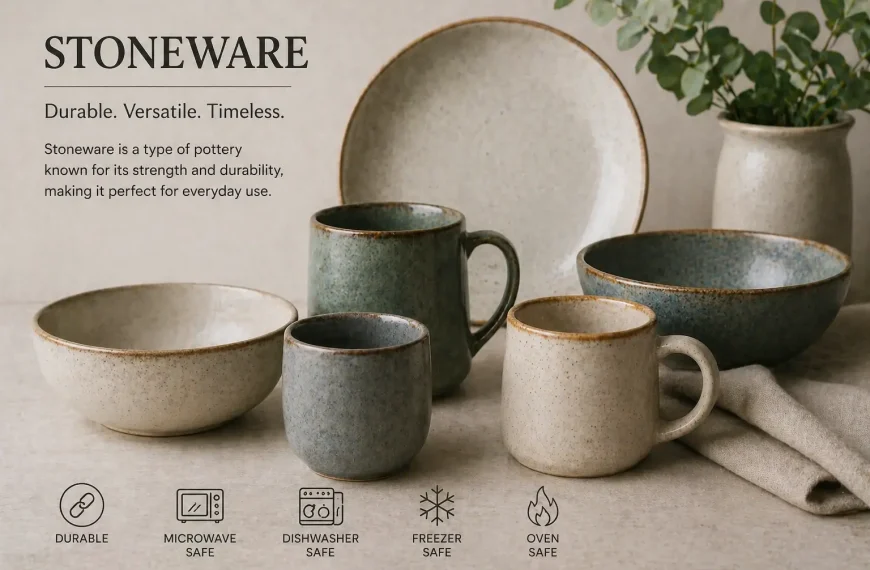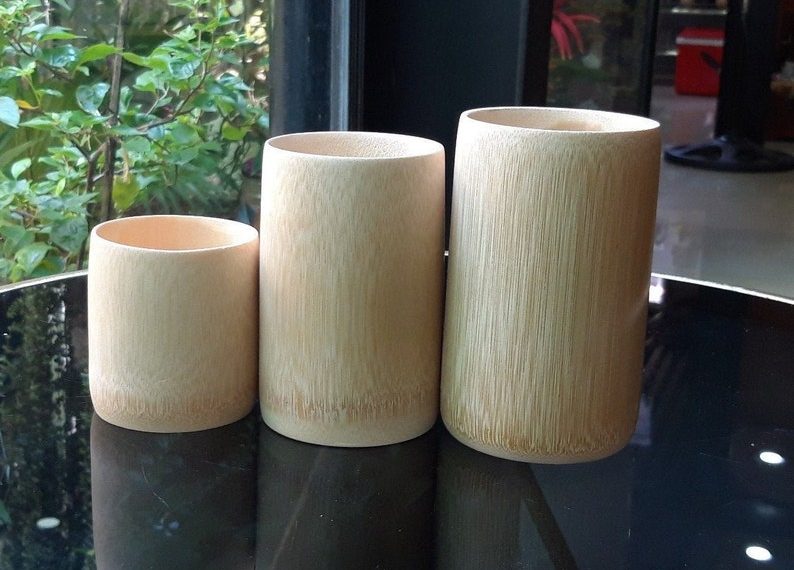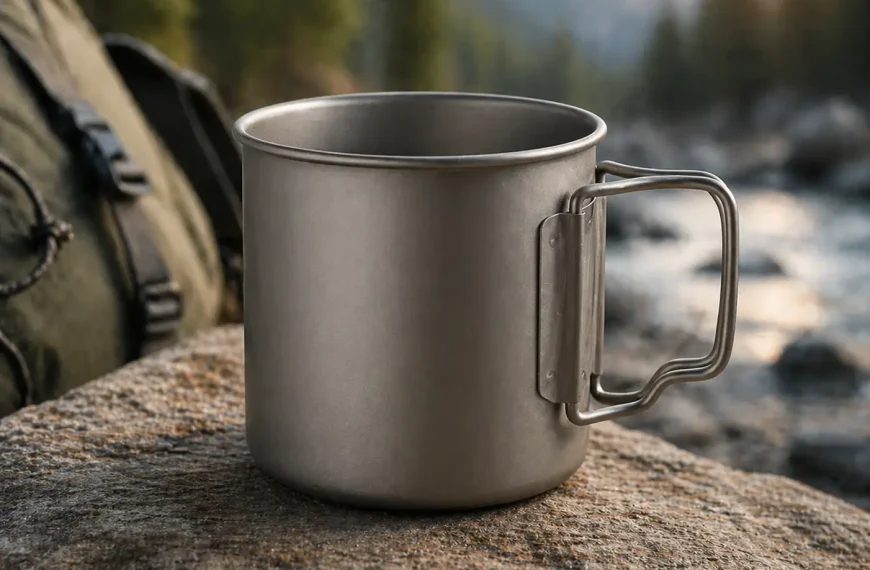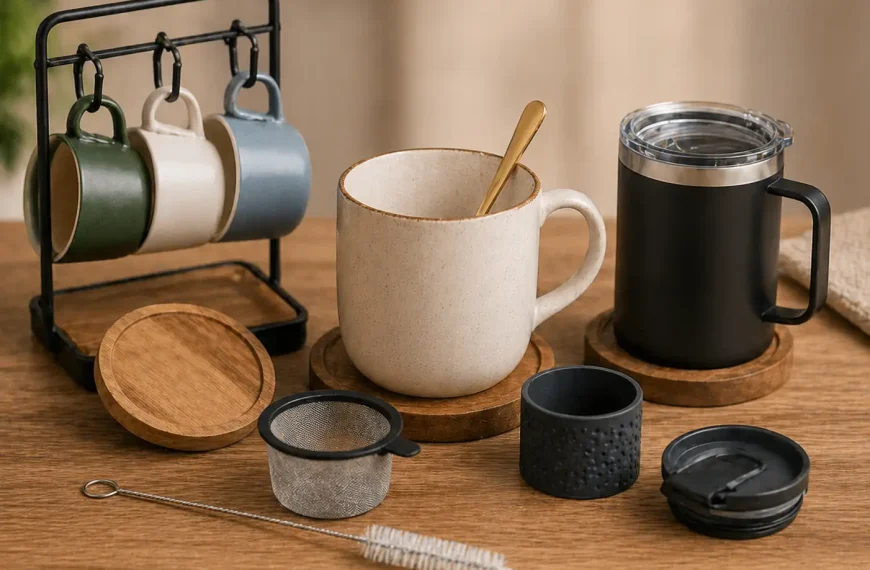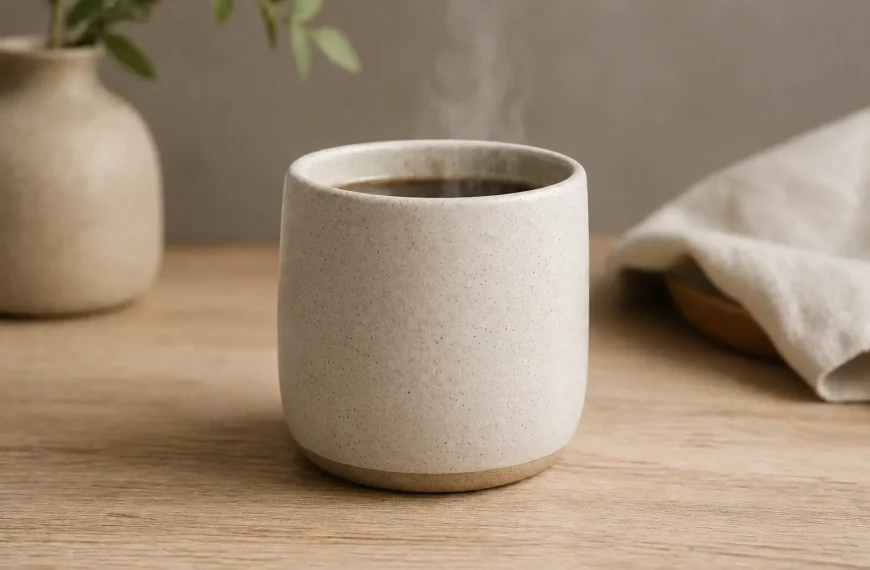

A clay mug is a drinking vessel formed from hydrous aluminium phyllosilicate minerals (clay minerals) mixed with water, shaped, dried, and hardened by firing. Unlike glass or metal mugs, its identity starts as a porous mineral body and becomes functional only after heat-driven densification and sealing. In functional ware, stoneware is a common standard because it is defined (for tariff testing) as absorbing no more than 3% of its dry weight in water under ASTM C373 conditions; earthenware is defined as more than 3%, and porcelain as no more than 0.5%. The key durability mechanism is vitrification, meaning formation of a glass phase during firing, which closes pores and reduces water and stain uptake. Food safety is not automatic: in a pilot study of lead-containing ceramic mugs, lead measured in brewed beverages ranged 0.2–8.6 μg/L (coffee) and <0.2–1.6 μg/L (tea), showing why verified, food-safe materials and finishes matter. (Ceramic Art)
This progression from raw earth to a vitrified drinking surface represents the most elementary yet technically complex category in our study of material-based mug types, where mineral purity dictates the safety of the user. To understand how these mineral bodies translate into everyday kitchenware, we must first establish exactly what defines a clay mug and how its physical properties diverge from other common vessels.
What is a clay mug, and what makes it different from other mugs?
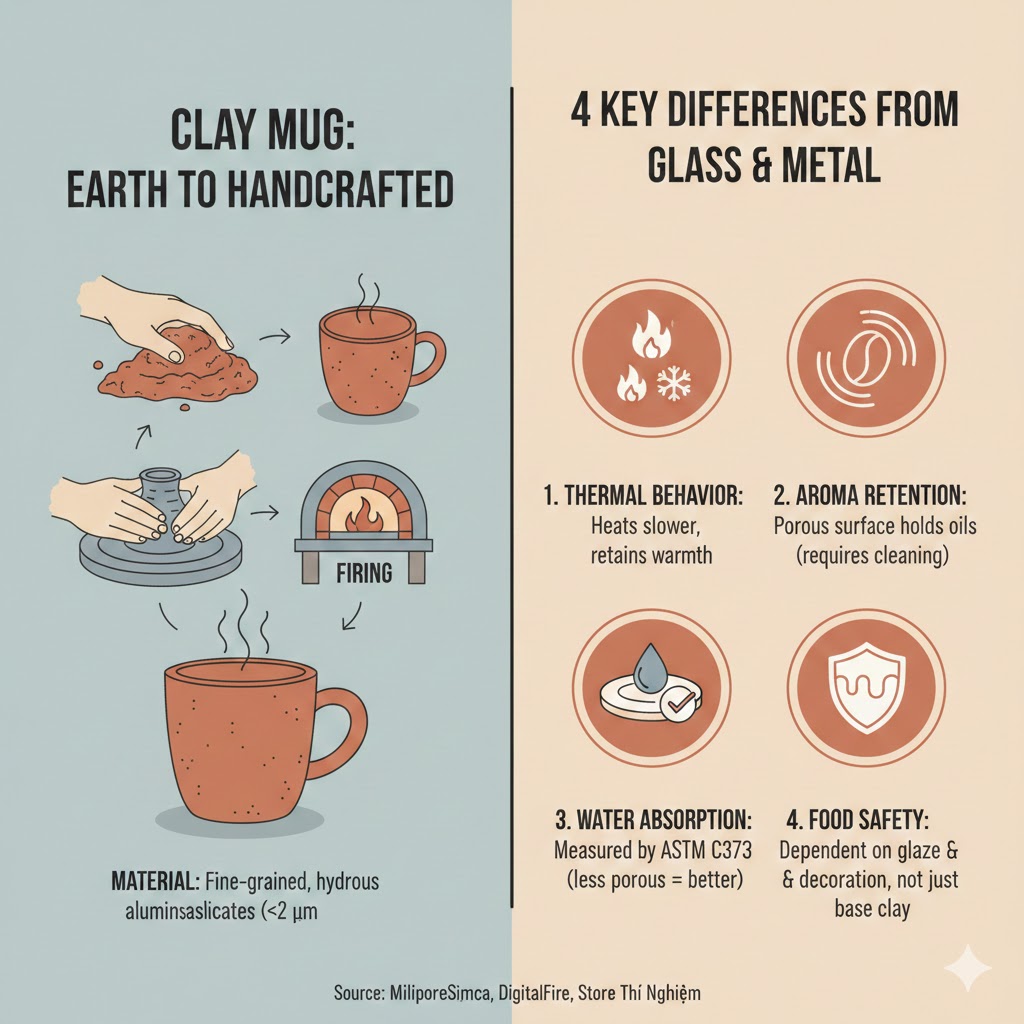
A clay mug is a ceramic drinking vessel made from clay minerals mixed with water, shaped, dried, then fired so the mineral body becomes hard enough for repeated contact with hot liquids. Clay minerals are described in materials science as fine-grained, hydrous aluminosilicates, typically with a sheet (phyllosilicate) structure and grain sizes under 2 μm.
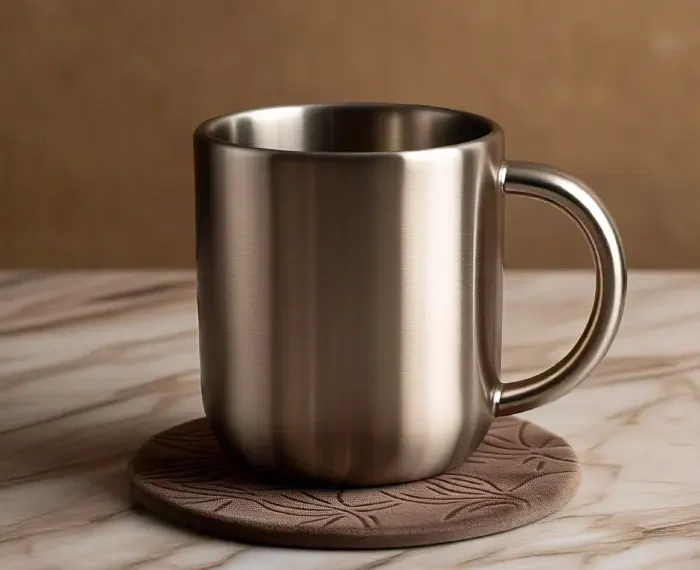
A clay mug differs from glass and metal mugs because the starting material is a porous mineral body that only becomes low-absorption and stain-resistant after firing drives densification and glass-phase development (vitrification).
There are 4 practical differences people notice in daily use:
- Thermal behaviour
Clay has higher thermal mass than thin glass or many metals, so the mug warms more slowly and then holds heat more steadily in the hand. - Surface chemistry and aroma retention
Unglazed or under-vitrified clay has open pores that can hold coffee oils and odours, which is why “smell build-up” is a real maintenance issue in porous ware. (DigitalFire) - Water absorption and stain risk
Functional clay bodies are judged by measurable absorption, not “looks,” and the standard test method referenced across industry is ASTM C373. (Store Thí Nghiệm) - Food-contact finish dependence
Food safety is strongly tied to glaze and decoration chemistry, not just the base clay.
What is the difference between a clay mug and a ceramic mug?
A clay mug is a ceramic mug, because “ceramics” is the broader category for objects made from clay-based materials that are hardened by heat.
The useful distinction is wording: “clay mug” points to the raw material and body behaviour (porosity, shrinkage, firing maturity), while “ceramic mug” often describes the finished class of product, including bodies that may include refined clays plus fillers and fluxes to hit a target firing range.
In pottery, “pottery” commonly refers to the craft and production practice of forming and firing clay objects, including functional ware like mugs.
What is the difference between glazed and unglazed clay mugs?
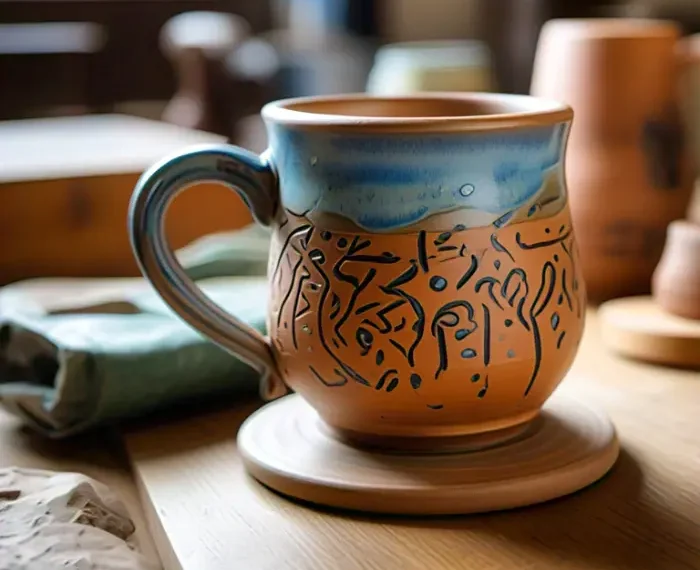
A glazed clay mug is a mug whose surface has a glass-like coating fused in firing to seal and protect the clay body, while an unglazed mug relies on the fired clay surface itself for contact performance. (Encyclopedia Britannica)
There are 3 everyday consequences:
Hygiene
Glaze creates a more cleanable barrier; an unglazed surface is more likely to retain residues because open pores can trap oils and stains.
Taste and aroma carryover
Unglazed surfaces can hold odours from previous drinks more readily, especially with coffee oils, so the “tea tastes like yesterday’s coffee” problem is more common in porous ware.
Durability of the drinking surface
A well-fused glaze can improve stain resistance, but glaze fit and firing maturity still matter for long-term performance.
What types of clay are used for making mugs?
Mug clay bodies are selected by firing range and target absorption, because durability and stain resistance depend on whether the body reaches a sufficiently dense, vitreous state.
In practice, functional mugs are usually made from earthenware, stoneware, or porcelain bodies, with each class tied to measurable water absorption categories used in standards and trade definitions.
The perceived weight difference often comes from wall thickness and the body recipe (clay plus fillers and fluxes), not from the word “clay” itself, because density and porosity change with maturity and composition.
What is earthenware, and why are traditional earthen clay cups different?
Earthenware is a low-fired ceramic body that remains relatively porous compared with stoneware and porcelain, so it can absorb water unless it is well-glazed.
Traditional earthen cups can feel cooler on the outside and can “sweat” or seep moisture when the body is absorbent, because water can move into open pores and then diffuse outward.
There are 2 practical reasons earthenware mugs are less forgiving for daily coffee:
- Higher absorption risk
Higher absorption increases staining and odour retention pressure on cleaning routines. - Narrower durability margin
If the body is under-fired for its recipe, it stays weak and porous; if it is over-fired, it can bloat or warp as glass phase behaviour changes.
What is stoneware, and why is it the standard for functional mugs?
Stoneware is a high-temperature ceramic body fired to a density that supports strong, durable functional ware.
Stoneware is often treated as the workhorse body because the “functional target” is clear: water absorption categories used in trade and testing place earthenware above 3% absorption and porcelain at 0.5% or less, using ASTM C373-style measurement, so stoneware bodies are commonly designed to sit in the low-absorption middle.
In daily use, that lower absorption reduces stain uptake and makes the mug less dependent on perfect user maintenance, while still allowing thick walls and stable forms that feel solid in the hand.
What is porcelain, and when is it used for high-end mugs?
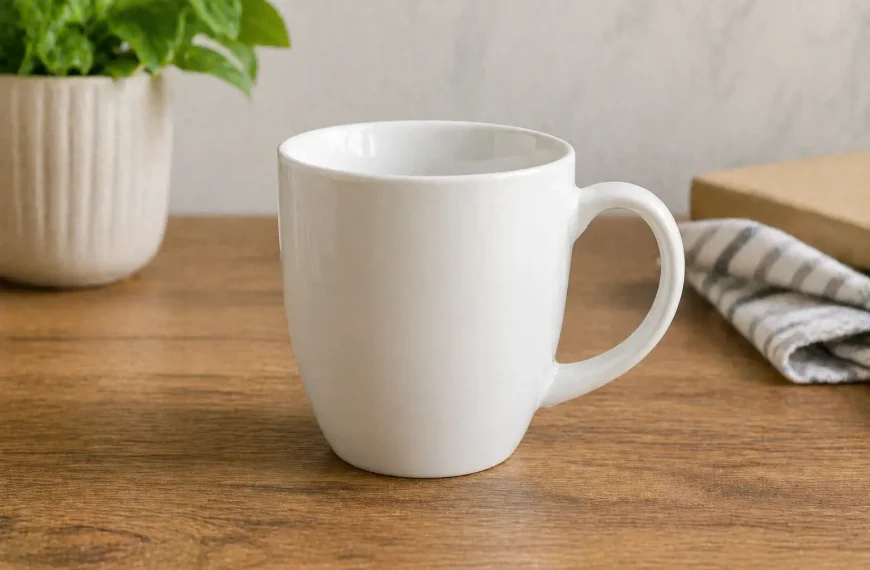
Porcelain is a refined, high-fired ceramic body that is commonly defined in standards contexts by very low water absorption, often 0.5% or less by ASTM C373 measurement in related ceramic categories.
It is used for mugs when thin walls, a clean drinking rim, and a bright, smooth surface are the priority, while still retaining fired strength.
Porcelain mugs often need more careful handling in kitchens because thinner walls and sharper transitions can be less forgiving under impact, even when the fired body itself is dense.
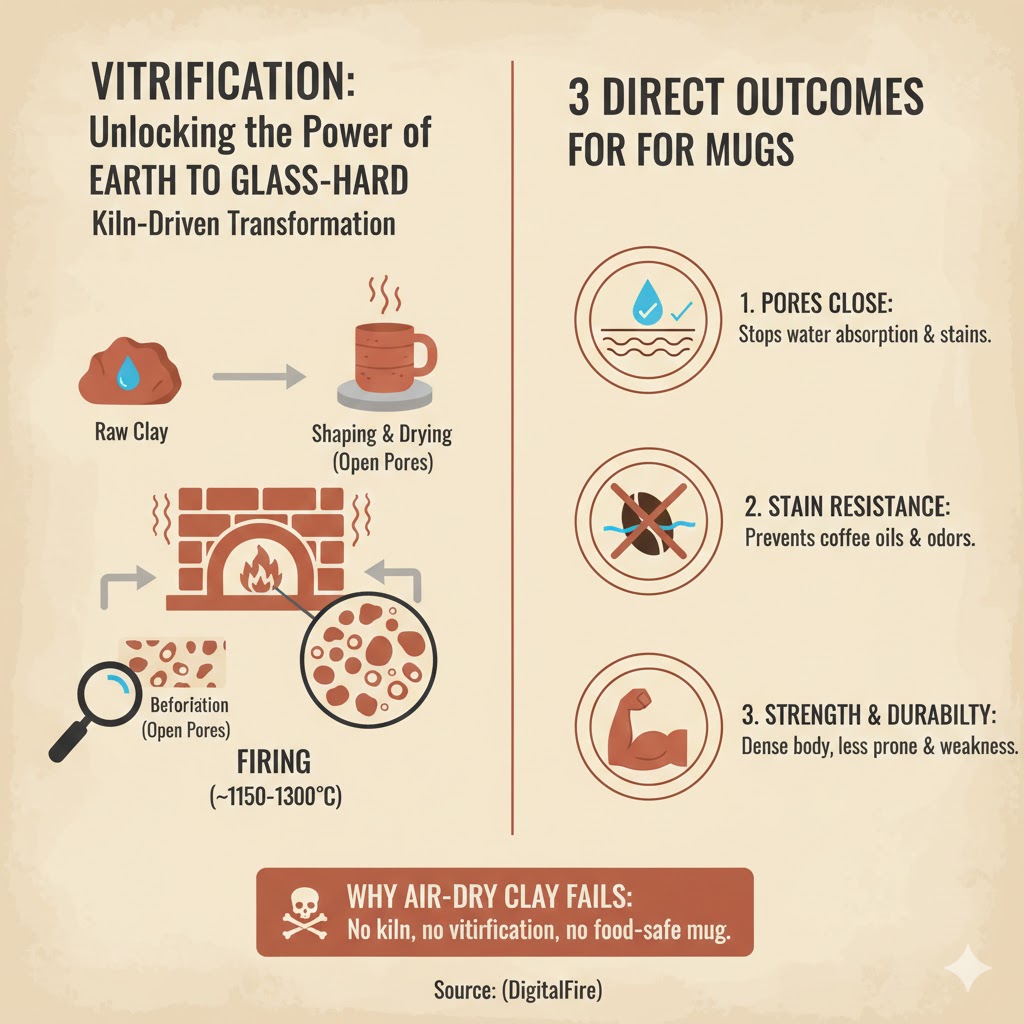
What is vitrification, and how does it prevent clay mugs from absorbing water or stains?
Vitrification is the firing-driven process where a clay body develops enough glass phase and density to reduce open porosity and deliver the strength expected in functional ware.
There are 3 direct outcomes relevant to mugs:
- Pores close rather than stay open
Open pores are what absorb moisture and carry stains; vitrification shifts the microstructure toward sealed pores and lower absorption. - Stain resistance improves
Lower absorption reduces coffee oil uptake into the body, which is a major driver of long-term odour retention. - Strength and durability increase
Denser bodies are typically stronger and less prone to moisture-related weakness in daily use.
Air-dry clay fails for drinkware because it never enters the kiln-driven densification process that produces mature, low-absorption ceramic.
How are clay mugs made and shaped?
A clay mug is made by preparing a workable clay body, forming the shape by hand or wheel, controlling drying shrinkage, then firing to convert fragile “greenware” into durable ceramic.
The making stage is not only shaping; it is a controlled moisture and shrinkage process, because uneven drying shrinkage is a direct driver of cracking.
The final geometry is also engineered: rim profile, wall thickness, base “foot,” and handle placement determine stability, ergonomics, and heat feel in the hand.
How to make a clay mug at home without a wheel?
A wheel-free mug is made by handbuilding, meaning the clay is formed without rotation equipment, then dried and fired like any other ceramic piece.
There are 4 essential steps that keep the piece functional:
- Choose a clay body intended for firing
Air-dry clays are not designed to become vitrified functional ware in a kiln and should not be treated as food-drink safe by default. - Build the form with consistent wall thickness
Consistent thickness reduces uneven drying shrinkage and lowers crack risk. - Dry slowly to bone-dry
Bone-dry is defined as greenware dried as much as possible before the first firing, and it should feel room temperature, not cool, when held because active evaporation makes clay feel cool. - Fire in a kiln for a true food-contact result
A kitchen oven cannot reproduce the ceramic firing process described in kiln firing charts where sintering begins around 800–900°C and continues upward into maturity ranges.
What are the pinch, coil, and slab methods for building a mug?
Pinch, coil, and slab methods are three handbuilding approaches that shape clay by compression rather than spinning.
There are 3 practical differences that matter for mugs:
- Pinch
Pinch building forms a hollow by finger pressure and naturally produces thicker, rounded walls that suit rustic forms. - Coil
Coil building stacks rolled coils and joins them, which makes it easier to control height and curvature while still keeping a handmade surface. - Slab
Slab building cuts and joins flat sheets, which supports geometric walls and sharper profiles, but requires careful joining and compression to avoid seam weakness.
What is throwing on a wheel, and why is centering essential?
Wheel throwing is shaping clay on a rotating wheel to form a symmetrical mug body, and centering is the alignment step that stabilises the clay mass during rotation.
Centering matters because a mug that is off-centre will wobble on the wheel and can produce uneven wall thickness, which later becomes uneven drying shrinkage stress.
Rotation also imposes continuous shear and outward force on the clay; centering keeps the mass balanced so the forming pressure creates even walls and a stable rim.
How to attach a handle to a clay mug without failure?
A handle is attached by joining clay-to-clay at compatible moisture levels, compressing the join, and controlling drying so the joint does not tear itself apart as the mug shrinks.
There are 5 failure drivers to control:
- Wrong timing
Leather-hard is the stage where the clay is partially dried but still workable for trimming and attachment adjustments. - Weak join preparation
Scoring is defined as scratching hatch marks to roughen the clay before joining; it increases mechanical keying at the interface. - Poor bonding medium
Slip is a mixture of clay and water used at the join to help bond scored surfaces before firing. - Insufficient compression
The join needs firm pressure and a small wiggle to blend the interface so it behaves like a single piece during shrinkage. - Uneven drying
Uneven drying drives stress and cracking at joins, so handles need similar drying conditions to the mug body.
For grip, there are 2 common functional targets:
- Two-finger handle openings for smaller cups and tighter grip.
- Four-finger handle openings for larger mugs and looser, balanced carry.
What stages does a clay mug go through before it is finished?
A clay mug progresses through moisture states and firings that determine its final durability and absorption behaviour.
There are 6 key stages to track:
- Plastic clay
Clay is workable and deformable, and the shape is established. - Leather-hard
Leather-hard clay is partially dried and still trim-able and adjustable for handles and finishing. - Bone-dry
Bone-dry is greenware dried as much as possible before bisque firing, and it is fragile to handling and impact. - Bisque-fired
Bisque is the first firing that hardens the piece and prepares it for glazing, with charts placing the start of sintering around 800–900°C. - Glazed
Glaze is applied as a suspension and later fused to form a glassy protective layer during glaze firing. - Glaze-fired, mature ware
The final firing targets maturity and vitrification behaviour appropriate for a mug’s intended use.
What do leather-hard, bone-dry, and trimming mean?
Leather-hard means partially dried clayware that can still be trimmed and adjusted without collapsing.
Bone-dry means greenware dried as much as possible before bisque firing, and it feels room temperature rather than cool because evaporation has largely stopped.
Trimming is the controlled removal of excess clay to refine walls and create the base “foot” ring so the mug sits stable and lifts slightly off the table.
How does firing turn clay into a durable mug?
Firing turns clay into ceramic by driving off physical water, burning out organics, starting sintering, and then developing density and glass phase behaviour that supports strength and low absorption.
Bisque firing is commonly described in ceramics teaching materials as a lower firing range for stoneware and porcelain bisque, often around cone 08 to 04.
Kiln charts describe staged changes such as organics burning out around 300–800°C and sintering beginning around 800–900°C, which is why a true kiln schedule is not interchangeable with a kitchen oven cycle. (Bellevue College)
What is thermal shock, and why do clay mugs crack from boiling water?
Thermal shock is cracking driven by rapid temperature change that creates internal stress gradients in the ceramic body and glaze.
A simple test described in ceramics reference material is the boiling-water to ice-water style challenge, which highlights that sudden temperature swings are the stressor, not “hot liquid” alone.
There are 4 practical ways to reduce risk in daily use:
- Warm the mug first
Rinse with warm water so the temperature jump is smaller. - Avoid pouring boiling water into a cold mug from the cupboard
The largest gradient happens at the inner wall right after the pour. - Use a gradual heat-up routine for very thick mugs
Thick walls mean bigger gradients during fast temperature change. - Avoid sudden cold shock after heat
Putting a hot mug under cold running water is a high-risk transition for cracking.
What makes a clay mug food-safe for daily use?
A clay mug is food-safe when the clay body and any glaze or decoration meet food-contact requirements for heavy-metal migration and the drinking surfaces are stable under heat and wear.
One reason this matters is shown in a pilot study measuring lead in brewed drinks from lead-containing ceramic mugs: lead in beverages ranged from 0.2–8.6 μg/L in coffee and <0.2–1.6 μg/L in tea, which supports treating glaze quality and verified compliance as a core purchase and use criterion.
When buying, the safest clay mugs are the ones where the earthy surface appeal is backed by low absorption, stable glaze, clean rim detail, and clear food-use intent. There are 5 checks that give a high-confidence signal for daily use:
- Clear “food-safe” or food-contact marking
Look for maker or brand labelling intended for tableware use. - Lead-free glaze claims backed by reputable production controls
Avoid unlabelled decorative ware used as drinkware. - Stable, well-fired surfaces
Vitreous, low-absorption bodies are less likely to retain residues and stains in the body itself. - No exposed metallic lustres or unknown decals on the lip
The drinking rim has direct oral contact exposure pathways. - No visible glaze corrosion at the rim
Wear and corrosion increase migration and hygiene risk over time.
(PubMed)
How do you care for and clean a clay mug properly?
A clay mug lasts longer when cleaning prevents oil build-up in pores or at seals, and when use avoids unnecessary thermal shock and glaze wear.
Microwave and heat use deserves special attention because a peer-reviewed study on glazed, colourful ceramic cups reported lead and cadmium leaching into 2.5-minute microwave-heated water (convection mode at 140°C) at concentrations above 0.5 mg/L, and it measured average lead leaching of 7.69 ± 0.56 mg/L in new cups versus 3.15 ± 0.15 mg/L in old cups.
There are 6 care rules that cover most daily questions:
- Dishwasher-safe depends on the glaze and maker spec
Dishwashers are abrasive over time and can dull some surfaces. - Microwave-safe is not only about cracking
It is also about glaze chemistry and heat-driven leaching risk in certain products, which is why labelled tableware matters. - Degrease regularly if the mug is unglazed or matte
Coffee oils carry odours; use hot water and detergent, then rinse well. - Dry fully, especially for porous ware
Full air-drying reduces stale smell and mould risk in any residual moisture. - Avoid steel wool on glazed surfaces
Scratching increases stain hold and can accelerate surface wear. - Repair cracks only with food-safe systems
Structural cracks that reach the drinking surface are a hygiene risk; decorative repairs are different from food-contact repairs.
Why do people prefer the sensory experience of a clay mug?
People prefer clay mugs when the combined feel, weight, temperature behaviour, and surface cues improve perceived drinking quality compared with thin glass or metallic vessels.
A peer-reviewed coffee study reported that mug colour alone can shift flavour perception: in experiment 1, a white mug increased rated coffee “intensity” relative to a transparent mug, and a follow-up experiment using identical mugs again found cup colour changed ratings, including sweetness differences.
There are 4 sensory drivers that show up repeatedly in real use:
- Hand feel and stability
Thicker walls and a stable foot ring change how “solid” the mug feels. - Rim feel
A rounded lip and consistent glaze line affect comfort and perceived quality. - Temperature cues
A warm outer wall signals heat, and cup colour can even affect perceived temperature in related work cited in sensory literature. - Personalisation and gifting
Custom forms, maker stamps, and surface decoration turn a functional vessel into a recognisable object people keep on a desk or gift as a “daily-use” item.
How do mug colour, weight, and shape change flavour perception and drinking behaviour (beyond clay chemistry)?
This topic sits outside the clay-mug core because it applies to any drinking vessel, yet it is strongly related because it changes what people perceive when they drink from clay, glass, or metal.
How do visual cues (colour, opacity, gloss) shift perceived sweetness, bitterness, and “richness” in coffee and tea?
Cup colour is a measurable external cue that changes flavour ratings even when the drink stays the same. In a controlled coffee experiment, a white mug enhanced perceived flavour intensity compared with a transparent mug, and a follow-up using identical mugs still showed cup colour effects on ratings such as sweetness.
Opacity and gloss also change expectations: transparent vessels reveal the drink colour, while opaque ceramics hide it, shifting what people think they are about to taste before the first sip.
How do haptic cues (weight, rim thickness, surface texture) alter mouthfeel expectations and satisfaction?
Haptic cues change flavour perception because touch and vision interact with taste processing, and sensory research summarises evidence that what people see and feel in a cup can alter perceived flavour.
Rim thickness and surface texture are especially strong because they are continuous cues across the full sip, not a one-off cue like a label.
How can you test perception effects at home with a simple blind A/B protocol using the same beverage and controlled temperature?
A home test works when it controls the drink and changes only the vessel cues.
There are 6 steps that keep the test clean:
- Choose one drink and brew one batch
- Use two mugs with one controlled difference
- Match fill volume
- Match starting temperature as closely as possible
- Serve in a blinded order
- Score intensity and sweetness separately
The practical checklist that makes a clay mug work every day
A clay mug works as durable drinkware when the body is fired to a sufficiently low-absorption state, the surface is stable for food contact, and daily use avoids avoidable stressors like sudden thermal shock and abrasive wear.
Most “bad mug experiences” trace back to three avoidable failures: porous under-mature bodies that retain stains, unknown or decorative glazes used as drinkware, and fast temperature swings that create cracking stress.
Get those right and the rest becomes preference: stoneware for a robust everyday feel, porcelain for a finer rim and low absorption, and glazing choices that balance cleanability with the surface texture people enjoy. Understanding these material thresholds allows for the selection of high-quality mugs that remain both chemically safe and structurally sound throughout their service life.