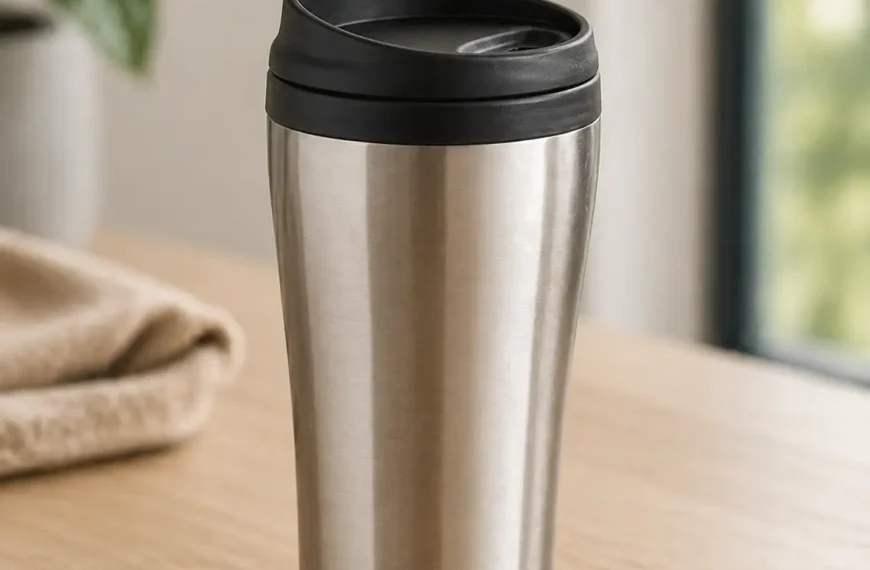

A self-stirring mug runs on either a built-in rechargeable battery or replaceable AAA batteries and uses a small electric motor to agitate the drink at the press of a button. Models sold as drinkware commonly sit around 400 to 450 mL capacity, so they are sized like a normal single-serve mug rather than a large jug.
The stirring action is typically built around one of two designs: a fixed impeller/blade driven by a shaft, or a removable magnetic stir piece that couples to the drive underneath. Patented “beverage container with integrated stirring” designs describe a motor driving a shafted stirring device to mix the contents without needing a spoon.
Power and maintenance set the practical limits. Manuals for rechargeable magnetic versions describe an automatic stop after 30 seconds and up to 60 mixing cycles per full charge, while many battery models specify 2× AAA as the power source. Electronics and metal components also mean these mugs are treated as non-microwaveable, because arcing and sparking in microwave fields is a documented phenomenon for metal objects and sharp edges. This integration of electromechanical components marks the most specialized technological tier within our classification of function-based mug types.
To understand where these mugs work well and where they fail, the key is the internal engineering and the fluid motion the stir system can create inside a drinking vessel.
What is a self-stirring mug and how does it work?
A self-stirring mug is a drinking mug that uses a small electric motor to spin an internal stirring element and create liquid agitation without a spoon. Patented designs describe the basic layout as a motor in the base that drives a shaft and a stirring device to mix the contents inside the container.
What is the difference between a self-stirring mug and a magnetic stirring mug?
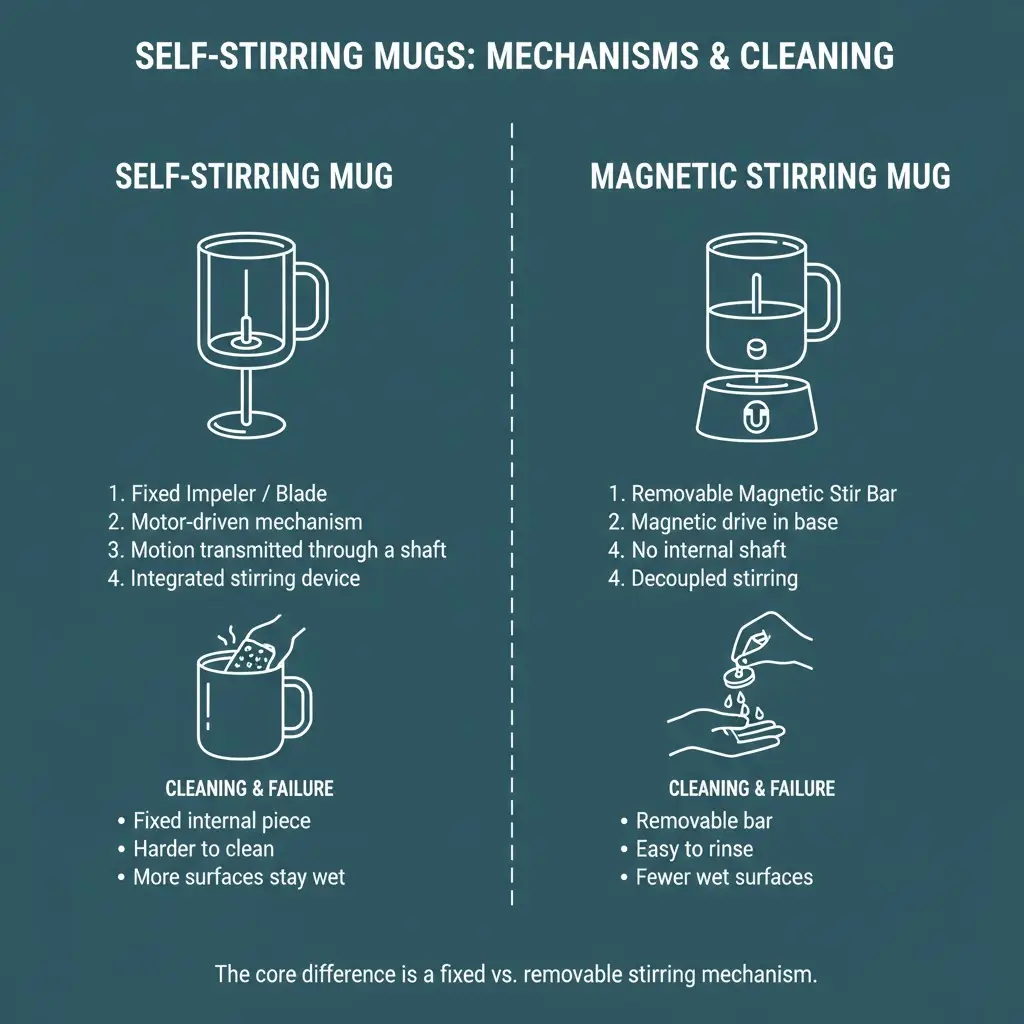
A self-stirring mug uses a fixed, motor-driven impeller or blade inside the mug, while a magnetic stirring mug uses a removable magnetic stir bar that couples to a magnetic drive in the base. In operation terms, the fixed-impeller type transmits motion through a shafted stirring device, which is the approach described in early “integrated stirring” mug patents.
The practical difference shows up most clearly in cleaning and failure points. A removable magnetic bar can be lifted out and rinsed, while a fixed internal piece stays attached to the drive hardware and leaves more surfaces that stay wet after use.
What does the impeller do inside the mug and how does it create liquid agitation?
The impeller is the rotating part that displaces liquid and forces circulation inside the mug. As it spins, it pushes liquid outward and pulls liquid back in to replace it, which builds a continuous loop of motion that breaks up settled solids and keeps powders from sitting on the surface.
In a shaft-driven design, the motor turns the shaft and the stirring device directly, so agitation depends on how well that rotating element couples with the liquid inside the mug.
How do torque and RPM change mixing performance?
Torque and RPM set the mixing “strength” in different ways: RPM drives how fast the liquid circulates, while torque is what keeps the stirrer turning when the mixture resists motion. A 2024 mixing study that tested mixing speeds from 100 to 400 rpm shows why this matters: at higher viscosity conditions, mixing power requirements rise sharply, with reported power consumption ranging from 53.0 to 492 W/m³ across the tested conditions.
That same study reports apparent viscosity values of 4.35 to 8.51 mPa·s, which is a reminder that thicker mixtures demand more from the drive system even at similar speeds. In a mug-sized motor, that translates into a clearer limit: thin drinks are easier to keep moving at higher RPM, while thicker mixes load the motor harder and demand more torque to avoid stalling. (ScienceDirect)
What parts make up a self-stirring mug?
A self-stirring mug is a sealed assembly of three main zones: the drinking vessel, the drive base that houses the motor and power electronics, and the user interface that starts and stops stirring. In the common “motor-in-base” architecture described in patents, the base contains the motor and the drive mechanism that turns the stirring device inside the vessel.
What role does the motor play and is it brushless?
The motor is the actuator that converts stored electrical energy into rotation for the stirring mechanism. Product listings and manuals for self-stirring mugs typically describe the motor function, but they do not consistently publish a verified motor type in a way that supports a universal “brushless” claim across the category.
Where a motor type is clearly specified by a manufacturer document, it belongs in that specific product’s specifications rather than as a general rule for all self-stirring mugs.
Is the stir bar or stirring piece removable?
Removability depends on the stirring design: magnetic-bar systems use a separate stir bar that lifts out, while fixed-blade/impeller systems keep the stirring element attached to the drive. The removable design changes hygiene routines because the stir piece can be rinsed and dried separately, while fixed internal parts keep more crevices close to the drive coupling.
What do you do if the stirrer/stir bar comes loose inside the mug?
A loose stir bar is either a simple alignment issue in a magnetic system or a mechanical fault in a fixed system. There are 2 practical checks that solve most “loose” cases without tools:
- Re-center the magnetic bar
Lift it out, rinse it, then place it back flat in the centre so it can couple cleanly to the drive magnet. - Check for drive wobble
If the internal stirring element wobbles or slips under load in a fixed-impeller design, that points to a shaft/coupler issue in the drive train, which is a repair or replacement situation rather than a cleaning fix.
What does the circuit board and wiring harness control?
The circuit board is the controller that routes battery power to the motor when the switch or button is activated. The wiring harness is the insulated set of conductors that carries power and control signals between the battery, board, and motor, and it has to be protected from water ingress because liquid and electronics do not mix.
How is a self-stirring mug powered and charged?
A self-stirring mug is powered either by replaceable batteries or by a rechargeable battery that charges through a cable or a dock-style connector. Retail listings commonly describe both formats, including battery models that specify 2× AAA and rechargeable models that advertise a finite number of mixing cycles per charge.
Is it rechargeable, or does it run on batteries?
Rechargeable models store energy internally and recharge via a supplied charging system, while battery models run on replaceable cells. A battery-powered example explicitly states 2 AAA batteries as the required power source, and rechargeable listings commonly describe cycle-based runtime claims.
The power choice also changes weight distribution because the motor and battery mass sits in the base, making the mug more bottom-heavy than a standard ceramic cup.
What batteries does it use and is it compatible with AAA batteries?
Some self-stirring mugs are explicitly specified to use 2× AAA batteries.
Battery voltage and exact compartment design vary by product, so the only reliable way to confirm compatibility is the manufacturer specification for the specific mug model.
How do you charge a rechargeable self-stirring mug and does it come with a cable?
Rechargeable models typically charge through a USB cable or a dock-like connector, depending on the design. One Australian retail listing specifies that a self-stirring mug “comes with USB recharging cable.”
How long does a full charge last for daily use?
Charge runtime is commonly presented as a number of stirring cycles rather than hours. A rechargeable model listing states 60+ cycles per full charge, while another listing shows 20+ stir cycles per charge for a different model.
Which drinks are self-stirring mugs used for most often?
Self-stirring mugs are mainly used for drinks that contain powders or syrups that need agitation to fully disperse. Plain black coffee rarely requires mixing, but beverages with suspended solids or powders benefit from consistent agitation to reduce clumping and sediment.
Can a self-stirring mug mix hot chocolate or cocoa powder without clumps?
A self-stirring mug mixes hot chocolate by creating continuous circulation that pulls powder into the liquid rather than leaving it floating on the surface. For clump control, the practical success depends on whether the stirring action can wet the powder fast and keep it moving before it forms lumps.
Can a self-stirring mug mix protein powder, matcha, or fine powders smoothly?
Fine powders rehydrate through a defined sequence of steps, and that sequence explains why clumps form. A 2025 scientific review describes the rehydration process as four stages: wetting, sinking, dispersibility, and dissolution, and notes that powders without effective instantisation often show clumping and difficulty achieving uniformity.
A self-stirring mug supports the “wetting and dispersibility” stages by keeping the surface moving and preventing dry layers from sitting undisturbed. It does not replace good mixing practice: putting liquid in first and adding powder gradually aligns with how wetting and sinking are described in the rehydration pathway. (PMC)
Can it mix milk properly and how does liquid viscosity affect performance?
Milk and cream are more viscous than water, so they resist motion more strongly and load the motor harder. A consistent workflow reduces stalls and improves dispersion, and it has 3 steps:
- Add the liquid first
Start with milk or water in the mug to avoid dry powder binding around the stir element. - Add powder gradually
Let the liquid wet the powder instead of dumping a full scoop on top. - Stir in short cycles
Stop and restart if the mug uses timed cycles so the motor avoids sustained high load.
How well do self-stirring mugs handle heat and insulation?
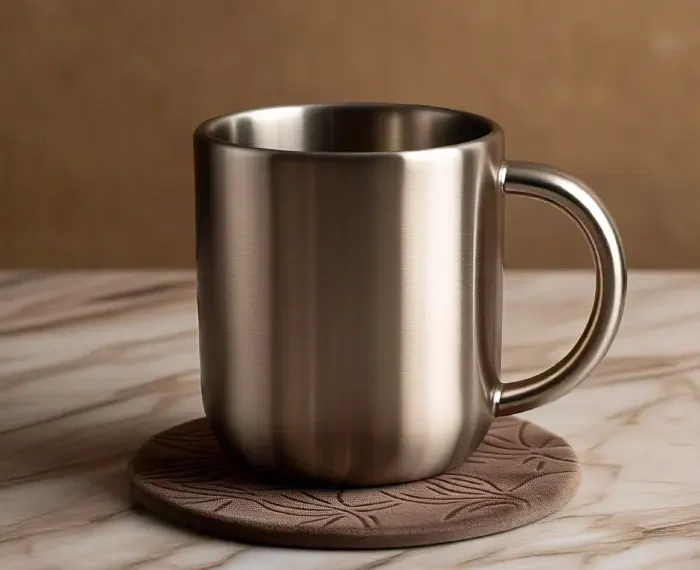
A self-stirring mug has to balance heat retention with protecting the electronics in the base. Many products in this category are sold in a stainless-steel mug form factor, and advertised capacities commonly sit around 400 mL for individual-use models.
Is a self-stirring mug safe for hot drinks like coffee or tea?
A self-stirring mug is designed for hot beverages when used within the maker’s temperature limits. Specific temperature limits are not consistently published across product pages in a way that supports a single verified maximum temperature for the category as a whole.
Does a self-stirring mug keep drinks warm or have a warming function?
A self-stirring mug is a mixing device first, not a heater. Listings that focus on stirring do not establish active heating as a standard function of self-stirring mugs, so warming should be treated as a separate feature that requires explicit manufacturer confirmation for a specific model.
Does it have a temperature display or LED indicator?
Some models are marketed with a temperature display, and at least one product listing explicitly includes “temperature” as a marketed feature.
Indicators and display behaviour vary by model, so colours and meanings require the specific user manual for the exact product.
What is the difference between double-wall and vacuum insulation in these mugs?
Double-wall construction uses two layers with an air gap, while vacuum insulation removes air from the gap to reduce heat transfer further. The insulation claim depends on the product’s published build, so the most reliable check is the product specification for “double-wall” or “vacuum insulated” wording in the technical details.
How do you clean and maintain a self-stirring mug safely?
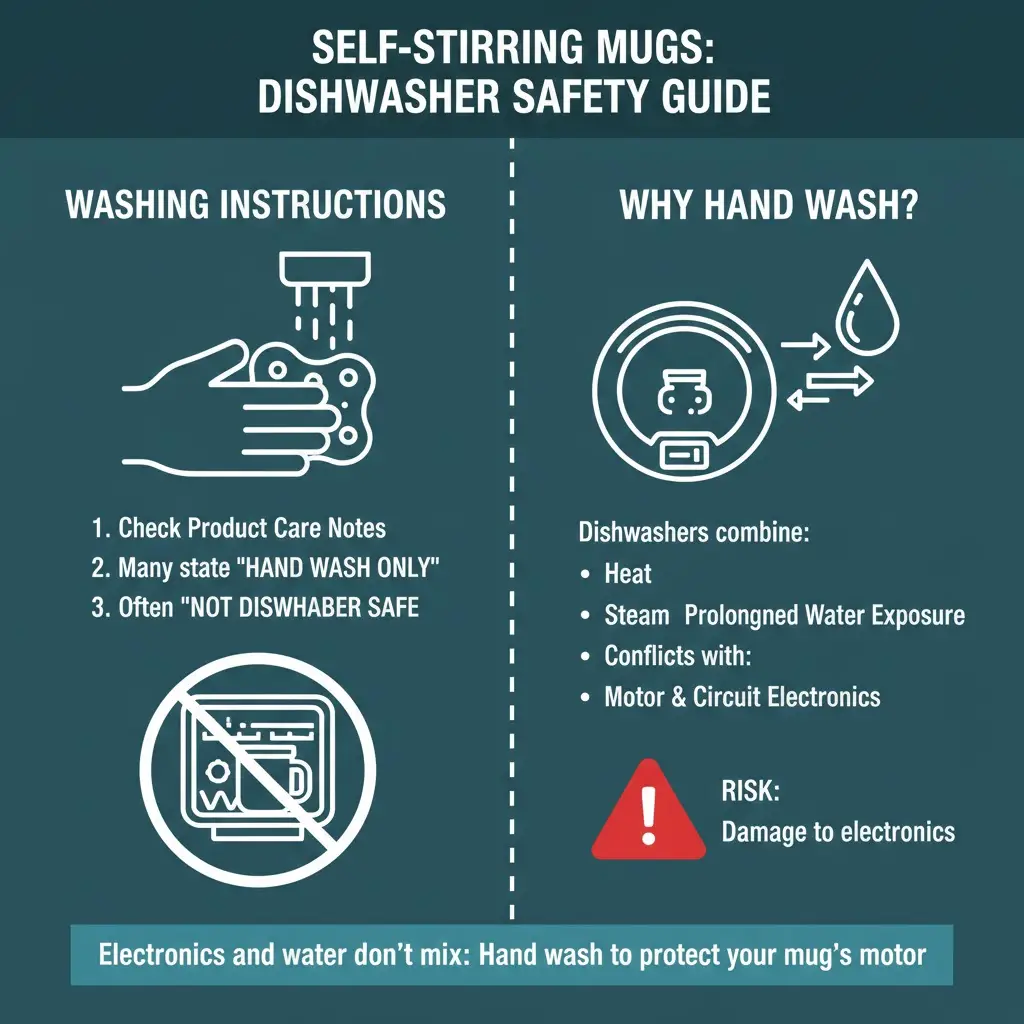
A self-stirring mug is an electronic product, so cleaning is primarily about preventing water from entering the motor housing and damaging electrical parts. Multiple retail sources explicitly state “hand wash only,” “not dishwasher safe,” and “not microwave safe” for self-stirring mugs sold as drinkware.
Is a self-stirring mug dishwasher safe or is “hand wash only” required?
Hand washing is the default instruction in many product care notes for this category, and some listings state “hand wash only” and “not dishwasher safe.”
Dishwashers combine heat, steam, and prolonged water exposure, which conflicts with a base that contains a motor and circuit electronics.
Can you put a self-stirring mug in the microwave?
Microwave use is unsafe for self-stirring mugs that contain metal components and electronics, and the broader risk profile of microwave arcing is documented in the scientific literature. A 2019 paper on plasma arcing in domestic microwave processing cites an average of 7,100 home structure fires per year involving microwave ovens (2007–2011), with about 150 civilian injuries and $31 million in direct property damage per year. (ScienceDirect)
That is why a self-stirring mug with a motor, wiring, and metal fasteners belongs outside the microwave category even before considering product-specific warnings.
Can you submerge the base in water or is it waterproof/water-resistant?
Submerging the base is incompatible with a design that houses electronics. Some product descriptions give partial guidance like “rinse the cup” but also warn against soaking battery covers or submerging the base assembly.
What is a port cover and what does it protect against?
A port cover is a silicone flap that seals the charging port area to reduce splash exposure. Its job is to block water and residue from entering the charging contacts where corrosion and short circuits start.
How ergonomic and portable is the design?
A self-stirring mug is built for one-handed use, but its motor and power system put extra mass in the base, changing balance compared with a standard mug. Many consumer models are sold around the 400 mL size range, which supports portability without turning the mug into a large container.
Does it have a button on the handle and how easy is it to press?
A self-stirring mug activates through a button or touch control that closes the circuit and starts the motor. Control placement differs by model, so the reliable features to check are button location and whether operation is tap-to-run or press-and-hold, both of which should be shown in the user manual or product specification.
Are self-stirring mugs helpful for arthritis, limited mobility, or dexterity issues?
A self-stirring mug reduces the need to hold a spoon and perform repeated stirring motions, because mixing is triggered by a simple control input. Claims about medical benefit levels require clinical evidence, and that evidence is not established by product listings alone, so the safe statement is limited to the reduction in manual stirring steps.
Is it suitable as a travel or commuting mug and does it come with a lid?
A travel-use self-stirring mug relies on a lid to control splashing created by the vortex. Some retail listings explicitly include a “sealed lid” as part of the product set.
Cup-holder fit and leak control depend on mug diameter, lid design, and seal gasket quality, which require the specific product’s dimensions.
Does it leak or spill easily when you’re carrying it?
Spill resistance is primarily a lid and gasket function rather than a stirring function. Leak performance requires a confirmed seal design, and product pages that specify “sealed lid” give the most direct signal available without lab testing.
What should you do if a self-stirring mug is not working?
A self-stirring mug failure is usually either a power delivery problem or a mechanical coupling problem between the motor and the stir element. A fast “first aid” check works best when it is structured as a short sequence rather than random trial and error.
What causes motor noise and is the stirring function loud?
Motor noise is the sound of rotation and vibration transferred into the cup body. Noise rises when the stirring element is off-centre or when the mug runs with too little liquid, because the system loses damping from the fluid.
What is a safety cut-off and what does overheat protection prevent?
A safety cut-off is an automatic stop function that limits run time per activation cycle. Product listings for magnetic self-stirring mugs describe an auto-stop after 30 seconds of stirring.
Overheat protection targets the same risk: preventing motor damage and protecting the battery by avoiding sustained load beyond a short cycle.
What should you do if the motor stops spinning?
A stopped motor is usually a power issue, a jam, or a coupling failure, and there are 3 checks that cover those causes in order:
- Check the power source
Confirm batteries are installed correctly or the rechargeable unit is charged. Battery-powered models explicitly call for 2× AAA in their product instructions. - Check for a stuck stir element
Remove the magnetic bar if present, rinse away residue, and confirm the base spins freely without load. - Check magnetic coupling
Re-seat the stir bar flat in the centre and try a short cycle to confirm the magnet engages.
What does a typical warranty cover for mugs with electronics?
Warranty scope is defined by the seller or manufacturer terms and varies by model and region. Product pages and marketplaces often list warranty information inconsistently, so the only trusted source for coverage is the published warranty policy for the exact mug model and retailer.
How do self-stirring mugs affect sustainability and e-waste, and what can you do about it?
A self-stirring mug contains electronics and a battery, so it becomes an e-waste item when it fails rather than a simple recyclable cup. The practical sustainability question is whether the mug is kept in service long enough to justify the extra materials and whether disposal is handled through proper e-waste channels.
What parts fail first (battery, switch, PCB, motor), and how does repairability affect product lifespan?
Failure points cluster around the power and control chain: battery degradation, switch wear, moisture damage to the circuit board, and motor wear. Repairability depends on whether the base can be opened without destroying seals and whether parts like batteries or seals are replaceable, which is model-specific information that requires manufacturer documentation.
How should you recycle or dispose of an electronic mug safely (battery removal, local e-waste rules, avoiding general bin disposal)?
Safe disposal follows standard e-waste handling: remove the battery when removal is supported by the product design and deliver electronics to an approved e-waste collection point. Local rules differ by jurisdiction, so the trusted step is to follow the official e-waste guidance for the user’s council or state program rather than relying on general advice from sellers.
What “buying signals” reduce waste (replaceable batteries, spare parts availability, warranty length, basic compliance marks like CE/FCC)?
Waste reduction depends on buying signals that indicate longevity and serviceability. There are 4 signals that can be checked before purchase:
- Replaceable power source
Clear specification for standard batteries such as 2× AAA supports easy replacement without specialised packs. (Amazon Australia) - Published charging and cycle specs
Cycle-based runtime claims such as 60+ cycles per charge at least define expected battery performance for a listed model. (Amazon) - Clear care limits that protect electronics
“Hand wash only” and “not microwave safe” instructions reduce early failure from water and heat misuse. (Brosa) - Accessible after-sales terms
A clear warranty policy and spare parts availability are the direct levers for keeping the mug in service longer.
The practical bottom line for choosing and using one
A self-stirring mug is a battery-powered mixing mug that works best when it is treated like a small electronic appliance rather than ordinary drinkware. The most reliable spec checks are the power system and runtime claims, such as 2× AAA for battery models and cycle-based numbers like 20+ or 60+ cycles per charge for rechargeable models.
For mixing performance, the physics is simple: thicker mixtures demand more drive power, and lab mixing data shows how quickly power requirements rise across viscosity and speed changes.
For safety and longevity, the rules are strict and easy to follow: avoid the microwave, keep the base out of soak water, and follow hand-wash care instructions that match the product’s electronic build. These electronic safeguards preserve the specialized functionality that distinguishes these vessels from traditional mugs.