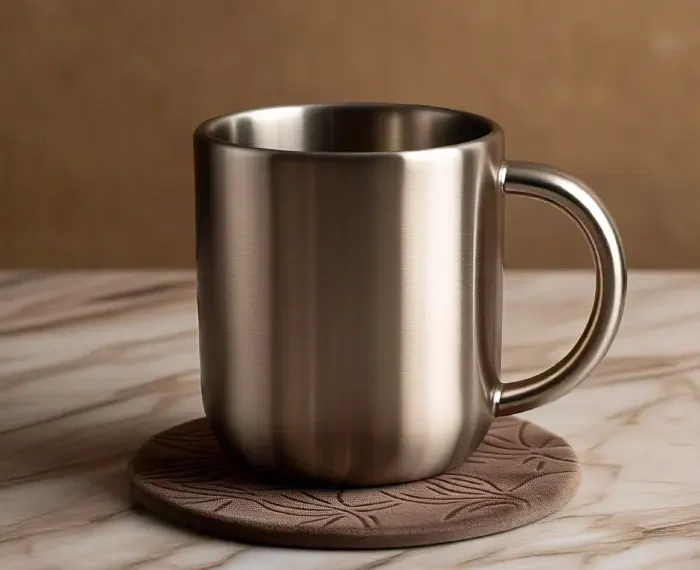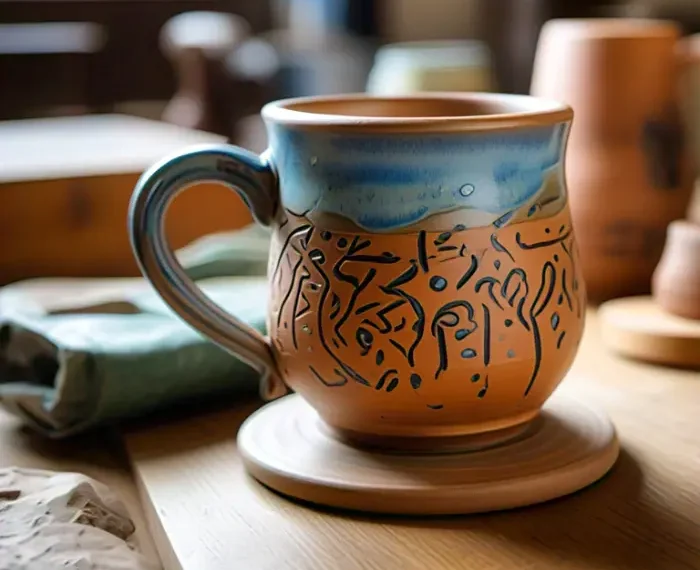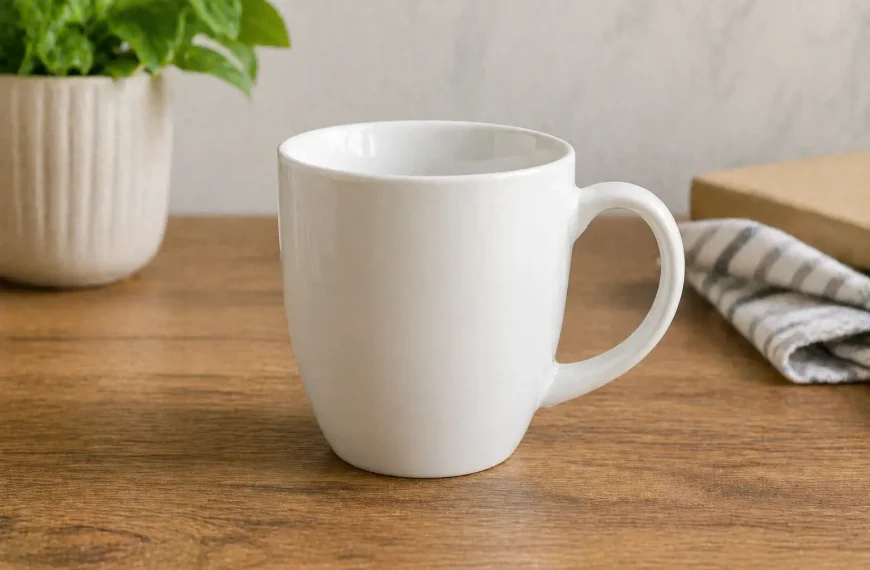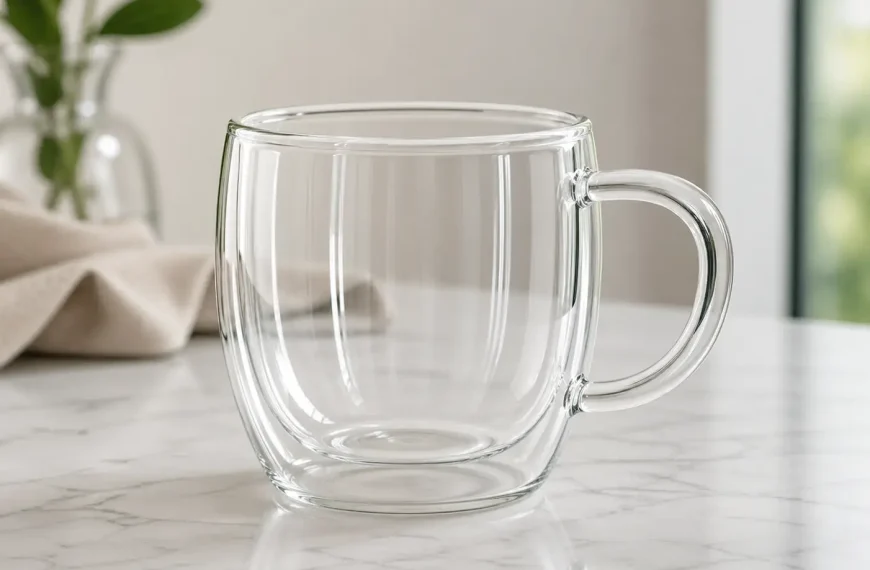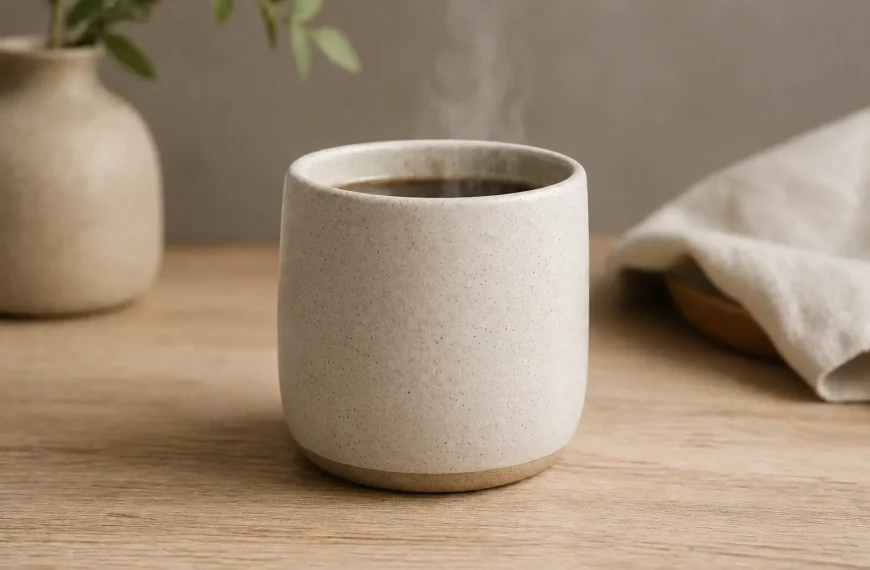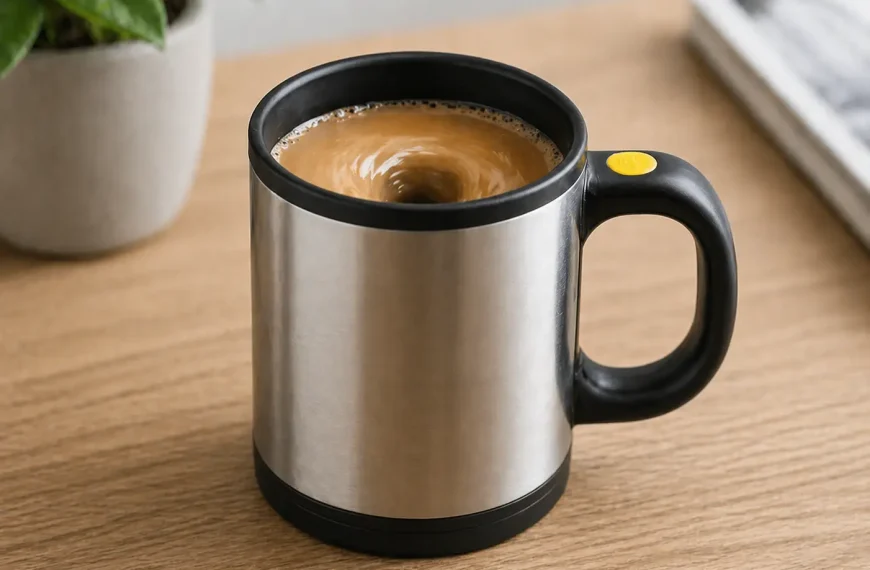

A stoneware mug is a drinking mug made from a high-fired ceramic body that becomes vitreous or semi-vitreous and is built for daily contact with hot liquids. In traditional ceramics, stoneware is typically fired at about 1200 °C and above, using clay bodies commonly formulated with clay plus feldspar and quartz/silica, and it remains opaque (not translucent) compared with porcelain.
The main value of stoneware in a mug is utility and safety under heat and cleaning stress: a properly made stoneware body is designed to handle microwave and oven temperatures and repeated dishwashing, while the real failure points are usually glaze chemistry, absorbed moisture, and thermal shock rules rather than the “ceramic” label alone. Microwave overheating of the mug body is strongly linked to water held in the ceramic matrix, because microwaves heat water molecules inside the clay itself, not only the drink. Dishwashers add another stress pathway: alkaline wash chemistry can chemically attack certain glaze surfaces, and tableware research describes glaze aging under combined mechanical and chemical stress, which is why matte or reactive finishes can show marking and surface change faster than smoother, more chemically resistant glazes. Food safety is tied to the same surface science: lead and cadmium migration from ceramic mugs has been measured using 4% acetic acid over 24 hours, including migration from the lip-area surfaces, and consumer testing has also reported measurable release from the drinking rim area (even when within limits). Stoneware is also positioned within the ceramic hierarchy as the rugged, opaque body that is distinct from porcelain’s typical translucency and different body characteristics, and it is also identifiable as more than “generic ceramic” by material and firing outcomes rather than branding.
Understanding these mineral densities and glaze dynamics is central to our categorization of ceramic mug, where firing temperature serves as the primary benchmark for durability. To judge performance and safety correctly, the next step is the material basics: the raw mineral recipe and the ceramic classification that separates stoneware from earthenware and porcelain. (ScienceDirect)
What is stoneware made of and is it considered ceramic?
Stoneware is ceramic because it is a clay-based body that is shaped, dried, and then fired until it becomes a hard, vitreous or semi-vitreous material. In traditional ceramics, stoneware bodies are commonly described as a blend built around clay, feldspar, and quartz (silica), fired at about 1200 °C and above so the body becomes dense enough for functional ware.
Stoneware also sits inside the everyday ceramic hierarchy used for tableware: earthenware (lower-fired, more porous), stoneware (higher-fired, dense), then porcelain (highly vitreous and sometimes translucent).
For mugs, the practical point is simple: stoneware is chosen when the body itself must tolerate repeated thermal cycling and washing without behaving like a porous sponge.
How is stoneware defined as a ceramic body?
Stoneware is defined as a high-fired ceramic body that becomes vitrified or semi-vitrified during firing, meaning part of the body’s minerals transform into a glassy phase that locks the structure together. Digitalfire describes stoneware as a high-fired body (about 1200 °C+) made from a clay–feldspar–quartz blend and notes it is not translucent and not “zero-porosity” by definition.
“Vitreous” in ceramics is tied to firing to a temperature where density and strength reach a practical maximum; firing beyond that risks warping, blistering, and bloating.
So, the ceramic-body definition is not about marketing terms like “ceramic mug,” it is about what the body becomes after firing: a dense, stable matrix designed for functional use.
How can you identify a stoneware mug vs a ceramic mug?
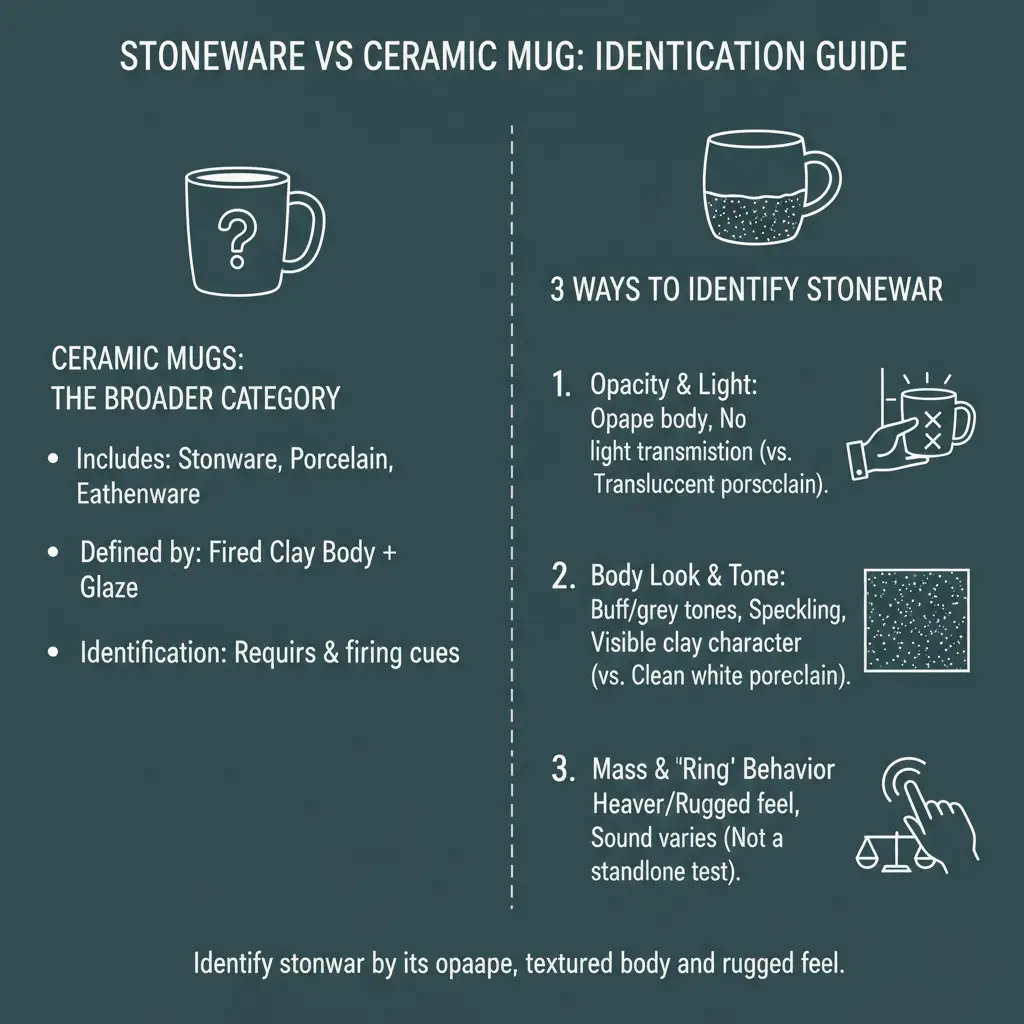
A stoneware mug is still a ceramic mug, so identification means separating stoneware from the broader “ceramic” label by looking for body and firing cues. There are 3 practical identifiers that work together:
- Opacity and light transmission: stoneware is opaque, while true porcelains are associated with translucency through thin walls.
- Body look and clay tone: stoneware bodies often show buff/grey tones, speckling, or visible body character, rather than the clean, bright white typical of many porcelains.
- Mass and “ring” behavior: stoneware is commonly perceived as heavier and more rugged for a given size, and the sound on tapping varies with thickness and density; the sound alone is not a reliable test, but it can support the other two checks.
How is a stoneware mug made and fired?
A stoneware mug is made by forming a clay body into a mug shape, drying it to remove water, then firing it high enough to drive permanent mineral changes that create strength and functional density. The key manufacturing difference is not “handmade vs factory” as a quality label, it is how forming influences wall uniformity, handle joins, and the final risk profile for defects under heating and cooling.
The firing is the turning point because that is when the body shifts from “dried clay” into a ceramic with a stable fired matrix.
What temperature is stoneware fired at?
Stoneware is typically fired in the 1200 °C to 1300 °C range for high-temperature stoneware bodies used in durable functional ceramics. A conservation and collections care reference describes stoneware bodies as fired at 1200 to 1300 °C, producing a vitrified, hard, durable ceramic with porosity < 3%. (manual.museum.wa.gov.au)
Soak time matters because holding at the top temperature helps heat penetrate thick mug walls and supports more complete maturation through the cross-section. A kiln-firing reference explains that soaking increases the amount of fused material and chemical action as the body becomes denser at higher temperatures.
How do wheel-thrown stoneware mugs differ from slip-cast mugs?
Wheel-thrown stoneware mugs differ from slip-cast mugs mainly in surface evidence of making and the kinds of normal imperfections that appear, not in whether they qualify as stoneware. Wheel-thrown mugs often show subtle spirals, trimming rings, and hand-attached handle joins, while slip-cast mugs are more uniform because the shape comes from a mold.
There are 3 small defects that are normal in handmade stoneware and do not automatically mean poor performance:
- Minor asymmetry at the lip or base
- Small trimming or throwing lines under the glaze
- Slight variation in wall thickness around the handle join
In practical use, thickness variation matters because uneven cross-sections can heat and cool unevenly, which increases stress during temperature swings.
What does “vitrified” mean for a stoneware mug in practical use?
“Vitrified” means the fired body has developed enough glassy phase that open porosity drops and the mug becomes dense, strong, and far less likely to absorb water or odors through the body. In a 2021 review of microwave-related stoneware firing, stoneware functional properties are discussed with emphasis on water absorption, porosity, and impact strength, which are exactly the measurable traits that separate a truly mature stoneware body from a more absorbent one.
Vitrification is also the reason a well-matured stoneware body can remain functional even if the glaze is damaged: the body itself is not acting like a water-absorbing sponge.
For everyday mug use, “vitrified” is best read as a performance term, not a decoration term: the body is engineered to behave like a dense ceramic under heat, washing, and contact with drinks.

How does vitrification affect durability and chipping risk?
Vitrification improves durability because it produces a more continuous, bonded microstructure, which raises practical resistance to water intrusion and reduces weakness from open pore networks. A fired body that is denser generally performs better for functional ware because absorption is a porosity product, and higher density correlates with higher durability in everyday handling.
The contrast point is earthenware: lower-firing bodies remain more porous and depend more heavily on glaze for impermeability, which changes their failure modes when the glaze is compromised.
Are stoneware mugs microwave, oven, and dishwasher safe?
Stoneware mugs are generally safe for microwave, oven, and dishwasher use when the body is properly fired and the glaze is stable, but safety still depends on thermal shock rules, glaze fit, and whether the piece has hidden absorbed moisture or weak points. “Microwave safe” also does not mean “stays cool,” because the mug can heat differently than the liquid.
Why does my stoneware mug get hot in the microwave?
A stoneware mug gets hot in the microwave because some mugs absorb more heat than the liquid, creating a burn risk even when the drink is not extremely hot. CSIRO reports instances where some types of crockery mugs absorbed more heat than the liquid they contained, and advises using oven gloves with new crockery until you understand how it heats.
This behavior aligns with two practical drivers: residual moisture in the body and the way uneven wall thickness concentrates heating and stress in specific zones like the handle.
Are stoneware mugs oven safe and can you bake in them?
Stoneware mugs are typically oven-safe for normal baking temperatures when they are mature, undamaged, and heated gradually, because stoneware is designed as functional high-fired ware. The highest risk is not “oven temperature” alone, it is fast transitions and direct, uneven heat that creates stress gradients in thick mug walls.
There are 3 drop-dead rules that prevent most oven failures:
- Avoid moving a cold mug into a fully preheated oven without warming it first
- Avoid direct broiler-style radiant heat on a mug, because it concentrates heat on one face
- Avoid heating an empty mug; heat it with liquid or food inside to moderate temperature gradients
These rules are all thermal shock management, not special “stoneware tricks.”
Are stoneware mugs dishwasher safe?
Stoneware bodies handle dishwasher heat and water pressure well when properly fired, but glazes can change in appearance over time under combined chemical and mechanical stress. That is why matte and reactive finishes are more likely to show dulling, light etching effects, or metal marking compared with smoother surfaces.
A practical way to treat dishwasher safety is as two separate questions:
- Will the body survive repeated washing without absorbing water and weakening?
- Will the glaze surface keep the same look and feel under repeated alkaline detergent exposure and abrasion?
If the mug is prized for its finish, spacing it so it does not knock other items reduces edge chipping and surface wear.
Can you put a stoneware mug in the freezer?
A stoneware mug can go in the freezer, but the real safety question is whether it will be forced into a rapid freezer-to-oven or oven-to-freezer swing that triggers thermal shock. Digitalfire defines thermal shock as stresses from sudden temperature shifts and notes that hot liquid in a cup is a classic everyday example of a mild thermal shock event.
There are 3 freezer-related situations to avoid:
- Moving a frozen mug directly into a hot oven
- Pouring near-boiling liquid into a mug that is freezer-cold
- Freezing a mug that has cracks or crazing that can hold water
These are all about preventing extreme temperature gradients and hidden water expansion in defects.
How well do stoneware mugs retain heat and handle boiling water?
Stoneware mugs retain heat well because they often have thicker walls and higher thermal mass than thin porcelain cups, so the mug warms up more slowly and then buffers the drink against rapid cooling. Heat retention is also linked to wall thickness and body density, because a thicker ceramic wall can act as a more stable thermal reservoir during sipping.
The trade-off is that higher thermal mass can mean the mug itself feels hotter to hold once the body has warmed, especially if the handle design is thin or conducts heat through the join area.
Do stoneware mugs crack from thermal shock?
Stoneware mugs crack from thermal shock when the temperature change is fast enough that one part of the mug expands or contracts much more quickly than another, creating stress beyond what the ceramic and glaze can accommodate. Digitalfire frames thermal shock as a stress response to sudden temperature shifts, with hot coffee in a cup being a common mild version of the same mechanism.
There are 3 practical steps that reduce cracking risk with boiling water:
- Warm the mug with warm tap water before adding boiling water
- Avoid setting a hot mug on a cold stone or metal surface
- Avoid pouring boiling water into a mug that is straight from a cold room or freezer
These steps work because they reduce the size of the temperature gradient across the wall.
Is it safe to drink from a stoneware mug?
Stoneware mugs are considered safe to drink from when the glaze and body are made for food contact and the piece does not release hazardous metals into acidic drinks. A 2025 study measured cadmium and lead migration from both the interior and exterior lip-area surfaces of new and second-hand ceramic mugs over 24 hours using 4% acetic acid, highlighting that the drinking rim is a meaningful exposure zone, not only the inside basin. (ScienceDirect)
Food-contact testing standards and regulatory work commonly use the same basic worst-case approach for ceramics: 4% acetic acid for 24 hours at about 22 °C, because it simulates acidic foods and long contact time.
So the safety logic is simple: modern functional stoneware is built for stable use, but vintage, unknown, or decorative pieces are only “safe” when they meet release limits under standardized leaching tests.
What is crazing and is it safe to drink from a crazed stoneware mug?
Crazing is a network of fine, spider-web cracks in the glaze surface caused by glaze-body mismatch and stress during cooling and use. A crazed glaze can still be safe for drinking if the underlying body is well-vitrified and does not absorb liquids, but crazing increases the risk of staining and retention in the crack network.
There are 2 safety checks that matter most with crazing:
- Whether the body is dense enough that it does not absorb water through unglazed areas
- Whether the glaze surface is stable and not releasing metals under acidic contact conditions
If the mug is vintage, decorative, or of unknown origin, the safe standard is testing rather than visual guessing.
Is unglazed stoneware safe for drinking?
Unglazed stoneware is safe for drinking when it is fired to a dense, vitrified state, because the body is then less able to absorb liquids and residues. Digitalfire links functional durability to fired density and absorption, and describes vitrification as a key route to strength and utility in ceramic ware.
The practical trade-off is tactile feel versus hygiene workload: unglazed surfaces can retain staining more easily than glossy glazes, so they demand more consistent cleaning and full drying.
How do you clean and remove stains from a stoneware mug?
Stoneware mugs clean best when the cleaning method matches the surface: glossy glazes tolerate more aggressive scrubbing than matte or reactive finishes that can show marking. Staining in mugs is mostly a surface film problem when the body is vitrified, while persistent odor retention points to either trapped residues in lids and joins or a more absorbent body.
Metal marking is more common on matte glazes because the texture can pick up utensil transfer and show it more visibly than glossy surfaces. (digitalfire.com)
How do you remove coffee or tea stains from a stoneware mug?
Coffee and tea stains can be removed without damaging most stoneware glazes by using mild abrasion and controlled soaking rather than harsh chemical stripping. There are 4 steps that cover most stain cases:
- Wash with warm water and a non-scratch sponge to remove surface oils
- Apply a mild abrasive paste (commonly baking soda and water) and rub the stained zone
- Rinse fully, then wash again with dish soap to remove any abrasive residue
- Dry completely before storage so no film remains in the bottom curve
If the mug has a reactive or matte finish, keep abrasion gentle and target only the stained area so the glaze texture is not burnished unevenly.
Does stoneware absorb odors or flavors?
Vitrified stoneware does not readily absorb odors or flavors through the body because fired density and low absorption reduce internal uptake pathways. Digitalfire’s functional ware guidance ties durability and performance to absorption and porosity, making dense fired bodies the practical standard for flavor neutrality.
There are 3 common causes when a “stoneware mug smells” anyway:
- Residue film left by milk-based drinks or sweeteners
- Staining trapped in crazing or rough surface texture
- Contamination from shared sponges or stored dampness
Fixing odor is usually about fully removing the film and fully drying the mug, not changing the mug material.
How does stoneware compare to other ceramic mugs?
Stoneware compares as the durability-first ceramic choice for mugs, because it is typically fired high enough to produce a dense, functional body designed for everyday heat and wash cycles. Digitalfire frames stoneware as a high-fired body (about 1200 °C+) formulated for functional use and distinct from porcelain by translucency and body behavior. (digitalfire.com)
The comparison that matters in buying decisions is not “ceramic vs stoneware” as if they are separate families, it is which ceramic body gives the performance you want: ruggedness, heat retention feel, finish stability, and the look of the material.
What’s the difference between stoneware and porcelain mugs?
Stoneware and porcelain differ mainly in translucency behavior, body character, and how close they are pushed toward full vitrification for thin-walled forms. Digitalfire describes translucent porcelain as enabling light to pass through the wall, while stoneware is described as opaque and typically semi-vitrified rather than the thin, highly vitreous form that can be translucent.
So the practical difference in mugs is this: porcelain often delivers a lighter, thinner feel and a cleaner visual palette, while stoneware delivers a more rugged body presence and is commonly built with thicker walls and more body character.
How does stoneware fit into the wider mug network?
Stoneware fits as the “functional ceramic body” topic that connects mug material choice to two adjacent knowledge zones: mug care practices and porcelain mug as a contrasting ceramic body. The care zone matters because surface chemistry and thermal shock habits drive real-life longevity, while the porcelain mug matters because it defines the clearest boundary for classifying stoneware by translucency and fired-body behavior.
How does mug material influence coffee taste, aroma, and drinking perception (beyond stoneware)?
Mug material and design can influence perceived coffee flavour because the drinking vessel changes aroma delivery, temperature curve, and tactile cues at the lip and hand. A 2019 review on the influence of the coffee cup reports that features of the vessel, including shape and surface feel, can exert a strong influence over perceived aroma and taste in coffee experience research.
Does mug material change perceived flavour or aroma through heat loss, lip feel, and surface texture?
Surface texture and tactile feel can measurably shift flavour perception because the brain integrates touch with taste and smell while drinking. A 2020 study found that coffee cup surface texture influenced people’s flavour perception and aftertaste-related judgments, showing that “mouthfeel” cues from the vessel can change evaluation even when the beverage is the same.
So the material question is not only “neutral or not,” it is also about the texture and thermal feel the material produces while the drink is cooling.
Which materials are most “flavour-neutral” for coffee and tea, and why do some retain odours more than others?
Flavor neutrality depends on whether the vessel surface holds residues and whether the drinking design blocks aroma delivery. Lids and narrow sip openings reduce aroma access, while absorbent or rough surfaces make residues harder to remove, and both shift what you perceive as “taste” because smell is part of flavour perception.
This is why the same coffee can feel different across a sealed travel mug, a thin glass cup, and a thick ceramic mug even when the recipe is unchanged.
Practical selection guide: best mug materials by drink type (black coffee, milk drinks, herbal tea) and use-case (home vs office).
Material choice becomes practical when it matches the drink’s sensitivity and the setting’s cleaning routine. There are 3 selection rules that cover most use-cases:
- Black coffee and espresso: choose a vessel shape and rim feel that supports aroma release and consistent sip flow, because vessel design measurably influences perceived aroma and taste.
- Milk drinks and sweetened drinks: prioritize surfaces and finishes that clean easily, because residues drive odor carryover more than the base ceramic category.
- Office and shared kitchens: prioritize durability and cleaning predictability over novelty finishes, because repeated washing cycles and contact with shared sponges amplify staining and surface wear issues.
The practical checklist that makes stoneware mugs perform like stoneware
Stoneware mugs perform at their best when the body is properly fired, the glaze is stable, and daily habits respect thermal shock and surface care. The fast way to judge a mug is to focus on three points: firing maturity (dense body), realistic heat transitions (no extreme hot-to-cold swings), and glaze behavior under washing and acidic contact. By evaluating these material durability factors, you can select vessels that offer the long-term reliability expected of all high-quality mugs.