
Theme-based mug types are a way to classify drinking mugs by motif, character identity, licensed intellectual property, pop-culture reference, seasonal iconography, or a defined visual aesthetic, instead of classifying them by material or use-case. In theme-based taxonomy, the theme is the primary label that “defines” the mug in a catalogue, on a shelf, or in search results, while material and function stay secondary.
Disney mug represents character-led, collectible licensed IP, and it anchors the whole domain as a recognisable “character mug” category with strong collector intent. Christmas provides the second major anchor because it represents event-based and calendar-tied seasonal themes, where the holiday itself becomes the organising unit for designs, giftability, and annual re-release patterns. Together, these two clusters set the core boundary between Licensed or Character themes and Seasonal or Holiday themes, which are the two largest structural sectors inside themed mug classification.
Beyond those anchors, the same taxonomy also includes interactive novelty units such as magic mugs, where the “interaction” is the theme identity and the core label is tied to a thermochromic reveal effect rather than to the mug’s clay, glass, or insulation. It also covers narrower but stable theme units that set the outer semantic edge of the domain: Tiki as a tropical bar-culture aesthetic, Gromit as a specific character-linked novelty form, Saltburn as a fast-moving viral film reference, fluted as a ridged architectural aesthetic treated as a theme identity, and moustache mugs as a face-interaction motif that functions as both gag and design cue. Across these variations, the unifying pattern is that the theme – not the structure – defines how mugs are grouped, compared, and retrieved. The next step is separating these theme units from material- or use-based types, so themed labels do not drift into hybrids like “ceramic travel mug” or “stoneware espresso cup.”
Theme-based mug types classify mugs by motif and identity first, not by what they are made of or how they are used. A “theme” label points to a character, holiday, quote, pop-culture reference, or a coherent visual style, while labels like ceramic, glass, travel, or insulated belong to separate systems that describe material or function. There are 4 common theme sub-categories used in practice:
Novelty mugs qualify as “novelty” when the theme is the primary purchasing hook and the design communicates that hook instantly, even if the mug is never used. That is why themed mugs often sit in two buyer intents at once: a gift intent that values recognisable meaning, and a collector intent that values series identity and continuity. Evidence for the strength of character cues exists outside mugs too: a 2022 systematic review and meta-analysis on licensed and brand-equity characters found that adding a character increased children’s taste preference under experimental conditions by a standardized mean difference of 0.273 on a 5-point scale versus packaging without a character, with p < 0.001. That numeric shift supports a narrow, careful point that applies to theme classification: character imagery works as a measurable preference cue, which helps explain why character-led mug themes can outperform plain, non-themed designs in attention and selection.
A themed mug can still be used every day, but the “theme” label remains about identity rather than durability or heat retention. Everyday suitability depends on construction and care labels, while the theme taxonomy stays stable because it only answers one question: “What does this mug represent?” (PMC)
A consistent theme taxonomy groups mugs by what the design signals, not by what the mug is physically made from. The simplest way to keep classification clean is to separate the theme system from every other system and keep each system single-purpose. There are 5 practical rules that prevent drift into material or function:
Character mugs and seasonal mugs differ by what anchors the meaning. A character theme is tied to a recognisable identity that stays stable across years, while a seasonal theme is tied to a repeating time period that drives predictable spikes and annual refresh cycles. Pop culture and seasonal trends influence themes through a simple lifecycle pattern that keeps reappearing in retail: spike, peak, taper, and long tail.
“Official” and “licensed” mean the mug is produced with legal permission to use protected IP, and “fan-made” means the design uses unofficial references or fan art without an authorised licence. That distinction matters most for character-led themes where trademarks, logos, and character likeness are part of the product’s meaning. There are 3 common sales channels where officially licensed themed mugs are typically distributed:
There are 6 practical authenticity cues that help separate licensed merchandise from unlicensed lookalikes:
Unlicensed fan mugs often circulate through marketplaces and print-on-demand listings because they are fast to produce and easy to distribute. That speed is part of why viral pop-culture references can appear quickly, even when “official” versions lag behind.
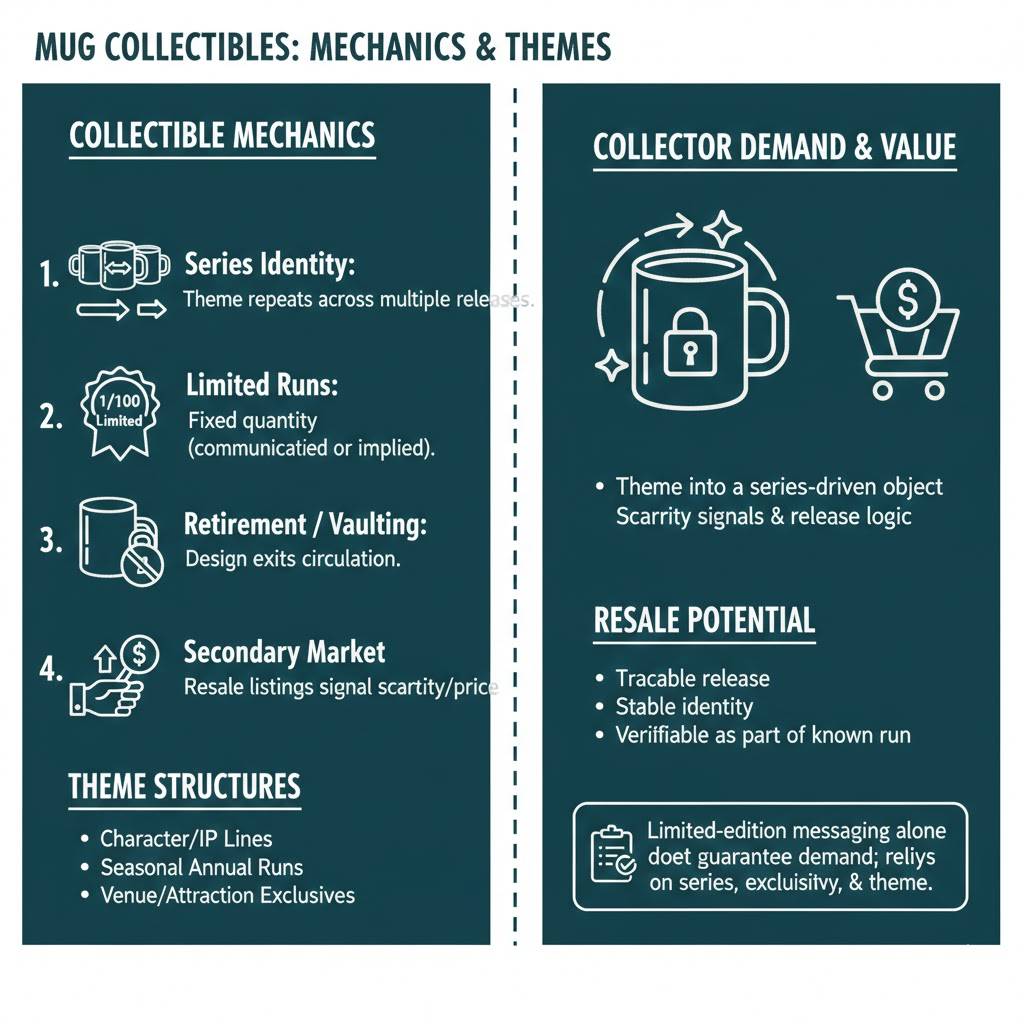
Collectible mechanics change a theme from “a design choice” into a series-driven object with scarcity signals and release logic. In themed mugs, the collector market forms around three structures: character and IP lines, seasonal annual runs, and venue or attraction exclusives. There are 4 mechanisms that commonly raise collector demand in a theme category:
A 2025 empirical study on scarcity and luxury purchase intention tested scarcity messaging using a manipulated scenario that included a “limited edition” condition restricted to 100 units, with a sample of 208 respondents. In that study, scarcity did not show a significant direct effect on purchase intention, reported as β = 0.013, p = 0.804 in the summary of key results. That supports a grounded takeaway for themed mugs: limited-edition messaging alone does not guarantee demand, so collectors often rely on additional signals like series continuity, exclusivity source, and recognisable theme identity. (Springer Link)
Value over time depends on the same mechanics. A theme increases resale potential when the release is traceable, the identity is stable, and the item can be verified as part of a known run. When those elements are missing, “limited edition” can behave like a marketing phrase rather than a collector-grade attribute.
A Disney mug theme is a licensed character and franchise identity applied to mug design as the primary label, usually centered on recognisable characters, film properties, or park-linked iconography. The theme’s core strength is that it functions as a character-led collectible system with both fandom and gift intent. There are 3 high-level subtheme buckets that repeatedly appear in Disney mug classification:
A short, high-level character set commonly used as shorthand examples includes Mickey, princess properties, and Disney-owned universes such as Star Wars and Marvel. Microwave and dishwasher suitability cannot be assigned at the theme level because safety and durability depend on the specific release’s decoration method, glaze, and care marking rather than the IP itself. Deeper coverage in Disney Mug Authenticity and Limited Editions.
A Christmas mug theme is a holiday-anchored seasonal identity where the calendar event organizes iconography, phrases, and annual retail cycles. This theme persists because it ties directly to gifting seasons, seasonal décor, and repeat yearly demand. There are 6 design iconography units that commonly define Christmas-themed mugs at a glance:
Christmas mugs can be collectible when they are part of annual editions or recurring runs that buyers intentionally track across years. They can also be purely seasonal décor when the design is one-off and not tied to a recognizable series. Deeper coverage in Christmas Mug Materials, Safety, and Holiday Gifting.
A magic mug theme is an interactive novelty identity where the “reveal” or “change” effect is the primary theme label. The macro mechanism is thermochromic behavior: the visible design changes as temperature changes, creating a reveal moment that is part of the product’s meaning. There are 3 common magic-mug subtypes used as taxonomy units:
Durability questions belong to the theme level because the reveal effect can fade if the surface is abraded or repeatedly exposed to high heat beyond what the decoration system tolerates. A 2024 systematic review and patent landscape analysis on thermochromic polymers in food packaging identified 288 eligible articles and 922 patents, but only 4 full-text publications met the final inclusion criteria after screening. That sharp reduction supports a strict claim relevant to the magic-mug domain: the applied evidence base for thermochromic systems in food-contact contexts is narrower than the volume of general “thermochromic” mentions suggests, so safety and performance discussions should rely on verified materials, documented limits, and manufacturer declarations rather than assumptions. Deeper how-to and technical handling in Magic Mug working, safety, and care guide. (MDPI)
A tiki mug is a theme unit built around tropical bar culture aesthetics, where carved-face styling, island motifs, and mid-century “tiki bar” identity define the mug’s meaning. The association comes from the mid-century popularity of tiki bars and their visual language, which turned stylised faces and tropical motifs into recognizable barware. In collector contexts, tiki mugs function as both drinkware and display objects because artists and bars release distinctive glazes, shapes, and collaborations that make the theme traceable. Home-bar collectibility is driven less by material and more by recognizable face forms, signature finishes, and branding tied to bars or artists.
A Gromit mug theme is a character-linked novelty mug based on Gromit from Wallace and Gromit, associated with Aardman Animations. The defining feature in many Gromit-themed designs is the use of a character “face” form or molded likeness that turns the mug into an object-shaped character piece rather than a generic printed cylinder. That object-shaped construction places it firmly inside novelty classification because the character form is the product’s primary identity. The theme’s classification stays character-first even when the mug is also usable, because its theme label answers who it represents, not how it performs.
A Saltburn mug theme is a pop-culture reference theme tied to the film Saltburn, directed by Emerald Fennell. The theme typically appears as quotes, imagery, or “vibe” motifs that circulate fast through online culture and print-on-demand channels. Viral film themes spread quickly because production and listing are frictionless, and the primary buyer value is recognition and signaling rather than long-term catalog stability. That makes Saltburn a clean example of a trend theme that spikes with cultural attention and then tapers as the conversation moves on.
A fluted mug theme is an aesthetic design identity defined by grooves, ridges, or ribbed vertical lines as the primary visual motif. This theme behaves differently from novelty because it is usually about décor alignment and texture-led styling rather than a gag or a character story. Fluted styling commonly sits inside minimalist, architectural, or modern décor taxonomies because the surface texture is the “signal” the buyer reads first. That is why fluted is best treated as an aesthetic theme unit, not as a material claim, even when many fluted mugs happen to be made in certain materials.
A moustache mug theme is a mug identity built around a moustache motif or a lip-alignment illusion that becomes visible when sipping. The interaction comes from placement: the moustache graphic sits where it visually aligns under the nose, turning the act of drinking into the gag reveal. There are 2 distinct versions that get conflated under one label:
As a theme unit, moustache mugs often sit inside “giftable novelty” rather than fandom or seasonal categories because the primary meaning is the joke and the face-interaction effect.
Choosing a mug theme works best when the decision starts with the buyer’s intent, not with the design itself. There are 3 practical decision tracks that cover most real searches:
Evergreen themes stay stable because the identity persists year-round, while trend themes spike when culture spikes. A simple way to separate them is to check whether the theme has a durable “home” outside the moment: a long-running franchise, a repeating seasonal calendar, or a stable aesthetic category.
Theme and novelty labels describe meaning, but printed and coated surfaces introduce a second layer of risk and maintenance that sits outside taxonomy. The key variables are decoration method, heat tolerance, abrasion resistance, and what the manufacturer states about dishwasher and microwave use.
Decoration method determines whether the theme survives daily use because each method has a different failure mode. There are 4 common themed-mug decoration approaches that show up across retail:
Dishwasher and microwave tolerance should be treated as a label-and-spec issue, not a theme issue. The correct classification action is to keep “theme” separate and store care rules as product attributes.
Food-contact safety concerns focus on whether components can migrate from inks or coatings under conditions like heat and contact time. Migration risk rises when the decoration system is not intended for food-contact surfaces or when it degrades and exposes layers. For thermochromic and specialty inks, the safe approach is to rely on documented compliance, declared limits, and avoidance of misuse scenarios like microwaving when not marked safe. Theme-based classification stays the same, but safety assessment becomes a separate, evidence-led attribute layer.
Care decisions should match the decoration type because surface wear is the main pathway to both aesthetic failure and possible exposure concerns. There are 6 practical care rules that protect the theme layer and reduce damage:
These steps keep theme identity intact and reduce avoidable degradation.
Clear theme labels make it easier for you to browse and find the mug you actually want. When themes focus strictly on design identity – such as characters, seasons, trends, or visual styles – and materials or features are handled separately, navigation stays simple and intuitive. A clean theme structure means better search results, clearer categories, and a smoother shopping experience overall when browsing for your next everyday drinking container.