
Material-based mug types are types of mugs defined by the core material used in their construction, such as ceramic, glass, stainless steel, copper, or composite blends, where each material directly controls heat retention, durability, and beverage interaction. These mug types for everyday drinking, coffee, tea, and specialty beverages differ in performance because ceramic mugs like porcelain and stoneware retain heat longer, borosilicate glass mugs resist thermal shock, and metal mugs such as stainless steel (e.g., 18/8 steel) and copper rapidly transfer or retain temperature depending on design.
Modern mug materials include ceramic-based mugs, glass mugs made from soda-lime or borosilicate glass (used by brands like Pyrex), metal mugs including stainless steel and copper, enamel mugs with fused glass coatings over steel cores, and bamboo fibre composite mugs combining plant material with polymer binders. Each material-based mug type aligns with key selection factors including heat insulation, impact resistance, dishwasher compatibility, and food-contact safety.
Regulatory standards such as Regulation (EC) No 1935/2004 define safety requirements for food-contact materials, ensuring that ceramic glazes, metal alloys, and composite binders remain stable during use. These material-specific compliance requirements reinforce that mug types are not interchangeable and must be selected based on use case, such as hot beverages, outdoor durability, or chemical resistance.
By classifying these vessels through their physical properties, we create a technical standard for mugs that allows for the direct comparison of ceramic, glass, metal, and composite types based on performance, safety, and long-term usability.
Mug materials fall into five primary families used in modern production: ceramics, glass, metals, polymers, and natural/composite materials.
There are 5 material families to sort mug options fast:
Ceramic mugs are a primary material-based mug type defined by clay-based construction and a glazed food-contact surface, where firing and finishing processes determine how the mug handles heat, impact, and everyday wear. Ceramic mugs are widely used for daily hot beverages because their structure supports stable heat behaviour, surface sealing, and compatibility with common kitchen use such as microwaving and dishwashing when properly finished.
As a category, ceramic mugs are not a single uniform type but a group that includes more specific forms defined by differences in density, firing temperature, and finish. These differences explain why some ceramic mugs feel thinner and more refined, while others are thicker and more resistant to chipping. In practical terms, ceramic mug types are most clearly understood through their two main subtypes:
Each of them represents a distinct balance between finish quality, durability, and thermal performance. For composition and firing specifics, the technical handoff belongs in Ceramic Mug., Porcelain Mug., and Stoneware Mug.
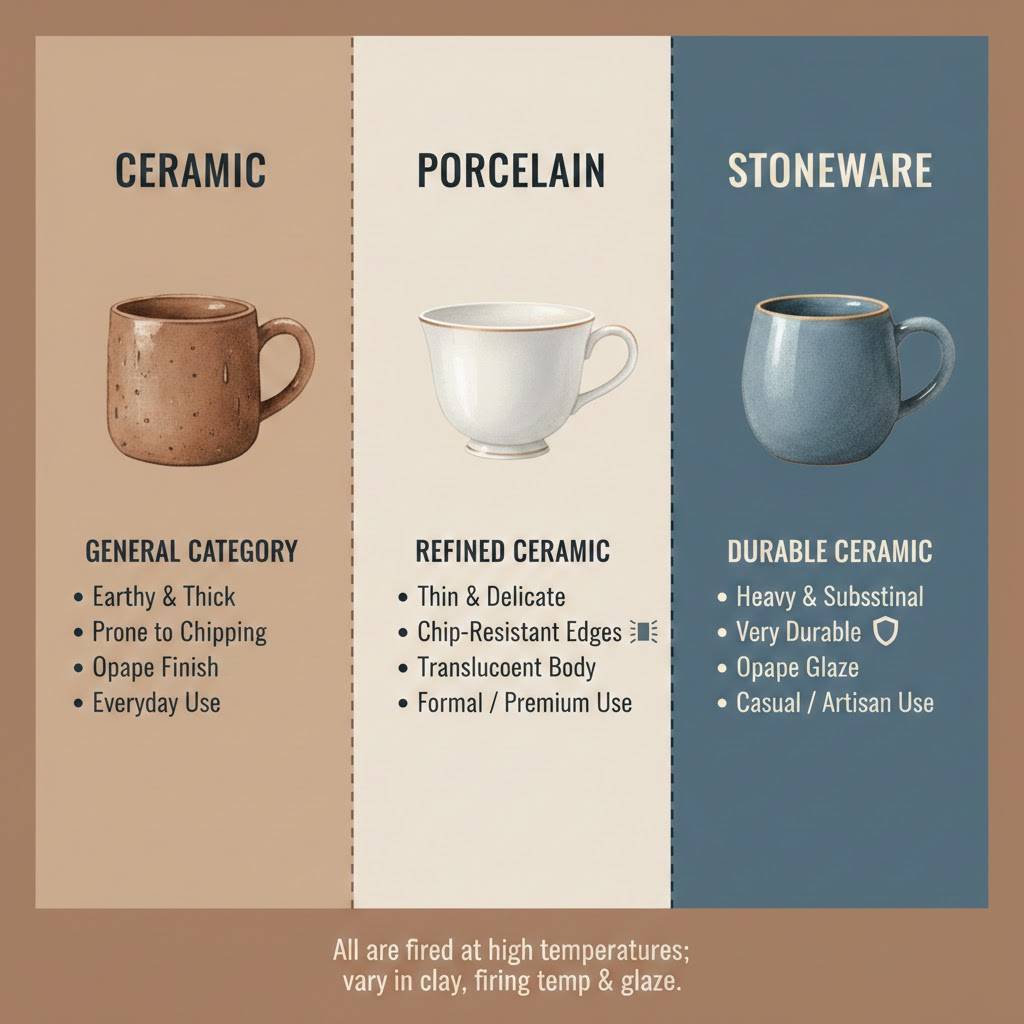
Porcelain mugs are a refined subtype of ceramic mugs defined by higher firing temperatures and a denser, less porous structure, which produces a thinner wall, smoother surface, and more uniform finish. This structure gives porcelain mugs a “glass-like” feel in hand and allows for detailed shaping and decoration, which is why they are commonly associated with formal tableware and precision-designed drinkware.
In use, porcelain mugs tend to balance heat retention with a lighter build, meaning they warm quickly and present a clean drinking surface, while remaining less bulky than thicker ceramic types. Their density also reduces absorption compared to lower-fired ceramics, supporting stain resistance and easier cleaning when the glaze is intact. While porcelain can be strong for its thickness, it is typically less tolerant of sharp impacts than heavier ceramic forms, which makes handling and storage conditions more important in daily use.
A common comparison appears between general ceramic mugs and porcelain mugs, where “better” depends on the intended use. Porcelain is often preferred for its refined finish and thinner structure, while heavier ceramic forms are typically chosen for daily durability and greater heat mass.
Stoneware mugs are a denser and typically thicker subtype of ceramic mugs, produced through high-temperature firing that results in a more vitrified and durable structure. Compared to lighter ceramics, stoneware is usually built with greater wall thickness, which contributes to its reputation for strength, chip resistance, and long-term durability in everyday environments.
This heavier construction also affects thermal behaviour, as stoneware mugs tend to absorb more heat from a beverage initially and release it more gradually over time. In practical use, this can create a different drinking experience compared to thinner mugs, with a stronger sense of warmth retained in the body of the mug during use. Stoneware is commonly chosen for routine home use where durability and resistance to daily knocks are more important than refined finish or reduced weight.
Stoneware is often referenced in comparison with earthenware, where the distinction is mainly about structure and finish: earthenware is generally more porous without glaze, while stoneware is typically more vitrified after firing and therefore more durable for repeated use.
Pottery mugs are a material-based mug type defined by hand-crafted production methods, where clay is shaped and fired using traditional or studio techniques rather than standardised industrial processes. Pottery mugs are recognised by visible variation in shape, thickness, and surface finish, reflecting the maker’s technique.
In practice, pottery mugs often overlap with ceramic categories such as stoneware, but the defining feature is the production approach rather than the exact material composition. This results in mugs that may vary in durability, heat behaviour, and surface finish depending on firing consistency and glaze application. For detailed construction methods, glaze behaviour, and safety considerations, see Pottery Mug.
Clay mugs are a material-based mug type defined by the direct use of natural clay as the primary substance forming the drinking vessel, often with simpler processing or finishing compared to fully glazed ceramic mugs. As part of the wider category of Mugs, clay mugs are commonly associated with traditional or minimally processed forms where the material itself plays a more visible role.
Compared to vitrified ceramic mugs, clay mugs may retain some level of porosity depending on how they are fired and finished, which affects moisture interaction and maintenance requirements. Because of this, factors such as surface sealing, intended use, and cleaning routines are more important to consider. For full details on material behaviour, safety, and long-term use, see Clay Mug.
Glass mugs are a material-based mug type defined by transparent construction, where the glass structure determines heat handling, durability, and resistance to temperature change. They are commonly used when visual clarity and flavour neutrality are priorities.
In practice, glass mugs are typically made from two main types:
The key performance difference appears in thermal shock behaviour rather than basic heat exposure, where sudden temperature changes can stress the material. Glass is also non-porous and chemically stable under normal use, but durability depends on thickness and handling compared to more impact-resistant materials. For detailed properties and usage limits, see Glass Mug.
Copper mugs are a material-based mug type defined by a metal body made from copper, often recognised for their use in traditional drinkware. They are commonly associated with specific beverage styles but are defined structurally by their material and surface design.
In practice, copper mugs are typically built with either a lined or unlined interior, where the lining determines suitability for different drinks. Because copper is a reactive metal, unlined surfaces can interact with acidic liquids, while lined designs—often using stainless steel or another stable layer—are used to create a safer food-contact surface.
As a result, the key distinction in copper mugs is not the outer material but the interior construction and intended use conditions. For detailed guidance on lining types, safety limits, and maintenance, see Copper Mug.
Stainless steel mugs are a material-based mug type defined by a corrosion-resistant metal body, most commonly made from food-grade alloys such as 18/8 stainless steel. They are widely used where durability, impact resistance, and temperature control are priorities.
In practice, many stainless steel mugs are built with double-wall or vacuum-insulated construction, which reduces heat transfer and supports longer temperature retention compared to single-wall designs. This makes them structurally different from other mug types, where performance is shaped not only by the material but also by the construction method.
The main performance considerations for stainless steel mugs relate to heat retention, resistance to physical damage, and food-contact behaviour under repeated use, particularly with hot or acidic drinks. Additional factors such as lid design, seals, and cleaning routines also influence everyday usability. For detailed performance data, safety considerations, and construction specifics, see Stainless Steel Mug.
Enamel mugs are a material-based mug type defined by a steel body coated with a fused glass-like enamel layer, often described as porcelain-on-steel construction. They combine the impact resistance of metal with a smooth, non-porous food-contact surface. (Kloeckner Metals Corporation)
In practice, the steel core provides durability and resistance to shattering, while the enamel coating creates a cleanable surface suitable for hot beverages. This construction allows enamel mugs to be used in environments where direct heating or rugged handling is common, with the main limitation being potential chipping of the enamel layer at edges over time.
Because performance depends on both the metal substrate and the enamel coating, factors such as coating integrity, intended heat use, and maintenance conditions are important in everyday use. For detailed construction methods, safety considerations, and usage limits, see Enamel Mug.
Bamboo mugs are a material-based mug type defined by either solid bamboo construction or bamboo-fibre composites combined with a binding material. In practice, their performance is determined less by the plant fibre itself and more by how the material is processed and finished for food-contact use.
A key distinction exists between solid bamboo mugs and bamboo composite mugs. Solid bamboo forms are typically shaped and sealed as a natural material, while composite versions combine bamboo fibre with resins, which significantly affects heat limits, durability, and safety under hot or acidic conditions.
Because of this, the main considerations for bamboo mugs relate to food-contact behaviour, temperature tolerance, and long-term stability of the material system rather than the “eco-friendly” label alone. For detailed safety data, material composition, and usage limits, see Bamboo Mug.
While mug types differ in structure and use, their performance also depends on how their contact surfaces behave under heat, acidity, and repeated use. This area is governed by food-contact safety and compliance requirements.
Food-contact regulations and compliance testing apply to mug types by defining how each mug’s drinking surface behaves when it comes into contact with beverages under real conditions such as heat, acidity, and repeated use. Rather than evaluating mugs only by their visible material, these frameworks assess the actual food-contact surface—such as ceramic glazes, metal linings, glass finishes, or composite binders—because this is where chemical interaction with the drink can occur.
In practice, different mug types are associated with different compliance concerns. Ceramic and pottery mugs are primarily assessed through glaze stability, as the glaze forms the functional drinking surface. Metal mugs such as stainless steel or copper are evaluated based on surface reactivity and whether a stable lining is present, especially for acidic beverages. Glass mugs are generally associated with low migration in normal use, but decoration layers and rim finishes still matter. Bamboo mugs, particularly composite types, are assessed based on the behaviour of binding materials under heat and repeated contact.
Understanding how these rules apply to mug types helps clarify that safety is not a fixed label, but a performance outcome that depends on use conditions, surface integrity, and long-term wear.
Food-contact requirements for mug types are defined through regional regulatory systems that set the baseline for safe use. In the European Union, Regulation (EC) No 1935/2004 establishes that any food-contact article must not transfer substances to food at levels that could endanger health or affect taste and composition. (EUR-Lex) In the United States, the U.S. Food and Drug Administration evaluates compliance at the level of the substances used in coatings, linings, and materials rather than approving a mug as a single unit. In Australia, food-contact expectations are expressed through the requirement that materials must be fit for purpose and not contaminate food.
Across these systems, the key idea remains consistent: each mug type must perform safely under its intended use conditions, which include temperature, beverage type, and repeated cleaning.
Migration testing is used to determine whether substances can transfer from a mug’s contact surface into a beverage under controlled conditions designed to simulate real use. This is particularly relevant because different mug types present different risk patterns depending on how they are constructed.
For ceramic and enamel mugs, testing focuses on the stability of the glazed surface, where pigments and coatings can influence metal release. For stainless steel and copper mugs, the focus shifts to how the internal surface behaves under acidic conditions and repeated use. For bamboo composite mugs, testing evaluates how binding materials respond to heat and prolonged contact with liquids.
This is where the idea of “food-safe” becomes measurable: a mug type is considered suitable only if its surface remains stable within defined limits under the conditions it is designed for.
When comparing mug types, the most useful compliance signals are those that reflect real testing, clear use limits, and transparent construction details.
In practice, three indicators matter most:
These checks help translate regulatory requirements into practical decisions when selecting between different mug types.
Understanding these principles at a mug-type level provides a practical overview, but full compliance depends on technical definitions, laboratory testing methods, and material-specific limits.
For detailed explanations of regulatory frameworks, migration limits, testing methods, and documentation requirements, see Food Contact Material Regulations for Drinking Mugs.
Material-based mug types provide a practical way to understand how different mugs perform in everyday use, because each type combines structure, surface design, and construction into a specific set of behaviours. Ceramic mugs emphasise balance and everyday reliability, glass mugs prioritise clarity and neutrality, metal mugs focus on durability and temperature control, while enamel and bamboo mugs introduce distinct trade-offs shaped by their construction systems.
The key advantage of this classification is that it turns a wide range of options into a structured decision process. Instead of comparing isolated features, each mug type can be evaluated based on how it handles heat, how it responds to daily wear, and how its food-contact surface performs under real conditions of use.
From this point, choosing the right mug becomes a matter of matching the mug type to the intended use, then confirming that its construction and surface design meet safety and maintenance expectations. Once the material-based type is clear, factors such as shape, size, and accessories become secondary refinements rather than primary decisions for these standard drinking vessels.