
Bamboo mugs are reusable drinking vessels made from either solid bamboo or bamboo-fibre composites, and their real-world value is judged first by chemical safety in food contact, not by the “plant-based” label. In a German Federal Institute for Risk Assessment assessment of 228 “bambooware” articles tested under EU hot-fill conditions, migration experiments were run for 2 hours at 70°C using 3% acetic acid as a food simulant, and the results flagged bamboo-filled melamine-formaldehyde items as a higher-risk category when used with hot contents.
A practical lifecycle view breaks the topic into seven areas: what the mug is made from, safety with hot and acidic drinks, heat handling and daily wear, design features, comparisons with other travel mugs, end-of-life disposal, and how to choose between solid and composite builds. On the chemistry side, the same BfR report states that for roughly one in four “bambooware” articles, formaldehyde release could drive exposure up to 30× the TDI for adults and 120× for children, and it also reiterates that melamine-formaldehyde resin articles are unsuitable for microwave use. On the contamination side, a 2025 Food Control study reports melamine detection in 32% of bamboo dishes and documents migration into hot lemon tea and orange juice, which matches the everyday pattern of hot and acidic beverages.
Analyzing the intersection of botanical fibers and synthetic resins is a vital final entry in our directory of material-based mug types, highlighting how “natural” origins require rigorous chemical vetting. To judge safety and durability with any precision, the first requirement is separating solid bamboo from bamboo-resin composites, then mapping how each manufacturing route creates different performance and risk profiles.
What is a bamboo mug and how is it made?
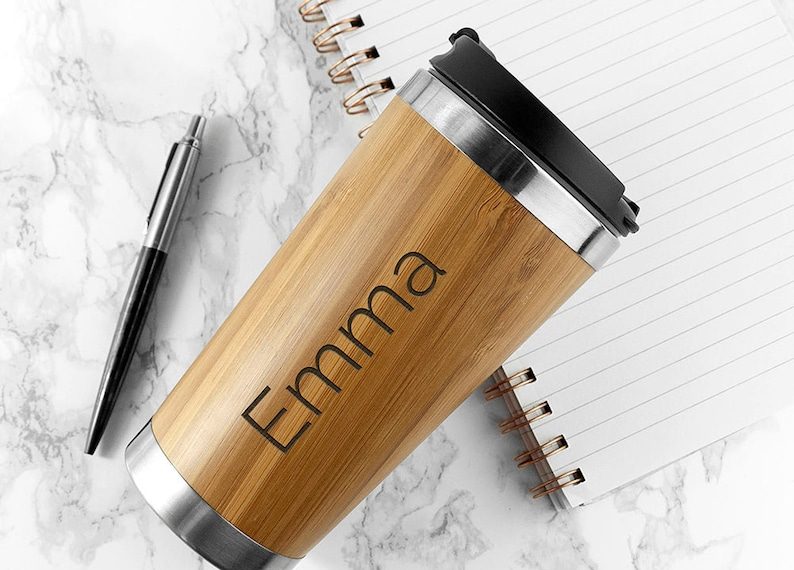
A bamboo mug is a reusable drinking vessel made from either solid bamboo or a bamboo-fibre composite that is moulded into shape. The two builds are not interchangeable because “solid bamboo” is a natural material, while “bamboo fibre” products are typically engineered composites that rely on a synthetic binder to hold the fibres together. In practice, most “bamboo fibre” mugs marketed for hot drinks fall into the composite category that regulators and food-safety bodies discuss under plastic food-contact rules.
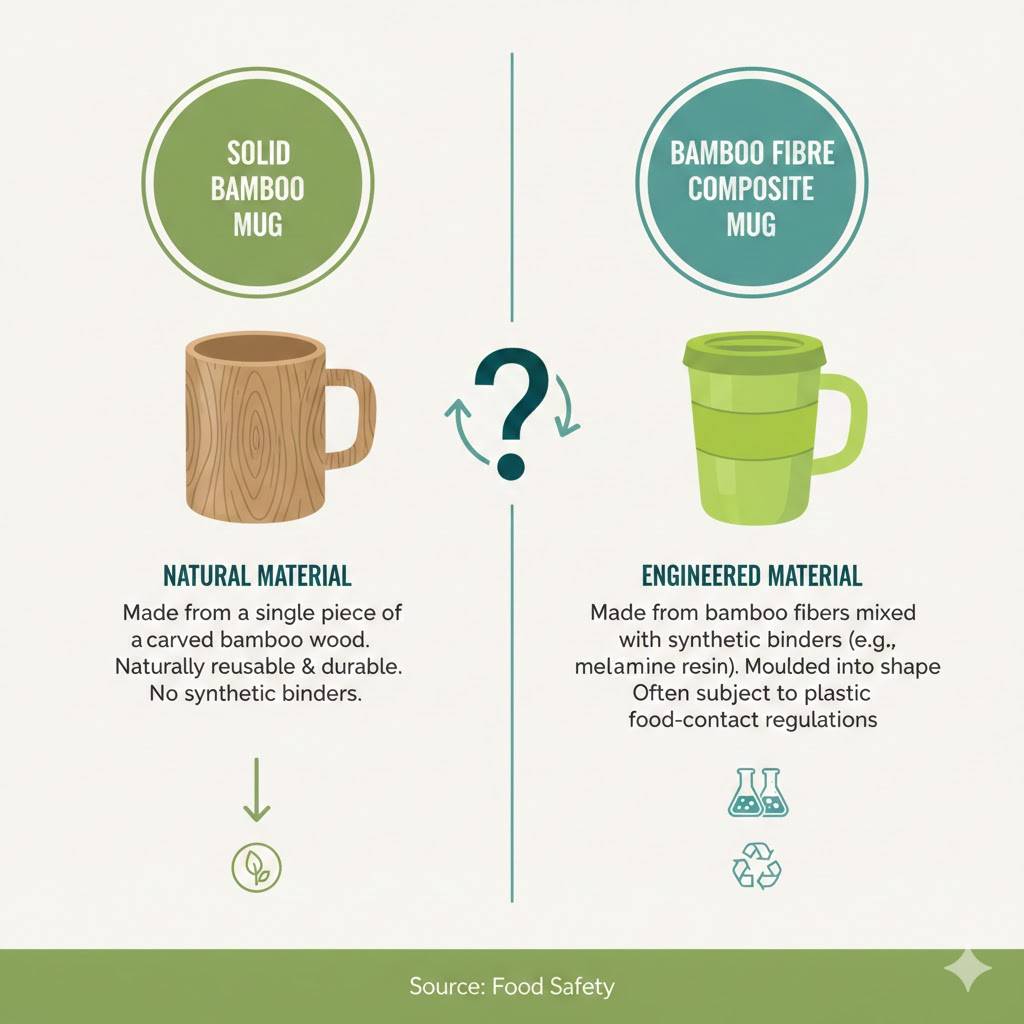
What is the difference between solid bamboo and bamboo fiber composites?
Solid bamboo mugs are carved or assembled from bamboo pieces, while bamboo-fibre composites are moulded from bamboo powder/fibre mixed with a binder and pressed into a mug shape. The key structural difference is simple: solid bamboo relies on the plant’s own structure, while composites rely on a resin network to lock fibres into a rigid form. That resin system is what puts composites into the “mixed material” category for safety testing, durability limits, and end-of-life disposal.
What is bamboo composite resin and why is it used as a binder?
Bamboo composite resin is the “glue phase” that binds plant particles into a hard, moulded cup. Without a binder, pressed bamboo powder does not keep a stable shape under heat, pressure, and repeated washing, so the resin is what makes the product behave like rigid plastic tableware. That is also why enforcement and safety discussions treat many “bamboo fibre” mugs as plastic food-contact materials that contain unauthorised plant fillers, rather than as pure bamboo products.
What is bamboo pulp and how is it processed into drinkware?
Bamboo pulp is processed plant material turned into a fibrous mass, then formed into products by moulding and drying steps. When the end product is sold as “bamboo fibre” drinkware, the relevant practical question is whether it is a fibre-only moulded item or a fibre-plus-resin composite. For food-contact use, the composite pathway is the one that triggers the strictest scrutiny because the resin system is the dominant factor in chemical migration behaviour.
How safe are bamboo mugs for food and beverages?
Bamboo mugs split into two safety profiles: solid bamboo is evaluated like a natural material with coatings and glues as the main variables, while bamboo-resin composites are evaluated like plastics that can release monomers or breakdown products when stressed by heat, acid, and repeated use. In the EU, multiple authorities have highlighted that bamboo and other ground plant materials are not authorised additives “by default” in plastic food-contact materials under the plastics regulation framework, and this is tied to safety and compliance concerns.
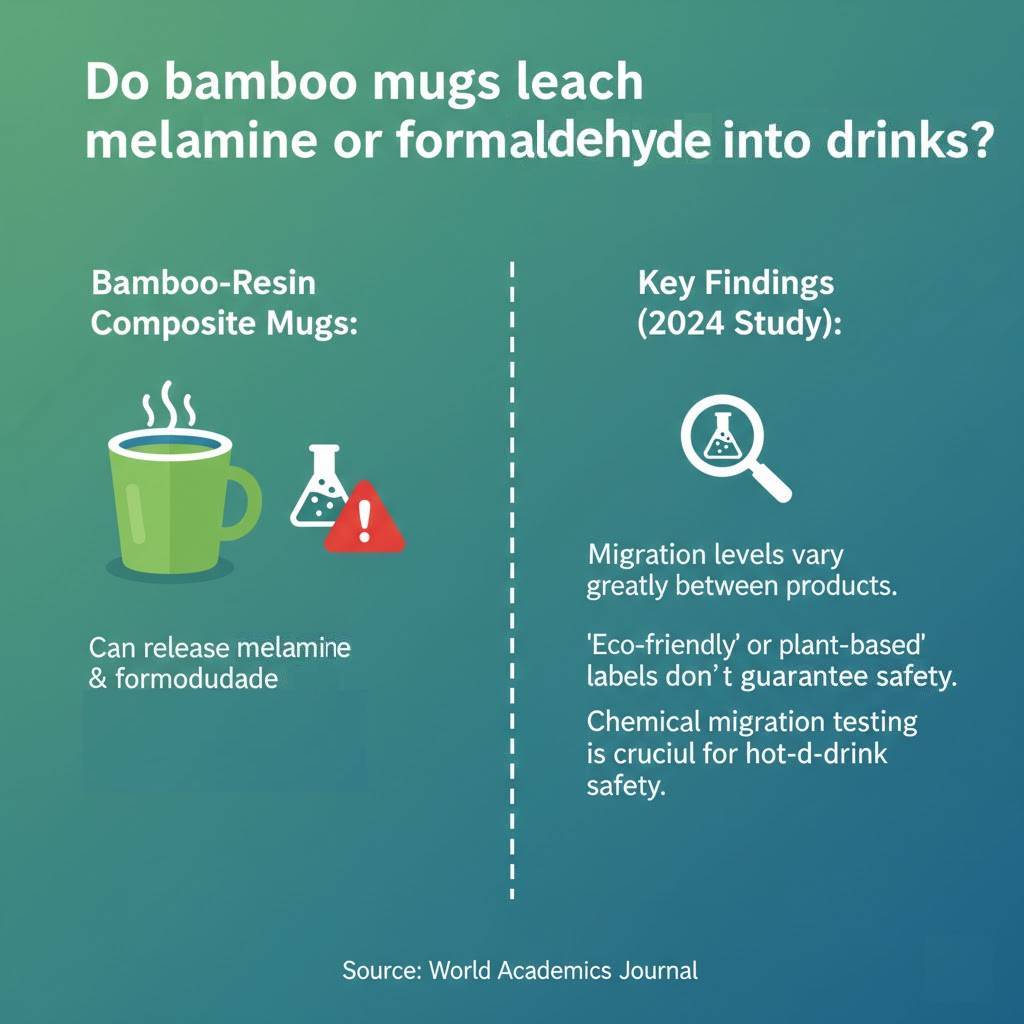
Do bamboo mugs leach melamine or formaldehyde into drinks?
Bamboo-resin composite mugs can release melamine-related substances and formaldehyde because the binder system is often based on melamine-formaldehyde chemistry. A 2024 peer-reviewed study on “eco-friendly” tableware that included bamboo-filled melamine resin products measured melamine migration under standardised conditions and found large differences between items, supporting the need to treat “bamboo composite” as a test-dependent category rather than a guaranteed inert material. That evidence directly supports treating chemical migration testing as the deciding factor for hot-drink safety, not marketing terms like “plant-based” or “eco.”
At what temperature do bamboo composite cups start leaching chemicals?
Hot-fill conditions are a defined stress test for these materials, and 70°C is the key reference point used in official testing protocols. In a BfR evaluation, migration experiments for melamine-formaldehyde “fillable articles” (including 228 ‘bambooware’ articles) were conducted under hot-fill conditions of 2 hours at 70°C using 3% acetic acid as a food simulant, and the report documents that a subset of “bambooware” showed markedly higher formaldehyde release than other tested groups. This directly supports a clear use rule for bamboo-resin composites: boiling-water use is incompatible with the safety logic behind the standard hot-fill test, and higher heat exposure is the stressor that migration testing is built around. (Bundesinstitut für Risikobewertung)
Are bamboo mugs safe for acidic drinks like coffee and juice?
Acidic liquids stress resin-based systems more than neutral water because acidity interacts with polymer chemistry and can accelerate release of small molecules under heat. A 2025 Food Control study on bio-based dishes reports melamine detection and documents melamine migration into hot lemon tea and orange juice, which are practical “hot + acidic” conditions that mirror common beverage use. That result supports a strict rule for bamboo-resin composites: acidic hot drinks are a higher-risk use case than room-temperature water. (ScienceDirect)
Why have health agencies issued warnings or recalls for bamboo-plastic cups?
UK authorities have publicly advised consumers not to use plastic food-contact items containing bamboo and similar plant-based materials, and have reminded businesses not to sell them due to non-compliance and safety concerns. The European Commission also frames the issue as a public-health risk pathway where unauthorised ground plant materials in plastics can accelerate degradation and increase migration from the plastic into food. These statements explain why the issue appears in enforcement notices: it is not “bamboo” as a plant, it is the bamboo-in-plastic composite system and its migration behaviour under use conditions. (Food Standards Agency)
What do BPA-free, non-toxic, and organic labels actually mean for a mug?
“BPA-free” is a narrow chemical claim about bisphenol A and does not certify that a mug is free from melamine-formaldehyde chemistry or other migration-relevant substances. “Non-toxic” and “organic” are often marketing descriptors unless they are tied to a specific food-contact compliance pathway and actual migration testing documentation. For bamboo-resin composites sold in the EU, the compliance logic hinges on plastic food-contact rules, authorised substance lists, and migration limits, so labels that do not connect to that framework do not settle safety questions.
How well do bamboo mugs handle heat and daily use?
Bamboo mugs handle daily use based on three variables: the build type, the binder and coatings, and how often the surface is stressed by heat and cleaning cycles. For composites, heat and repeated high-temperature washing act as the degradation drivers that matter most because they push the system toward higher migration and faster wear. A practical durability check is simple: if the mug is marketed as “bamboo fibre” and behaves like rigid moulded plastic, treat it like a resin composite and apply conservative heat and wash limits.
Can you put a bamboo mug in the microwave or oven?
Bamboo-resin composite mugs are not microwave-safe or oven-safe as a category when assessed under the safety logic used by regulators. The EU’s coordinated enforcement messaging treats bamboo-in-plastic composites as a risk-managed plastic system, and UK notices advise against use of bamboo-containing plastic food-contact items due to safety concerns, which is incompatible with microwave heating scenarios. For solid bamboo, any microwave or oven claim still depends on the full construction, including coatings, glues, and embedded components, so “microwave safe” needs explicit manufacturer validation tied to food-contact testing.
Are bamboo mugs dishwasher safe or hand wash only?
Hand washing is the durability-maximising default for bamboo-resin composites because dishwasher cycles combine heat, detergent, and repeated exposure, which are the same stressors that testing frameworks use to evaluate migration risk. Official safety discussions repeatedly centre on hot-fill conditions and repeated use, which aligns with why high-heat cleaning is treated as a wear accelerator rather than a neutral maintenance step. If the mug’s label does not give a verified dishwasher specification, treat “hand wash only” as the safe operating assumption. (cot.food.gov.uk)
Do bamboo mugs crack, warp, or stain over time?
Composite mugs can warp or roughen as the resin matrix degrades under heat and washing, while solid bamboo can crack if it dries unevenly or if coatings fail. Staining and odour retention show up most with coffee and tea because pigments and oils adhere to worn or porous surfaces, and that effect becomes more noticeable when the surface finish is abraded. The practical maintenance rule is to keep the surface smooth and sealed, since surface wear increases both staining and the effective contact area exposed to liquids.
Is a bamboo mug safe to use if the surface is scratched or worn?
A scratched bamboo mug is a higher-risk state than an intact one because the worn surface increases liquid contact with the underlying material system. For composites, surface damage exposes more resin-fibre interface and can make cleaning less effective, which increases both residue retention and the functional wear cycle. The safe threshold is straightforward: visible wear, persistent odour, or a roughened interior is the signal to retire the mug from food use.
What design features and aesthetics should you look for?
Bamboo mugs are chosen as much for usability as for looks, and the design features that matter most are the ones that control heat contact, sealing, and grip. In practice, the highest-value features are the ones that reduce spills and reduce surface wear, because both directly affect longevity and hygiene. A design review also needs to separate “anti-leak design” from “leak-proof,” since many lids reduce spills without being sealed for inversion.
What are the insulation limits and heat retention of bamboo?
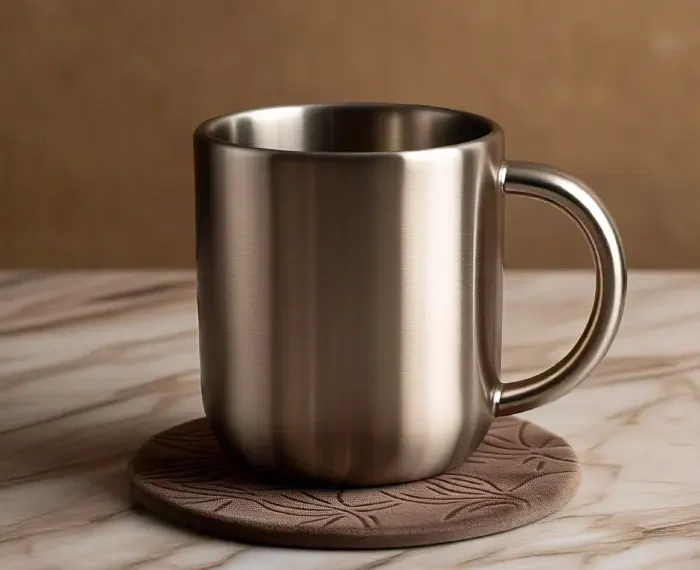
Bamboo provides modest thermal insulation compared with bare metal because it is a plant-based material and is less conductive than stainless steel. It does not match vacuum insulation systems used in double-wall steel travel mugs, so it does not deliver the same long heat retention profile as a vacuum-insulated design. The practical expectation is a comfortable grip and slower heat transfer to the hand, not all-morning temperature lock.
What are the benefits of bamboo lids, handles, and silicone seals?
Bamboo lids and handles can improve grip feel and reduce direct contact with hot surfaces, while silicone seals are the functional component that makes a lid resist leaking. There are three component checks that decide whether the mug is commuter-friendly:
- Seal geometry
- Lid closure mechanism
- Disassembly for cleaning
A lid that cannot be disassembled and dried fully is a predictable hygiene weak point in daily use.
How do bamboo grain, texture, and veneer finishes affect the feel?
Grain and texture affect grip and perceived quality, but finish type affects real durability because it controls porosity and stain resistance. Veneer finishes are often used for appearance, and they can sit over a different core material system, so the “bamboo look” does not guarantee a bamboo-dominant structure. The correct buying behaviour is to treat aesthetics as secondary to the labelled material composition and the functional limitations stated for hot use and cleaning.
How do bamboo mugs compare to other travel mugs?
Bamboo mugs compete on feel, weight, and perceived sustainability, while stainless steel and glass compete on heat retention, durability, and chemical inertness. The comparison is not “better vs worse,” it is a trade-off across heat performance, lifespan, and end-of-life disposal. A useful selection rule is to decide first whether hot-drink performance or eco-aesthetics is the top priority, then choose the material system that matches that priority.
What are the benefits of bamboo compared to stainless steel or glass?
Bamboo-based designs are often lighter and can feel cooler to hold than bare metal, while stainless steel and glass are simpler to evaluate for chemical stability in hot beverage use. Stainless steel travel mugs commonly rely on double-wall designs that deliver stronger heat retention than bamboo-based bodies, and glass is inert but more fragile in drop scenarios. For everyday commuting, the most consistent “performance” choice is vacuum-insulated steel, while bamboo is typically chosen for tactile feel and branding.
Are bamboo mugs a good option for coffee-to-go and camping?
Bamboo mugs work best for lower-temperature drinks and short carry times, not for repeated boiling-water fills or aggressive cleaning cycles. For camping, impact resistance and seal reliability decide whether a mug is practical, and many bamboo-composite mugs behave more like rigid plastic than like rugged outdoor gear. A camping-fit checklist has four items:
- Drop tolerance
- Leak resistance
- Ease of cleaning without a dishwasher
- Safe heat limits for camp kettles
How should bamboo mugs be disposed of at the end of their life?
End-of-life handling depends on whether the mug is a pure natural material system or a mixed material composite. Regulators explicitly warn that bamboo-in-plastic food-contact items are not compliant and are not treated as compostable or recyclable in normal household systems. The practical outcome is that most bamboo-resin composite mugs go to general waste unless a specialist program exists.
Are bamboo mugs actually biodegradable or compostable?
Bamboo-resin composite mugs are not compostable in a home garden because the resin binder does not behave like plant matter in typical compost conditions. UK food safety agencies explicitly advise consumers not to use bamboo-containing plastic food-contact items and to dispose of them, which aligns with the reality that these are mixed-material systems rather than clean compost inputs. The simple rule is: if the product is moulded “bamboo fibre” tableware with a plastic-like feel, treat compostability claims as unreliable without certified industrial composting proof tied to the full composite.
Can you recycle bamboo-resin composites?
Most curbside recycling systems do not accept mixed bamboo-plastic composites because they cannot be sorted into a single recyclable polymer stream. Authorities discussing bamboo-in-plastic items frame them within plastic food-contact compliance and safety risk, not as recyclable biowaste, which is consistent with why normal recycling channels do not process them as a clean material. If a product lacks a clear recycling route printed by the manufacturer, assume general waste is the correct disposal route.
How can you spot greenwashing in “eco-friendly” drinkware claims?
Greenwashing is present when claims focus on the bamboo filler while omitting the resin system and real end-of-life pathway. There are five red flags that consistently indicate a claim-first product page:
- No material composition disclosure beyond “bamboo fibre”
- No food-contact compliance references tied to plastic FCM rules
- Compostable claims without a recognised certification route for the full composite
- No safe-use limits for heat and acidic drinks
- No end-of-life instructions beyond “eco” wording
What is the total life cycle impact of a bamboo mug vs. a paper cup?
Life cycle impact is decided by the number of reuses, washing impacts, and disposal, not by the name of the material. A UNEP Life Cycle Initiative report on beverage cups states that reusable cups have lower climate impact than single-use cups once they are reused enough times, and it also highlights that the break-even reuse count varies by material and use conditions. The practical rule is to treat “reusable” as an environmental claim only when the mug survives long enough to be reused repeatedly, and when washing is not wasteful in energy and hot water.
How do you choose the right bamboo mug for your drinkware collection?
Choosing the right bamboo mug is deciding between two products: a natural bamboo build with coatings, or a bamboo-resin composite treated as a plastic system with strict heat and use limits. There are six buying checks that reliably filter out risky purchases:
- Composition clarity: solid bamboo vs composite
- Explicit hot-use limits and acidic-drink guidance
- Microwave and dishwasher statements that match compliance reality
- A lid that disassembles for cleaning and drying
- A surface finish that stays smooth under daily use
- End-of-life instructions that match local waste systems
Plant-fibre plastic composites beyond mugs (bowls, plates, cutlery): what’s the safety issue and how do you identify them?
Plant-fibre plastic composites appear across kitchenware categories and are regulated and discussed as a single risk pattern because the issue is the filler-in-plastic system, not the product shape. UK agencies explicitly broaden their advice to plastic containers and utensils containing bamboo and similar plant-based materials, and the EU has coordinated actions that target these composite materials as a compliance and public-health concern. The practical takeaway is that the same identification and safe-use rules used for “bamboo mugs” apply to bowls, plates, and cutlery sold with the same composite structure. (Food Standards Agency)
What are plant-fibre plastic composites (bamboo, wheat straw, rice husk) and why are they treated differently from pure plastics or pure natural materials?
Plant-fibre plastic composites are plastic materials that include ground plant fillers, and they are treated differently because fillers are not automatically authorised for plastic food-contact use and can change plastic degradation and migration behaviour. Regulators frame this as a public-health risk pathway because degraded plastics can release substances into food more readily under stress conditions. That is why enforcement work focuses on the material class and authorised-substance rules, not on marketing descriptors like “eco tableware.”
How can consumers spot fibre-plastic composites in stores and online listings (common labels, wording patterns, and missing composition clues)?
A fibre-plastic composite is identified by what the listing avoids stating as much as what it claims. There are five reliable identification signals:
- “Bamboo fibre” or “plant-based” with no binder disclosure
- Rigid moulded form with a plastic-like finish and uniform thickness
- No safe-use limits for heat or acidic foods
- Vague “biodegradable” claims without a certification path for the full composite
- No end-of-life guidance beyond “eco friendly”
If you already own them, what are the safest “do/don’t” use rules (hot/acidic limits) and what’s the best disposal or repurposing approach?
Safe use for plant-fibre plastic composites is defined by avoiding the stressors highlighted by regulators: heat and acidic contact. There are six practical rules that match official safety messaging:
- Do not use for hot liquids or hot foods
- Do not use for acidic foods and drinks
- Do not microwave or heat in ovens
- Do not run through high-heat dishwasher cycles
- Replace at the first sign of interior wear or roughening
- Dispose of in general waste or repurpose for non-food storage
A practical bottom line for bamboo mugs that stays safe and honest
Bamboo mugs only make sense when the build matches the use case and the safe-use limits are respected. If the mug is a bamboo-resin composite, treat it as a plastic system with strict heat and acidic-drink limits, and retire it early when wear appears. If the mug is solid bamboo, judge it on coatings, construction quality, and whether it is actually designed for hot beverages. The purchase decision stays simple when it follows one rule: buy for verified safe use and long lifespan first, then treat sustainability claims as real only when the mug survives enough reuses to beat a single-use alternative. By applying these verification steps, you can ensure your choice of drinkware fulfills the safety and durability requirements expected of all modern mugs.