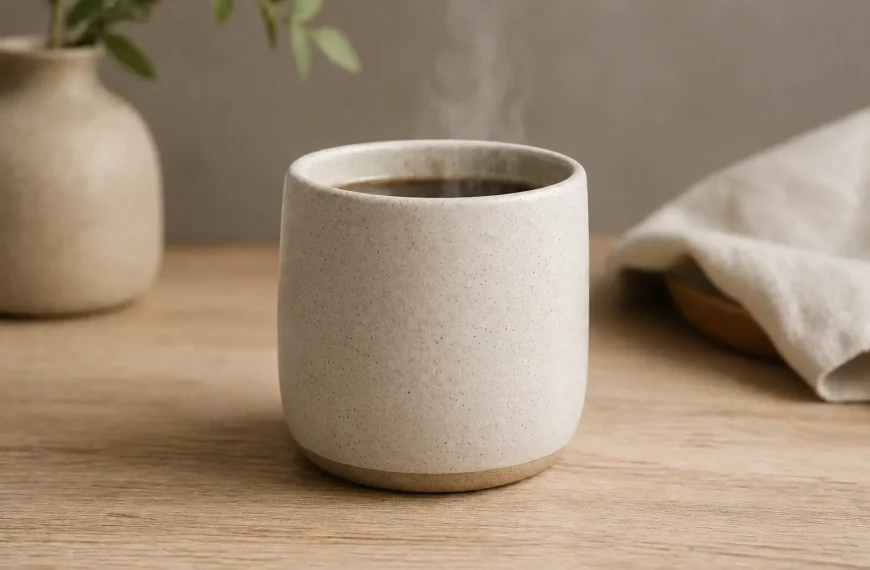

A porcelain mug is a drinking mug made from a high-density, vitrified ceramic body fired to near-complete glass-like maturity, commonly around the >1,200°C high-fire range used to densify porcelain structures. A core performance reason people choose porcelain is modern appliance compatibility: when the body and glaze are properly vitrified and free of metallic decoration, porcelain is widely used as a microwave-safe, dishwasher-safe, and oven-safe beverage vessel, with the practical limits set by thermal shock and any metallic trim that can arc in a microwave.
Beyond appliance use, a porcelain mug is judged on two high-intent performance metrics: safety and material purity and thermal performance. Safety and purity are evaluated with formal leach testing approaches used for foodware, including extraction with 4% acetic acid for 24 hours to measure lead and cadmium release. Thermal performance is shaped by porcelain’s dense, low-porosity structure and typical thin-wall geometry, which affects how heat moves from the drink to the hand and how the mug holds temperature compared with coarser ceramics. These same constraints also connect directly to long-term satisfaction: a good buying decision comes from reading the material signals first (vitrification quality, glaze integrity, and food-contact safety expectations) and then checking the design details that control daily use and durability.
This combination of high-density structure and sanitary vitrification is a defining characteristic within our analysis of ceramic mug, where mineral purity dictates long-term performance. To see why porcelain is treated as a distinct “top-tier” ceramic for mugs, the key is the material classification that separates it from other ceramic varieties such as stoneware and earthenware. (PMC)
What is the difference between porcelain and other ceramic mugs?
Porcelain mugs are a specific class of ceramic mugs defined by a high-fire, highly vitrified, low-porosity body, while “ceramic mug” is the umbrella category that also includes earthenware and stoneware. Porcelain typically reaches vitrification in a second firing around 1,260°C to 1,400°C, which tightens the body and supports translucency in thinner walls.
There are 3 practical differences that show up in daily use:
- Porosity and stain uptake (vitrified porcelain absorbs far less than earthenware).
- Wall geometry (porcelain is often made thinner without losing stiffness, so it can feel “refined” at the rim).
- Failure mode (harder surface and crisp glaze, but it can shatter on impact more readily than thick stoneware).
Is porcelain a type of ceramic, and what is porcelain made of?
Porcelain is a type of ceramic made from a controlled mineral mix that is fired until the body vitrifies. The core recipe is typically described as kaolin (china clay) plus fluxes and silica sources such as feldspar and quartz, where the firing range is what drives densification and the glassy phase that gives porcelain its “tight” body.
That firing range matters because moving from a porous bisque stage toward vitrification is what separates porcelain from lower-fire ceramics. A mug that is fired too low stays more porous and behaves more like ordinary ceramic in stain, odor, and moisture behaviour.
How can you tell if a mug is porcelain or ceramic?
A reliable consumer answer is that a porcelain mug is usually thinner-walled for its stiffness, more uniformly white, and more likely to show light transmission at the rim when held against strong light. A practical identification check uses 4 cues, and each cue should be checked because no single cue is perfect:
- Translucency at thin edges (more common in porcelain than stoneware).
- Rim thinness and “clean” lip geometry (porcelain production supports finer edges).
- Body tightness (less water absorption signals higher vitrification).
- Tap sound (a clearer ring often indicates a more vitrified body, but shape also affects sound).
What is the difference between porcelain and stoneware mugs?
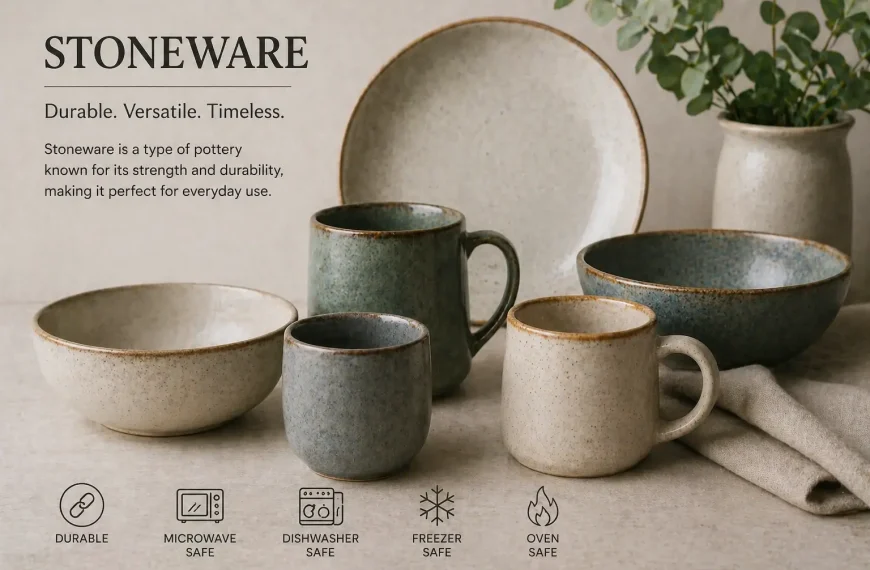
Stoneware mugs are ceramic mugs fired hot enough to be relatively dense, but porcelain mugs are ceramic mugs engineered to reach a more glass-like vitrified structure at a higher, more controlled maturity range. In manufacturing terms, porcelain is commonly described with a vitrifying firing stage in the 1,260°C to 1,400°C range, while stoneware often relies more on body thickness and robust forms for durability. (ceramique-technique.com)
In daily use, stoneware often feels heavier and thicker, holds heat through higher thermal mass, and hides knocks better because its walls are not pushed as thin. Porcelain tends to deliver a cleaner rim feel and lower porosity when fully vitrified, but it is less forgiving of drops.
What is the difference between porcelain and bone china mugs?
Bone china mugs are a porcelain-family ceramic that contains bone ash, which changes the fired body’s colour and translucency profile compared with “true” hard-paste porcelain. The practical difference is that bone china often looks creamier, while hard-paste porcelain is often described as blue-white when compared side by side.
Chip behaviour depends heavily on geometry and glaze fit, but the common reason bone china competes in “durability” discussions is that its fired body can be tough in thin sections, even when it appears delicate.
Why are porcelain mugs more expensive than ceramic mugs?
Porcelain mugs cost more because they are built around tighter raw material control, higher firing ranges, and higher losses when thin pieces warp or crack during firing. A high-fire porcelain process commonly relies on firing stages that reach vitrification around 1,260°C to 1,400°C, and running kilns and quality control across that range raises production cost.
Thin-walled forms also demand tighter forming and finishing, which adds labour and reject rate. The price gap becomes most obvious in mugs with fine rims, clean handles, and consistent glaze coverage.
How are porcelain mugs made, and how does production affect quality?
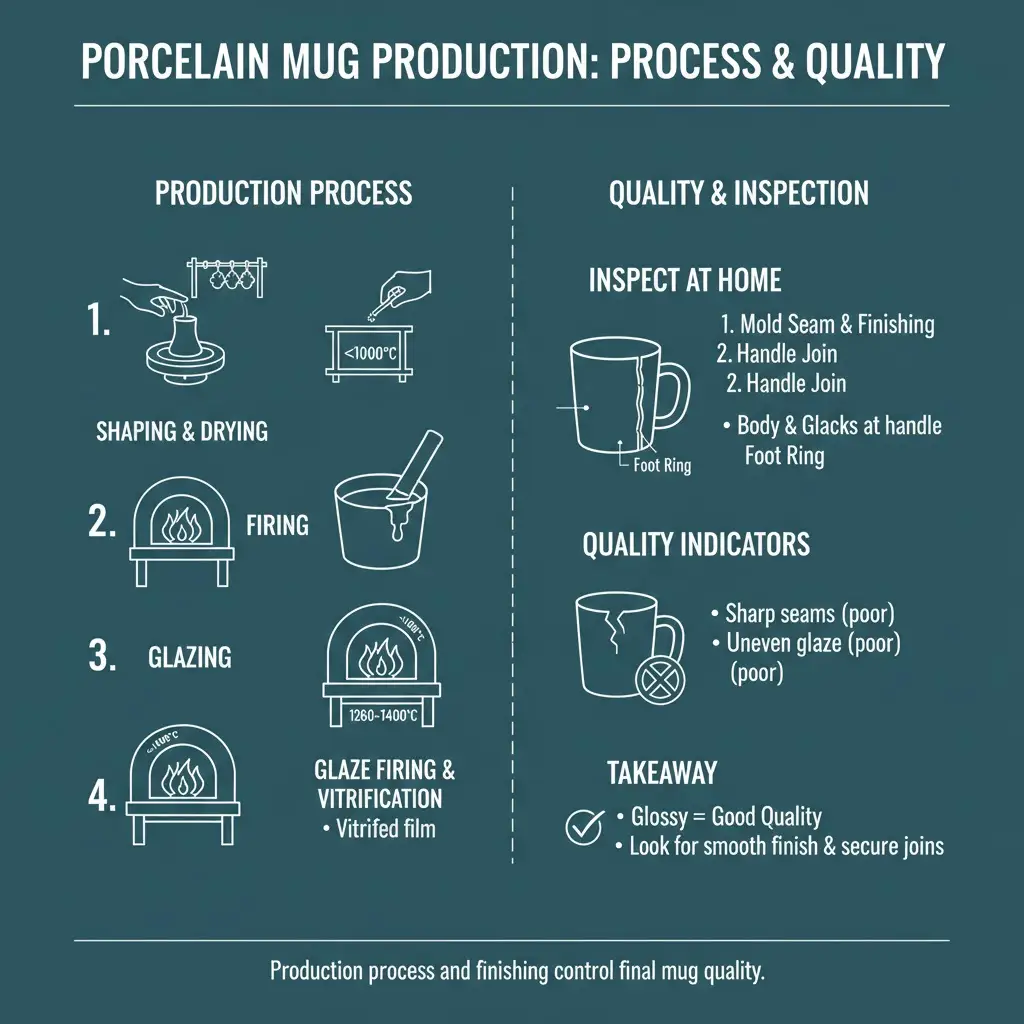
Porcelain mugs are made by shaping a controlled porcelain body, drying it, firing it to a bisque stage, glazing, and firing again until the body and glaze vitrify. A technical description of porcelain production commonly includes a first firing below 1,000°C followed by a second firing in the 1,260°C to 1,400°C range that drives vitrification and transforms the glaze into a vitrified film. (ceramique-technique.com)
Production quality shows up in three places you can inspect at home: the mold seam and finishing, the handle join, and the foot ring. A mug can look glossy and still be poor quality if the seam is sharp, the glaze is uneven at stress points, or the handle join shows micro-cracks.
How does slip-casting shape the walls and form of the mug?
Slipcasting forms a mug by pouring liquid clay “slip” into a porous mould so a wall builds up as water is drawn out. The quality signal is that slipcasting can produce thin, even walls, but only if the casting time is controlled and the piece is finished cleanly after demoulding.
There are 3 seam outcomes you can see and feel:
- Prominent seam ridge that catches a fingernail, which usually signals low finishing.
- Softened seam that can still be seen under certain light, which signals partial finishing.
- Hidden seam where the join is sponged and refined, which is typical of higher-end finishing.
Why does a porcelain mug “ring” when tapped, and what does it indicate about vitrification?
A porcelain mug “rings” because a well-vitrified ceramic body behaves more like a continuous, stiff structure, so it sustains higher-frequency vibration when tapped. The key signal is not “ring = safe,” but “ring = consistent firing and fewer internal damping defects,” especially when the sound is clear and the handle join is stable.
Shape matters: tall straight walls ring differently than wide forms, so use the sound as a clue alongside glaze quality, weight, and seam finish.
Which material properties define the performance of a porcelain mug?
A porcelain mug performs the way it does because it combines a vitrified ceramic body with a vitreous glaze that seals the surface and stabilises food contact. The tightness of that body is driven by high-fire vitrification, commonly described in the 1,260°C to 1,400°C firing range for porcelain processes.
From a user perspective, performance splits into 3 zones: mouthfeel and rim geometry, heat movement and comfort, and impact survival.
What is translucency, and what does it signal about porcelain quality?
Translucency is the property where light passes through thin sections of the ceramic wall, and it is a hallmark of well-fired porcelain in thin edges. In technical descriptions, translucency is linked to the vitrified structure created in the high-fire stage, where the body densifies and the glaze becomes a vitrified film.
Translucency is not a guarantee of durability, but it is a consistent sign that the mug was designed and fired to a porcelain maturity level rather than a coarse ceramic profile.
Are porcelain mugs heavier or lighter than other ceramic mugs?
Porcelain mugs are often lighter in the hand than stoneware mugs of the same volume because porcelain can be made thinner without collapsing, even though the fired ceramic itself is dense. The best check is simple: compare two mugs with the same capacity and look at wall thickness at the rim and body.
If a porcelain mug feels unusually heavy, it may be built thick for durability or it may have a thick base, which affects balance and heat retention.
Do porcelain mugs keep coffee hot, and do they keep drinks hotter than ceramic?
Porcelain mugs keep coffee hot by combining a sealed, low-porosity interior with a wall that is often thinner than stoneware, so the heat behaviour depends heavily on mug geometry and not just “porcelain vs ceramic.” In the practical thermodynamics, there are 2 competing factors:
- Thermal mass (thicker mugs store more heat and can slow cooling).
- Heat transfer comfort (thin walls can feel hotter faster, and a big surface area loses heat faster).
A separate but important point is taste neutrality: a vitrified glaze is designed to be a sealed barrier so the mug does not behave like an absorbent surface during use.
Why is porcelain brittle, and are porcelain mugs more fragile than stoneware?
Porcelain is brittle because like many ceramics it resists deformation, so under sudden impact it tends to crack rather than bend. That can make porcelain mugs more likely to chip at sharp edges or shatter when dropped compared with thicker stoneware, even when porcelain resists scratching well.
The most realistic durability predictor is geometry: rounded rims and thicker lips reduce edge chipping, while tall thin mugs are less forgiving of knocks.
Are porcelain mugs safe for hot drinks and food contact?
Porcelain mugs are considered food-contact drinkware when the body is vitrified and the glaze system does not release hazardous metals into the drink under standard test conditions. In the EU ceramics framework, the migration test conditions referenced in risk and compliance discussions commonly use 4% acetic acid for 24 hours at 22 ± 2°C as a food simulant contact test.
Safety questions cluster around glaze decoration, lip-area contact, and ageing defects like crazing.
Are porcelain mugs lead-free, and do they contain cadmium?
Porcelain mugs can be lead-free and cadmium-compliant, but the risk focus is usually glazes and decorative layers, especially at the lip area where repeated contact and wear occur. A 2025 peer-reviewed study measured lead and cadmium migration from new and second-hand ceramic mugs using a 4% acetic acid extraction over 24 hours at 22 ± 2°C, and it explicitly compared interior surfaces and the exterior lip area to capture realistic exposure pathways.
If you want a compliance anchor, the EU ceramics limits for fillable articles are commonly stated as Pb 4.0 mg/L and Cd 0.3 mg/L under the regulated test conditions, and those limits are reproduced in risk and regulatory summaries from German federal risk assessment documentation. (ScienceDirect)
There are 4 practical checks that reduce risk without guessing chemistry:
- Prefer mugs with a clear declaration of conformity when buying from regulated markets.
- Be cautious with brightly coloured overglaze decals at the rim.
- Avoid damaged glaze at the lip, including crazing and worn metallic trim.
- Treat unknown vintage pieces as displayware for hot acidic drinks.
Can porcelain mugs leach chemicals into drinks, and are they non-toxic?
A well-fired porcelain body with a stable glaze is designed to be chemically inert in typical beverage use, which is why it is regulated through migration testing rather than through assumptions. The key mechanism for “leaching” risk is not the porcelain minerals themselves but the glaze and decoration chemistry, plus the surface condition at the lip and interior.
Acidic drinks matter because acids increase extraction potential, which is why standards use acid simulants for fixed durations.
Are vintage or antique porcelain mugs safe to use?
Vintage porcelain mugs are riskier because older glazes and decorative systems can include lead-containing pigments, and ageing defects can increase effective surface area. German federal risk assessment guidance on ceramic crockery notes that release into food depends on factors including glaze quality, firing temperature, food type such as acidic foods, and duration of contact, and it uses the standardised 4% acetic acid, 24-hour framework when discussing testing.
For daily hot drinks, the safest handling rule is simple: keep unknown vintage pieces for display or cold, short-contact use unless you have modern compliance documentation.
Are porcelain mugs microwave-safe, dishwasher-safe, and oven-safe?
Porcelain mugs are typically compatible with microwave, dishwasher, and oven use when the mug is properly vitrified, the glaze is stable, and there is no metallic decoration, but each appliance has a different failure mode. Microwave hazards focus on metallic coatings and superheating patterns, dishwashers stress the glaze through heat and detergent chemistry, and ovens stress the mug through thermal gradients.
A reliable usage approach is to treat “safe” as a combination of material, decoration, and temperature-change rate rather than as a single label.
Can you microwave porcelain mugs, and why do some get very hot in the microwave?
Porcelain mugs can be microwaved when they have no metallic trim and the body and glaze are stable, but some mugs become dangerously hot because metallic coatings and certain decorative systems can heat unevenly and hold heat at the handle or rim. A 2024 burns-paper on “microwaved drinkware” reported a rise in contact burns linked to metallic-coated drinkware, and highlighted that metallic coating can produce higher temperatures and prolonged heat retention in coated parts such as handles after microwave heating.
There are 3 safety checks that directly prevent this failure mode:
- Do not microwave mugs with gold, silver, or metallic trim or metallic-coated handles.
- If a mug heats faster than the drink, stop using it for microwaving because it indicates a material or decoration interaction risk.
- After heating, let the mug stand briefly and handle it by cooler areas to reduce contact burn risk.

Are porcelain mugs dishwasher-safe, and can they be sublimated on?
Porcelain mugs are usually dishwasher-safe when the glaze is well matured and the decoration is underglaze or properly protected, but harsh cycles and high-heat drying accelerate wear on low-quality decals. If the decoration sits over the glaze as a decal layer, abrasion and detergent chemistry can dull it faster than the porcelain body itself.
Sublimation printing on porcelain mugs requires a special coating designed to accept sublimation dyes, so “porcelain” alone does not guarantee sublimation compatibility.
Can you put porcelain mugs in the oven, and can you bake in them?
Porcelain mugs can tolerate oven heat when they are designed for it, but the limiting factor is usually thermal shock, not peak temperature. A mug can survive hot air in an oven and still crack if it is moved from cold to hot quickly, or if it is set on a cold surface after heating.
If baking in a mug, the safer pattern is gradual preheating and avoiding contact with cold water, cold counters, or frozen fillings.
Are porcelain mugs freezer-safe, and can they go from the freezer to the microwave?
Porcelain mugs can be freezer-safe in the sense that the ceramic will tolerate cold, but moving directly from freezer to microwave is a high-risk thermal shock path. The technical reason is that sudden temperature gradients strain the body and glaze system, and a mismatch in expansion response increases crack initiation at defects and at the handle join.
There are 3 safer transition rules that preserve mugs:
- Move freezer mug to fridge first, then to room temperature before heating.
- Pre-warm with warm water before adding boiling liquid.
- Avoid heating a mug that already shows crazing, chips, or a damaged foot ring.
What causes damage, and how do you prevent cracking or chipping?
Porcelain mugs are damaged mainly by impact, thermal shock, and glaze-body mismatch defects that grow over time. Prevention is practical and behaviour-based: reduce edge knocks, avoid extreme temperature jumps, and treat the mug’s rim and handle join as the highest-stress zones.
A mug can look intact while micro-cracks grow at the handle join, so daily handling and storage are a real part of “material performance.”
Do porcelain mugs crack with boiling water?
Porcelain mugs can crack with boiling water when the mug is cold and the temperature change is abrupt, because thermal shock concentrates stress at defects and geometry transitions. The most effective prevention is pre-warming, not “lowering the kettle temperature.”
There are 3 pre-warm methods that work without special tools:
- Rinse the mug with warm tap water for 10–20 seconds.
- Fill with warm water and let it sit briefly, then empty.
- Avoid placing a hot mug on a cold stone bench or under cold water immediately after use.
Do porcelain mugs chip easily, and what does “chip-resistant” mean?
Porcelain mugs chip mainly at the rim and foot ring because those are exposed edges that take knocks. “Chip-resistant” is mostly a design claim, not a magic material claim, and it usually means the rim and corners are rounded and protected rather than sharp.
There are 3 design cues that reduce chipping:
- Rounded rim profile and a slightly thicker lip.
- Stable foot ring that does not create a knife-edge.
- Handles joined with smooth transitions rather than sharp fillets.
What causes crazing, and is a crazed porcelain mug safe?
Crazing is a network of fine glaze cracks caused by a mismatch between how the glaze and ceramic body expand and contract during cooling and later temperature cycling. Crazing can make staining worse because the cracks trap residues, and it can turn cleaning into a permanent struggle.
For food safety, the practical concern is that micro-cracks make sanitation harder, so a crazed mug should be treated as higher-risk for daily use, especially for milk-based drinks.
How do you clean porcelain mugs and remove stubborn stains?
Porcelain mugs stain when tannins and oils bind to micro-texture on the glaze and settle into tiny surface defects, especially if the glaze is worn or crazed. Cleaning is usually easy because porcelain is sealed, but aggressive cleaning can scratch the glaze and create a permanent stain trap.
The best approach is to remove stains early and avoid tools that damage the glaze surface.
How do you clean porcelain mugs without scratching the glaze?
Safe cleaning means using mild abrasives and soft tools that remove deposits without cutting the glaze. There are 4 cleaning steps that remove tea and coffee stains while protecting the glaze:
- Soak with warm water and dish soap to soften oils.
- Use a paste of baking soda and water with a soft sponge for stain lift.
- Rinse with hot water to remove residues from the glaze pores and corners.
- Fully air-dry, especially around the handle join and foot ring area.
Avoid metal scourers because once the glaze is scratched, stains become easier to form and harder to remove.
Which design features affect ergonomics and daily usability?
Porcelain mug usability is driven by handle geometry, balance, rim shape, and base design because porcelain allows thin walls and crisp edges that change grip and drinking feel. The mug’s design controls how it sits in the hand, how it delivers liquid to the palate, and how stable it is on a table.
A “good porcelain mug” is usually the one where the geometry matches your drink volume and your grip style.
What is a foot ring, and how does it affect table contact?
A foot ring is the raised base ring that stabilises the mug and provides a firing surface where the piece can be supported, which is why the bottom edge is often unglazed or minimally glazed. A well-finished foot ring is smooth and reduces scratching of tables, while a rough foot ring acts like sandpaper.
If you want a quick quality check, slide the mug gently on a surface and feel for grit or sharpness at the base edge.
How do the lip, radius, and rim thickness change the drinking experience?
Rim thickness and radius change flow control and how heat is sensed at the lips because the rim is the interface between mug and mouth. Thin tapered rims usually feel cleaner and give better control, while thick rims are more robust but can feel blunt and hold more heat at the edge.
A practical rule is to choose thin rims for black coffee and tea where lip feel matters most, and choose thicker rims for high-knock environments like offices and shared kitchens.
What size porcelain mug is best for coffee, tea, or lattes?
The best size depends on beverage volume and cooling rate, and mug geometry controls both. There are 3 common volume bands that map to daily drinks:
- 8 oz (about 240 mL) for espresso-based long blacks and smaller teas.
- 12 oz (about 355 mL) for standard coffee and milk drinks.
- 16 oz (about 475 mL) for large lattes and long milk drinks.
Wider openings cool faster, so if heat retention matters, a narrower mouth and a lid do more than the “porcelain vs ceramic” label.
What does “stackable” mean for mug geometry and storage?
Stackable mugs are designed with a recessed foot or a stacking ridge that allows one mug to nest into another without rocking. The practical stability check is that the stack sits straight and does not wobble, which depends on consistent rim roundness and foot-ring symmetry.
Porcelain’s thinner walls can make stacking more space-efficient, but it also means contact points should be smooth to avoid edge chipping in storage.
Are double-walled porcelain mugs worth it?
Double-walled porcelain mugs add an air gap that reduces heat transfer to the hand and can slow cooling, which is why they feel cooler outside. The trade-off is that the construction can be more fragile, especially at the rim joins and base, and the mug often loses the “hand-warming” feel some people like.
If you want insulation without fragility, a lid and a smaller mouth opening often deliver a larger practical temperature benefit than double walls.
What should you look for when buying a porcelain mug for long-term satisfaction?
A porcelain mug worth keeping is one where the body is well-vitrified, the glaze is stable, and the design matches how you drink and wash it. Buying decisions should be made with a checklist, because many “porcelain-looking” mugs are actually other ceramics with bright glazes. When comparing porcelain mugs for daily use, prioritise a well-vitrified body, stable glaze, smooth foot ring, comfortable handle geometry, and decoration that matches your microwave and dishwasher habits.
There are 6 buying checks that predict long-term satisfaction:
- No metallic trim if you want microwave use.
- Smooth foot ring that will not scratch surfaces.
- Even glaze at rim and handle join, with no rough patches.
- Comfortable handle geometry that supports your grip style.
- Rim thickness that matches your drink preference.
- Compliance signals when available, especially if the mug is heavily decorated.
Are porcelain mugs environmentally friendly compared with plastic or stainless steel?
Porcelain mugs are environmentally favourable mainly because they are reusable and can last for years, while single-use and short-life plastics create recurring waste. The sustainability trade-off is that ceramics are energy-intensive to fire, but the practical consumer lever is longevity: a mug that lasts avoids repeated replacement.
If you want a simple sustainability rule, buy one well-made mug you will keep, and avoid fragile decorative finishes that shorten service life.
How does the porcelain mug fit into your drinking vessel network?
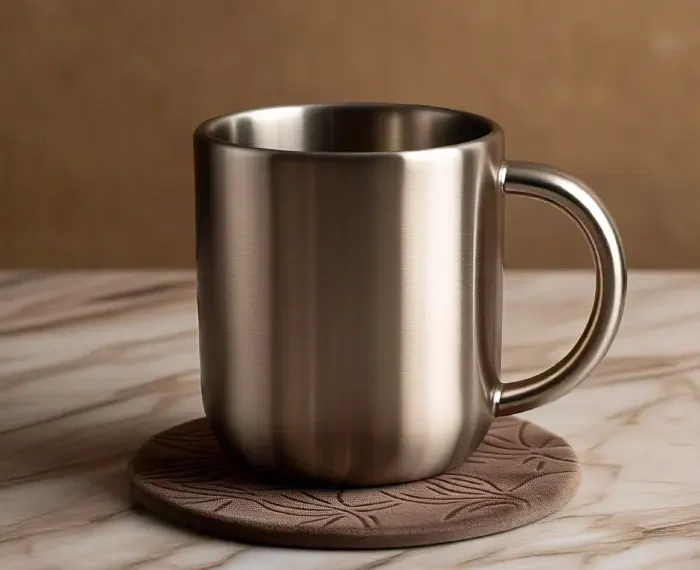
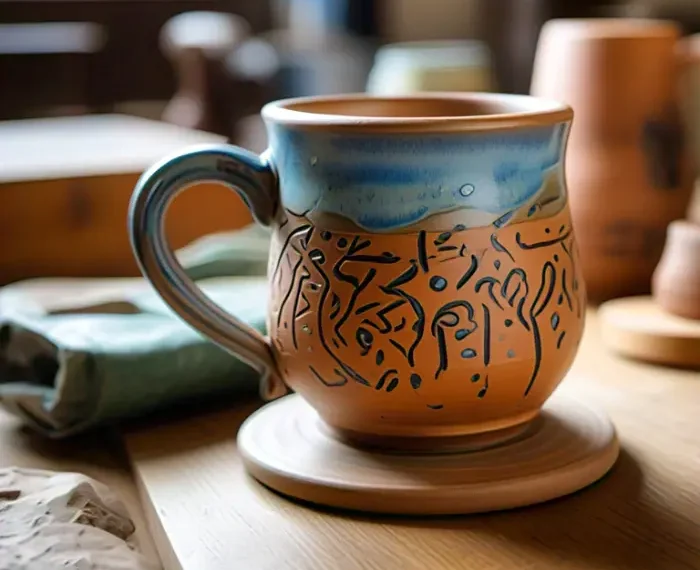
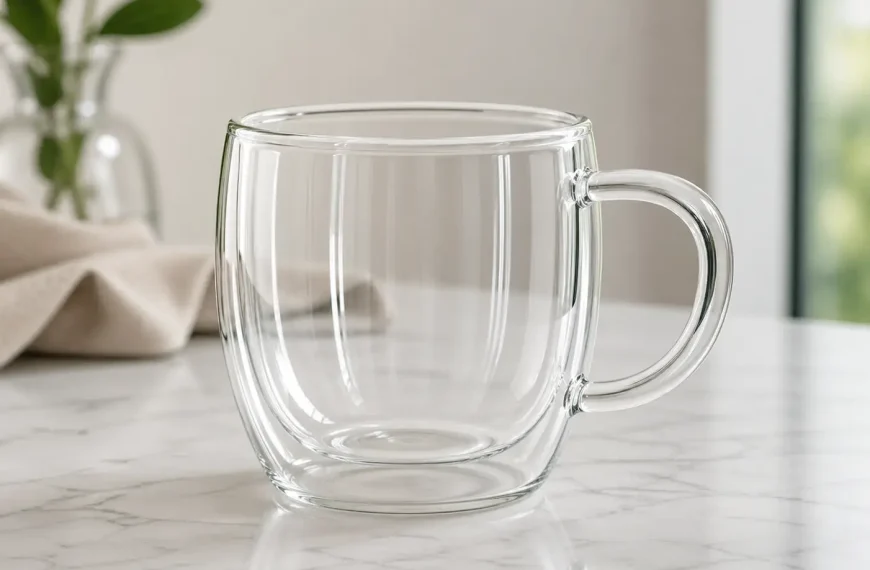
A porcelain mug sits in the mugs network as a high-density ceramic option that prioritises a sealed interior, refined rim geometry, and broad kitchen compatibility when decoration is microwave-safe. In a material navigation sense, porcelain typically competes with glass mugs for neutrality and visual clarity, and with stoneware mugs for warmth and impact tolerance.
Choosing between them becomes a performance decision: porcelain for refined mouthfeel and sealed surfaces, stoneware for rugged thickness, and glass for transparency and non-porous behaviour.
How do cup colour, texture, and weight change the perceived taste of coffee and tea?
Cup design can change perceived flavour even when the drink is identical, because the drinking vessel provides sensory cues that shape expectations and evaluation. A peer-reviewed 2019 review of coffee receptacle effects summarised evidence that colour, shape, texture, and weight of a cup can influence perception, including findings that cup colour can prime sweetness or acidity expectations..
What do studies suggest about cup colour and contrast effects on perceived sweetness, bitterness, and intensity?
Cup colour can shift what people expect before tasting, and those expectations can carry into the tasting ratings. The coffee receptacle review literature includes repeated examples where colour cues such as pink or warm tones can prime sweetness, while yellow or green cues can prime acidity expectations in coffee perception experiments.
If you are selecting porcelain, the practical application is that glossy white tends to act as a neutral visual baseline, while coloured glazes can bias how sweetness and acidity are perceived.
How do surface texture and cup weight influence flavour judgments and “quality” perception even when the drink is identical?
Cup texture can change perceived flavour and mouthfeel because touch cues interact with taste evaluation. A controlled study on specialty coffee cups tested smooth vs rough cup textures with 231 participants and found that surface texture affected flavour perception and tactile judgments during evaluation.
Weight also acts as a cue in servingware research, so heavy, thick mugs can feel “premium” even when they are not better thermally, while thin porcelain can feel “delicate” even when it is structurally sound. (Oxford University Research Archive)
Practical takeaways for porcelain selection: glossy vs matte finishes, shape, and weight cues without changing the brew chemistry.
Glossy porcelain interiors usually clean easier than matte interiors because matte surfaces hold more micro-texture and can stain faster. There are 3 selection moves that improve daily experience without touching the brew:
- Choose a glossy interior glaze if you drink tea or black coffee and care about stain resistance.
- Choose a rim profile that matches your preferred sip flow, thin for clean lip feel and thicker for robustness.
- Choose a weight and wall thickness that matches how you hold the mug, lighter for long holds and heavier for stable desk use.
The porcelain mug decision that holds up after 100 cups
A porcelain mug that stays satisfying is the one that keeps its glaze intact, stays easy to clean, and matches your appliance habits and grip. If microwave use is important, avoid metallic trim and treat unusual handle heating as a safety signal tied to documented burn risk from metallic-coated drinkware.
If safety is the priority, buy from sellers who can provide conformity documentation and avoid heavily decorated rims unless they have clear compliance backing under regulated migration test conditions.
If taste experience matters, treat cup geometry and surface feel as part of the sensory system, because cup colour and texture have published effects on perception even when the coffee is unchanged. By cross-referencing these sensory factors with material safety data, you ensure your selection meets the high standards required of all professional mugs.