
Glass mugs serve as non-porous, transparent drinking vessels designed to show liquid clarity, colour, and layering while still managing heat transfer well enough for hot beverages. In practice, performance splits sharply by base glass type: high-performance mugs are typically built around borosilicate glass (an engineering borosilicate standard), where a low linear thermal expansion value around 3.25 × 10⁻⁶ K⁻¹ (20–300 °C) is documented for SCHOTT’s borosilicate glass family (BOROFLOAT® 33), alongside thermal conductivity around 1.2 W/(m·K). By contrast, common soda-lime container glass is commonly reported around ~9 ppm/K thermal expansion, which mechanically increases thermal-stress risk under the same temperature gradients. (Wikipedia)
That material choice then dictates the structural options that matter most in daily use: double-walled construction reduces outward heat flow by inserting a low-conductivity gas layer (dry air is reported at about 26.06 mW/(m·K) at 25 °C), which is orders of magnitude lower than glass, and this is why double-wall designs can keep the outer surface cooler while slowing heat loss. Heat safety follows the same physics: sudden ΔT shifts concentrate stress at flaws and stress points, which is why thermal-shock behaviour is treated as a primary failure mode for glassware. Long-term maintenance also has measurable limits: controlled dishwashing research reports surface clouding/etching on glassware appearing after roughly ~1000 washing cycles under machine-dishwashing conditions.
This intersection of optical clarity and thermodynamic stability represents a specialized branch of our material-based mug types index, where the invisibility of the material is its most complex technical feat. The safety and performance of any glass mug are dictated entirely by its base material, which forces the first question: what types of glass are used to make glass mugs?
What types of glass are used to make glass mugs?
Glass mugs are made from a small set of base glass families, and the base chemistry largely controls thermal shock risk, heat resistance, and long-term surface durability. In practice, the main split is between borosilicate (engineered for low thermal expansion), soda-lime (common container glass), and processed variants such as tempered or strengthened forms that start from a base glass and then change stress profiles through treatment.
What is borosilicate glass?
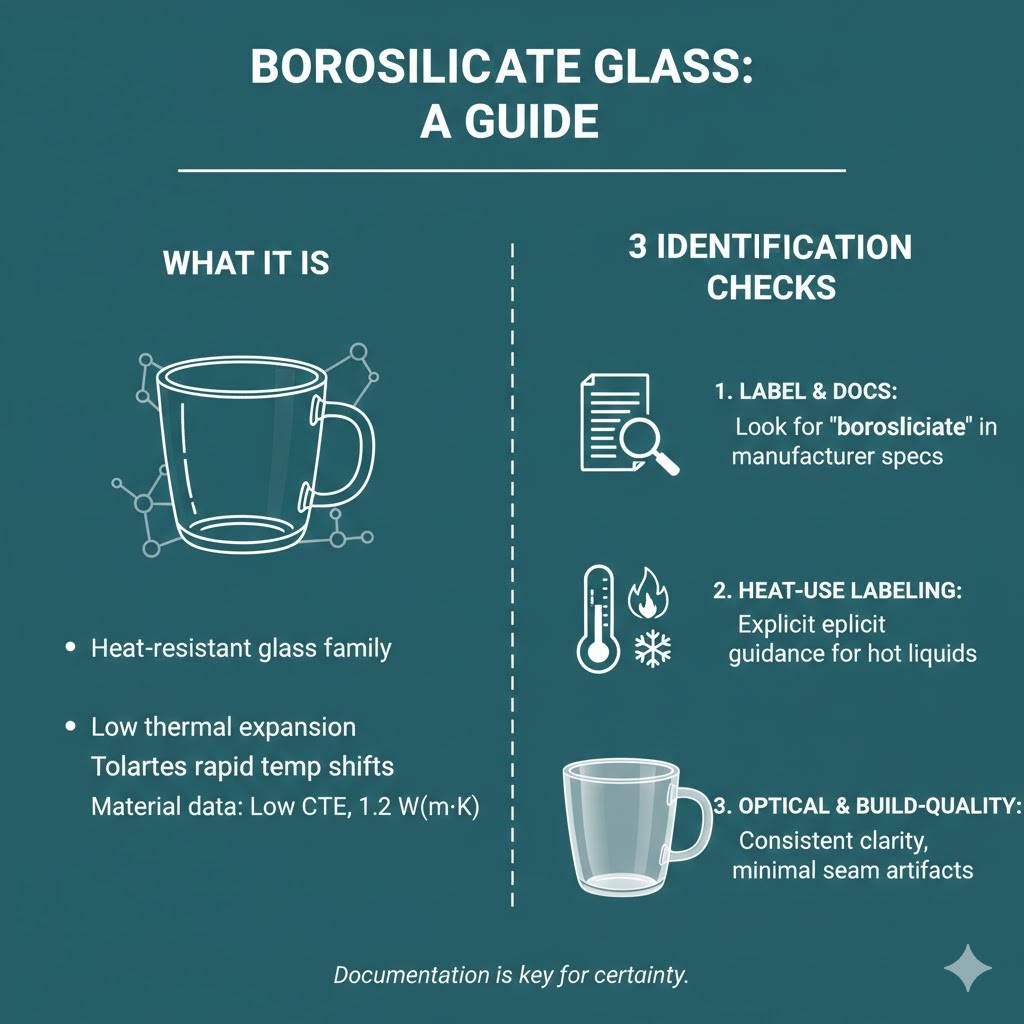
Borosilicate glass is the heat-resistant glass family used for many higher-performance hot-drink mugs because its thermal expansion is low enough to reduce thermal-stress buildup during rapid temperature shifts. SCHOTT’s borosilicate technical data for BOROFLOAT® 33 reports a coefficient of linear thermal expansion of 3.25 × 10⁻⁶ K⁻¹ (20–300 °C) and thermal conductivity of 1.2 W/(m·K) (90 °C), which are material-level reasons it tolerates hot beverages better than ordinary container glass.
There are 3 practical checks people use to identify borosilicate in real products:
- Label and documentation check: look for “borosilicate” in the manufacturer’s specs or datasheet, not just marketing text.
- Heat-use labeling check: products intended for hot liquids usually state heat-use guidance and thermal limits more explicitly than cold-only drinkware.
- Optical and build-quality check: consistent clarity and minimal seam artifacts are more common in higher-quality production, but this is not a chemical proof and should not override documentation.
Is tempered glass stronger than regular glass for mugs?
Tempered glass is stronger in impact and thermal stress handling than annealed glass because it is manufactured to hold compressive stress at the surface, which suppresses crack initiation from small surface flaws. When it fails, tempered glass tends to fragment into many smaller “dice-like” pieces, while annealed glass more often breaks into sharper, larger shards, which is why tempering is widely used when a safer break pattern is desired. The tradeoff is that deep scratches, edge chips, and point impacts can still trigger sudden failure because glass remains a brittle material with low tolerance for defect growth.
What is the difference between annealed and strengthened glass?
Annealed glass is the baseline state produced by controlled cooling to reduce internal stress, and it is the starting point for much commercial glassware. Strengthened glass is annealed glass that has undergone a secondary process, usually thermal or chemical strengthening, to change its stress profile and improve resistance to impact and certain thermal stresses. In mug terms, annealing is about stability and predictability, while strengthening is about raising the failure threshold without changing the fact that the material still fails in a brittle way.
What is soda-lime glass in glass mugs?
Soda-lime glass is the most common and cost-effective glass used for everyday containers and many cold-drink mugs. Its higher thermal expansion, commonly cited around ~9 × 10⁻⁶ K⁻¹, makes it more vulnerable to thermal shock when exposed to rapid temperature gradients than low-expansion borosilicate families.
That is why soda-lime is often found in beer mugs and steins designed for cold drinks, where the main loads are impact and handling rather than boiling-water temperature jumps.
How do glass thickness and construction affect strength and feel?
Thickness and geometry determine how a glass mug carries load at the rim, handle junction, and base, which are the parts most likely to chip, crack, or concentrate stress. A glass mug is typically defined by 4 structural zones: rim, wall, handle attachment, and base, and each zone can be engineered thicker or thinner to tune durability, weight, and drinking comfort.
What is glass thickness and what does it determine?
Wall thickness determines both mechanical robustness and heat flow rate, because thicker walls resist bending and can tolerate more abuse but also increase mass and change heat transfer behavior. There are 2 common use profiles that push thickness choices in opposite directions:
- Delicate visual profile: thinner walls emphasize clarity and reduce weight, but reduce damage tolerance.
- Commercial durability profile: thicker walls improve chip tolerance and handling resilience, but add mass and a heavier feel.
In physical terms, thicker sections also create larger temperature gradients across the wall during hot fills, so thickness is not automatically “safer” for thermal shock if the mug is exposed to abrupt ΔT.
What is rim thickness and how does it affect comfort and durability?
Rim geometry controls “lip feel” and chip resistance because it is the most frequently impacted edge during use and washing. A rolled rim generally improves edge durability by reducing sharp corners and distributing stress, while a cut rim can feel precise but can be more vulnerable to edge chipping if not finished well. If a mug is used daily, rim integrity matters because small rim chips are not just cosmetic, they are defect starters that can grow into cracks.
How does weight affect balance and daily usability?
Weight affects stability because it shifts the center of gravity and changes how the mug tips when filled. A heavier base improves stability on a countertop but increases wrist load during long holds, while a lighter mug feels agile but can feel top-heavy when filled if the handle and wall geometry are not balanced. In practice, balance is better judged by how the mug behaves when filled near its typical capacity, not when empty.
What is a double-walled glass mug and is it worth it?
A double-walled glass mug is built from two layers of glass separated by an air gap, creating a thermal barrier that reduces outward heat flow and lowers the external surface temperature during hot use. The practical value comes from reducing conductive heat transfer through the wall because air’s thermal conductivity is about 26.06 mW/(m·K) at 25 °C, which is far lower than glass.
That insulation logic also reduces condensation on cold drinks because the outer wall stays closer to room temperature. (NIST)
What does “double-walled” mean on a glass mug?
“Double-walled” means the liquid is held by an inner glass chamber that is separated from the outer wall by a sealed gap, often visible as a small hand-blown “plug” at the bottom. The structure creates the “suspended liquid” look because the outer wall forms a clear shell around the inner vessel. The failure mode is also structural, because the inner wall is thinner and more vulnerable to point impacts than the outer wall.
Do double-walled glass mugs keep drinks hotter longer?
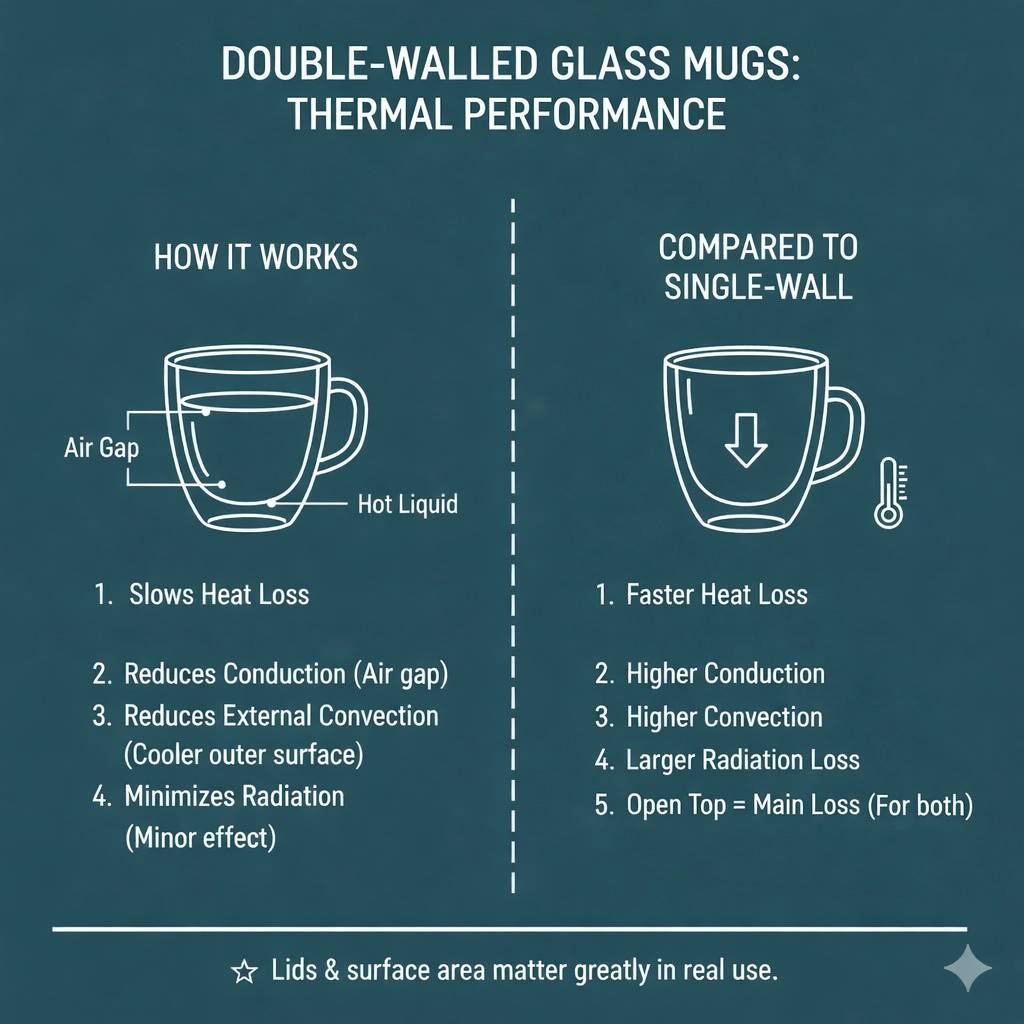
Double-walled mugs slow heat loss because they reduce conduction through the wall and reduce convective heat transfer at the external surface by keeping the outside cooler. There are 3 heat-loss channels that a double wall can reduce compared with single-wall glass:
- Conduction through the wall: limited by the air gap’s low thermal conductivity.
- External convection: lower outer-surface temperature reduces heat flux to room air.
- External radiation: slightly reduced when outer wall remains cooler, though radiation is usually a smaller term than convection for a mug in air.
The largest remaining heat loss for hot drinks is often the open top surface, so lids and surface area matter as much as wall design in real use.
Are double-walled glass mugs microwave safe?
Microwave safety depends on manufacturer rating because microwaves heat unevenly and can create localized hot spots that stress the inner wall. The highest risk scenario is a cold mug taken straight into a microwave with a small volume of liquid, where the inner wall heats faster than the outer wall and stress concentrates at defects. If a brand explicitly rates a specific mug as microwave safe, that rating should also be read alongside warnings about sudden temperature shifts and handling after heating.
Why is there water or fog trapped between the walls of my double-walled glass mug?
Fog or water between walls indicates a seal failure or a defect in the breather area that has allowed moisture ingress. Once moisture enters the cavity, the thermal performance drops because the gap no longer behaves like a stable insulating layer, and repeated heating cycles can drive expansion and contraction that worsens the seal defect. The practical endpoint is that the mug can no longer be treated as a stable insulated vessel.
Do double-walled glass mugs crack or lose their seal over time?
Seal longevity is limited by mechanical shocks that the inner wall experiences, especially tapping, stirring with hard metal, or knocking the mug during washing. The inner chamber is usually thinner than the outer shell, so it reaches critical stress from point impacts sooner than users expect, even when the outside looks intact. If the inner wall cracks, the mug can lose insulation function even before it fully fails as a container.
How heat-resistant are glass mugs for hot coffee and tea?
Heat resistance is the ability to tolerate both high temperatures and rapid temperature change without cracking, and the deciding variable is the size of the temperature gradient (ΔT) combined with defect location and wall geometry. Real-world safety depends less on “hot coffee” as a concept and more on how abruptly the mug is forced from one temperature state to another.
Can you put boiling water in a glass mug?
Pouring boiling water is safe only when the mug is engineered for hot use and is not cold at the moment of fill, because the most dangerous case is a hot liquid contacting a cold wall that cannot expand uniformly. There are 4 practical steps that reduce failure risk during boiling-water pours:
- Start from room temperature: avoid taking the mug from a refrigerator or cold tap rinse straight into a boil pour.
- Pre-warm with warm water: raise the wall temperature gradually before a boiling fill.
- Pour down the side: reduce localized stress by avoiding a single hot jet hitting one spot.
- Avoid hard contact during the first minute: do not stir aggressively against the wall while expansion is still occurring.
Why did my glass mug crack when I poured hot water into it?
Cracking occurs when thermal expansion creates tensile stress at a defect faster than the glass can redistribute stress, and the crack then propagates because glass does not plastically deform to blunt the crack tip. A thermal-shock study on 3 mm soda-lime glass used a hot-cold technique with hot temperatures spanning 100 °C to 550 °C and a cooling air jet at 20 °C, reporting a heat transfer coefficient of about 600 W/(°C·m²) over a 6 second shock period, which shows how quickly real gradients can be imposed in controlled testing.
In a kitchen, the equivalent trigger is a cold mug, a hot pour, and a stress point such as a scratch, chip, or sharp thickness transition near the base or handle.
What is thermal shock, and how does it break glass mugs?
Thermal shock is fracture caused by rapid temperature change that creates internal stress because different parts of the glass expand at different rates. In controlled machine-dishwashing research on glass cups, clouding and other surface damage modes were observed after repeated cycles, including clouding that appeared after about 1000 washing cycles, and the authors describe water and detergents acting as weak etchants that progressively damage the glass “skin.”
That surface damage matters for thermal shock because etched surfaces and micro-scratches increase the density of stress-raising defects that can turn a high ΔT event into a crack initiation event.
Can you put a cold glass mug straight into the microwave?
Putting a cold glass mug straight into the microwave is unsafe because microwaves heat unevenly, creating localized thermal gradients that concentrate stress at defects. The risk is highest when the mug is cold and the liquid volume is small, because the glass can heat in patches rather than uniformly. A safer pattern is to start from room temperature, use sufficient liquid volume, and avoid aggressive heating steps that create sudden ΔT within the wall.
Can you use a glass mug on the stovetop or in the oven?
Most glass mugs are not stovetop safe because direct flame or contact with an electric coil creates extreme localized heating and steep gradients that exceed typical glassware design conditions. Oven safety is also label-dependent because an oven imposes slower heating but still exposes the mug to large absolute temperatures and handling shocks when removed. If a mug is not explicitly rated for direct-heat use, it should be treated as a countertop vessel only.
Are glass mugs safe for daily use and kids?
Daily safety depends on brittleness management and on whether the mug has damage, decorative coatings, or accessory components that add risk. Glass is chemically inert as a material for taste and staining, but it is mechanically unforgiving when dropped or chipped.
Are glass mugs more fragile than ceramic mugs?
Glass is more brittle in failure behavior, while ceramic risk is more connected to porosity, glaze integrity, and chipping behavior. Glass tends to fail suddenly once a crack starts, while ceramic can survive minor edge damage longer depending on glaze and body composition. The practical safety choice is driven by environment, because a tile floor, sink edge, or crowded dishwasher raises impact risk regardless of material.
Can glass mugs contain lead or cadmium?
Lead and cadmium risk in glass mugs is primarily linked to decorated surfaces, enamels, or decals rather than the clear glass substrate itself. A market monitoring study in Poland tested 1273 samples of ceramics and glassware collected across 2010–2012 using 4% acetic acid for 24 hours at 22 ± 2 °C, reporting that lead and cadmium release was usually below analytical detection limits and that permissible limits were rarely exceeded, with exceedances mainly reported in items imported from outside the EU.
This is why food-contact confidence comes from compliance testing and documentation, not from visual appearance, especially when the decoration is on a drinking rim or interior contact surface.
What does BPA free mean in the context of glass mugs and parts?
Glass is inherently BPA-free because BPA is a plastic-related chemical issue, but many glass mug systems include plastic lids, silicone sleeves, or gasketed seals that are separate food-contact components. There are 3 checks that reduce confusion with “BPA free” claims:
- Identify which component is plastic: lid, slider, straw, sleeve insert, or seal.
- Check component-level compliance statements: the mug body being glass is not the same as the lid system being compliant.
- Avoid heat exposure for unknown plastics: do not microwave or pour boiling liquids through plastic parts unless rated.
What are the risks of brittleness and brittle failure in glass?
Brittle failure is sudden breakage without plastic deformation, which means defects control lifespan more than gradual bending or denting. Micro-scratches from abrasive cleaning, edge chips, and impact points at the handle junction act as stress concentrators that shorten the margin against both impact and thermal shock. The safest handling pattern is defect prevention, because once a defect exists the failure threshold can drop sharply.
Are glass mugs safe if they have a chip or hairline crack?
A chipped or hairline-cracked glass mug is not safe for continued use because the crack can grow with heat cycles and the chip edge can cut the user. The damaged region also traps residues and becomes harder to clean reliably, which is a hygiene problem even if the mug does not fail immediately. The correct action is replacement, not repair for food-contact use.
Are glass mugs dishwasher safe and easy to clean?
Glass mugs are easy to clean because glass is non-porous and does not absorb coffee oils the way some porous materials can, but dishwasher exposure can still change the surface over time. “Dishwasher safe” is not the same as “immune to alkaline etching,” especially with high-alkaline detergents and long cycles.
What does “dishwasher safe” really mean for a glass mug?
“Dishwasher safe” means the mug is expected to survive typical dishwashing conditions without immediate failure, not that the surface will remain unchanged forever. A machine-dishwashing study of glass cups reported that one common damage mode, surface clouding on inner and outer surfaces, appeared after about 1000 washing cycles, and the mechanism was described as weak etching by water and detergents that erodes the smooth surface and reveals granular structure that scatters light.
This supports a practical definition: the mug can remain functional while clarity and surface feel slowly degrade under harsh long-term wash conditions. (ResearchGate)
Do glass mugs stain from coffee or tea?
Glass resists staining because it is non-porous and does not bind oils into a matrix the way porous surfaces can. The most common “stain” users see on clear glass is actually mineral scale from hard water, which appears as haze or spots rather than brown coffee staining. The simplest differentiation is that coffee staining is usually patchy and brown, while mineral deposits are often whitish or rainbow-like films.
How do you remove coffee or tea stains from a glass mug without scratching it?
Removing stains without scratching requires non-abrasive chemistry, not aggressive abrasion, because scratches add defect sites that weaken glass. There are 3 safe cleaning approaches that avoid steel wool and minimize micro-scratch risk:
- Warm water plus dish soap with dwell time: let the surfactant work before scrubbing.
- Vinegar soak for mineral films: dissolve scale rather than grinding it off.
- Baking soda paste with a soft cloth: use light pressure and rinse thoroughly, keeping the abrasive action minimal.
Do glass mugs hold onto odors or flavors?
Glass does not retain odors easily because it is non-porous and chemically inert in the way it interacts with most beverage compounds. This is one reason glass is commonly used when clean sensory evaluation is required, because it does not add metallic notes and does not hold prior aromas the way some plastics can. If odors persist, the cause is usually residue trapped in non-glass parts such as lids, gaskets, or sleeves.
What sizes and shapes of glass mugs should you buy?
Choosing a glass mug size and shape is a capacity and stability decision tied to beverage type and heat handling, not just aesthetics. The best fit comes from matching volume, wall geometry, and grip design to how the beverage is prepared and how long it stays in the mug.
What is a glass beer mug called (What is a glass stein)?
A glass beer mug is commonly called a stein or a tankard, and the design often uses thicker walls for durability in handling and cold-drink service. Many beer mugs include dimples or textured surfaces that can add grip and can also change how the wall distributes stress under impact. The typical use case is cold beverages, where thermal shock is less central than impact resistance and handling robustness.
What is the difference between a latte mug and an espresso glass?
A latte mug or latte glass is tall to support visual layering, foam presentation, and higher beverage volumes, while an espresso glass is small and designed for short volume service. The primary functional difference is capacity and geometry, because a taller vessel increases surface area and changes cooling behavior, while a small espresso glass limits heat-loss time simply by being consumed quickly. The clearer the vessel, the more it emphasizes layering and clarity, which is a main functional reason people choose glass for espresso-based drinks.
How do you judge quality when buying glass mugs?
Quality is judged by material disclosure, consistency of construction, and how well the product aligns with recognized test frameworks for thermal shock and heavy-metal release control. For glass mugs, the highest-value signals are the ones that reduce uncertainty about thermal safety and food-contact compliance.
What do ASTM and ISO standards mean for glassware?
Standards indicate there is a defined method to measure a defined risk, rather than a marketing claim. ASTM describes C149 as a test method intended to determine relative thermal shock resistance of glass containers using controlled transfer between hot and cold baths, which directly relates to real service shocks like washing and temperature changes.
ISO 7086-1 specifies a test method for release of lead and cadmium from glass hollowware intended for food contact, which matters most when decoration or coatings could introduce heavy-metal migration risk. (ISO)
How can you judge quality and consistency by brand?
Quality by brand is judged by consistency indicators that reflect process control rather than style. There are 3 physical signs that often correlate with tighter manufacturing control:
- Minimal mold lines and seam visibility: prominent seams can indicate lower finishing quality.
- Clarity with low optical distortion: distortion can indicate uneven thickness or forming issues.
- Low bubble and inclusion rate: visible bubbles and inclusions can be defect starters under thermal or impact stress.
Brand-level consistency also shows up in whether replacement parts exist for lids, sleeves, or gaskets, because that reflects a planned product lifecycle rather than a one-off item.
What should you look for in user reviews, packaging, and replacement policies?
Packaging and policy matter because shipping damage is a dominant failure mode for glass. There are 4 review and purchase signals that reduce risk:
- Arrival condition reporting: repeated “arrived chipped” reviews are a logistics warning.
- Protective packaging details: molded inserts and double boxing reduce breakage probability.
- Clear replacement policy: explicit “arrival guarantee” language reduces downside if the mug arrives damaged.
- Usage-specific feedback: reviews that mention boiling pours, microwave use, and dishwasher cycles are more predictive than aesthetic-only comments.
Are glass mugs available in bulk or sets?
Glass mugs are widely sold in sets because uniformity matters for home use and for cafes that want consistent presentation. Bulk purchasing usually trades unit price down for a higher reliance on packaging integrity and replacement policy. For commercial use, the stability and rim durability signals matter more than decorative variation because high handling volume amplifies defect accumulation.
How do glass mugs compare to other drinking vessels?
Glass mugs compare best when the comparison is framed around thermal behavior, taste neutrality, condensation behavior, and end-of-life handling. The core tradeoff is that glass is taste-inert and visually transparent but mechanically brittle, so it rewards careful handling and punishes damage.
Do glass mugs keep coffee hot as long as ceramic mugs?
Single-wall glass loses heat faster than insulated designs because it does not provide the same thermal mass and insulation effect as many thick ceramic mugs, while double-wall glass reduces heat loss by inserting a low-conductivity layer. The physics is straightforward because air’s thermal conductivity is about 26.06 mW/(m·K) at 25 °C, which is far lower than glass, so an air gap acts as insulation. (NIST)
Pre-warming matters for both glass and ceramic because it reduces the initial heat sink effect, improving early temperature retention for the beverage.
Do glass mugs change the taste of coffee compared to ceramic mugs?
Glass is taste-neutral in the sense that it is a non-porous, chemically stable surface for beverage contact, so it does not retain prior flavors the way porous or polymeric surfaces can. Ceramic can also be neutral when properly glazed, but flavor carryover becomes more likely when the glaze is worn, cracked, or porous. The practical taste advantage of glass is strongest when the user rotates between different beverages and wants minimal carryover.
Do glass mugs sweat or condense on the outside with cold drinks?
Single-wall glass sweats because the outer surface cools below the dew point and water condenses from air onto the surface. Double-wall glass reduces external condensation because the outer wall stays closer to room temperature, so it is less likely to drop below the dew point. This is the same insulation logic that slows heat loss for hot drinks, applied in reverse for cold drinks.
Are glass mugs eco-friendly and recyclable?
Glass is recyclable as a general material category, but not all glass behaves the same in recycling streams and broken glass often creates contamination and safety issues in sorting. A South Australia local-government contamination brochure notes that toughened and heat-proof glass has a very high melting point and cannot be recycled like glass bottles and jars, which is a practical reason glassware is often excluded from container-glass streams.
For household reality, the environmental outcome depends on how long the mug lasts, how often it breaks, and whether it is treated as container glass or general waste at end-of-life.
How should you dispose of or recycle glass mugs safely, especially borosilicate ones?
Disposal and recycling of glass mugs requires treating them as a different waste category than bottle-and-jar container glass in many areas, because heat-proof or toughened glass can be incompatible with standard remelt streams. Local recycling programs also often treat broken glass as a contamination and safety hazard because shards can contaminate paper and damage sorting machinery.
Is borosilicate glass recyclable in curbside programs, and why do many facilities reject it?
Many curbside systems focus on container glass, and heat-proof glassware can disrupt remelt processes because it behaves differently under furnace conditions than standard container glass. A South Australian recycling contamination guide explicitly separates toughened and heat-proof glass from bottle-and-jar recycling eligibility, pointing to incompatibility with the normal recycling pathway for containers.
The practical action is to follow local program rules, because the correct disposal route varies by region and facility capability.
Safe disposal protocol for broken glass mugs (containment, labeling, and bin rules).
Safe disposal requires containment that prevents injury and prevents contamination of other recyclables. There are 4 steps that reduce harm:
- Contain shards in a rigid container: thick cardboard or a hard plastic tub prevents punctures.
- Seal the container: tape prevents re-opening during handling.
- Label clearly: “broken glass” warnings reduce injury risk for handlers.
- Use the correct bin route: many programs treat broken glass as non-recyclable due to contamination and hazard risks.
When is reuse or upcycling acceptable, and when is it unsafe (chips, micro-cracks, food-contact risk)?
Reuse is acceptable only when the mug is structurally intact and the food-contact surface is undamaged, because chips and cracks are defect starters and cut hazards. Upcycling is safer when it removes food-contact use, such as converting an intact mug into a pen holder, rather than continuing beverage service from a damaged rim. If the mug has rim damage, hairline cracks, or internal delamination in double-wall designs, it should be removed from drink use.
The safest way to use glass mugs every day
Safe daily use is achieved by choosing the right base glass for hot use, preventing defects, and avoiding sudden temperature jumps that impose extreme ΔT at stress points. Double-wall designs add insulation benefits because air is a low-conductivity barrier at about 26.06 mW/(m·K) at 25 °C, while borosilicate performance is anchored by low expansion values such as 3.25 × 10⁻⁶ K⁻¹ (20–300 °C) in published borosilicate datasheets.
Food-contact risk is managed by keeping decorated contact surfaces out of the drinking zone and treating chips and cracks as end-of-life conditions, not maintenance issues. Long lifespan comes from defect control, because glass does not forgive abrasion and impact the way ductile materials do. Adhering to these thermal and mechanical safety protocols ensures that your glassware maintains the transparency and structural integrity expected of high-quality mugs.