
A copper mug is a drinking vessel made from copper, usually built so the liquid does not sit directly against bare copper for normal beverage use. Copper’s practicality as drinkware is tied to its safety profile, because copper can transfer into liquids during contact, especially when the drink is acidic. In controlled testing of a Moscow Mule cocktail held in a copper mug, copper did leach into the drink and the leaching rate increased as pH decreased.
Food-contact guidance reflects the same chemistry: the FDA Model Food Code states that copper and copper alloys may not be used in contact with food with pH below 6, with limited exceptions for specific brewing steps. Public-health limits also exist for copper intake routes such as drinking water; for example, Australia’s drinking-water guideline states copper should not exceed 2 mg/L based on health considerations. (Australian Drinking Water Guidelines)
Those safety constraints connect directly to how the vessel is built and verified in practice: whether it is authentic copper or copper-plated, whether it has a food-safe lining (tin, stainless steel, or other barrier), and whether wear, dents, or coatings compromise the interior surface. Navigating the complex relationship between metallic conductivity and chemical leaching is a critical chapter in our exploration of material-based mug types, where the choice of lining is as vital as the metal itself. The starting point is material and structural authenticity, because safety and performance assumptions depend on what the mug is made from and how it is constructed.
What defines an authentic copper mug?
An authentic copper mug is a mug whose exterior body is copper and whose construction is transparent about what touches the drink. Authenticity matters because copper’s safety rules depend on whether the drink contacts bare copper or a food-safe barrier, and because performance claims only apply when the vessel is actually copper. The key identifiers are the base material (solid copper vs plated), the interior surface (lined vs unlined), and the build details that reveal what the mug is made from.
What does “mule mug” mean as a synonym for copper mug?
“Mule mug” is a barware synonym for a copper mug because the Moscow Mule became strongly associated with being served in that style of mug. In practice, the term is used in retail listings and bar menus to describe the vessel form factor, not a regulated material standard. That’s why “mule mug” can describe solid copper, copper-plated steel, or copper-colored stainless mugs unless the listing also states the actual materials.
How can you tell if a copper mug is real copper or copper-plated?
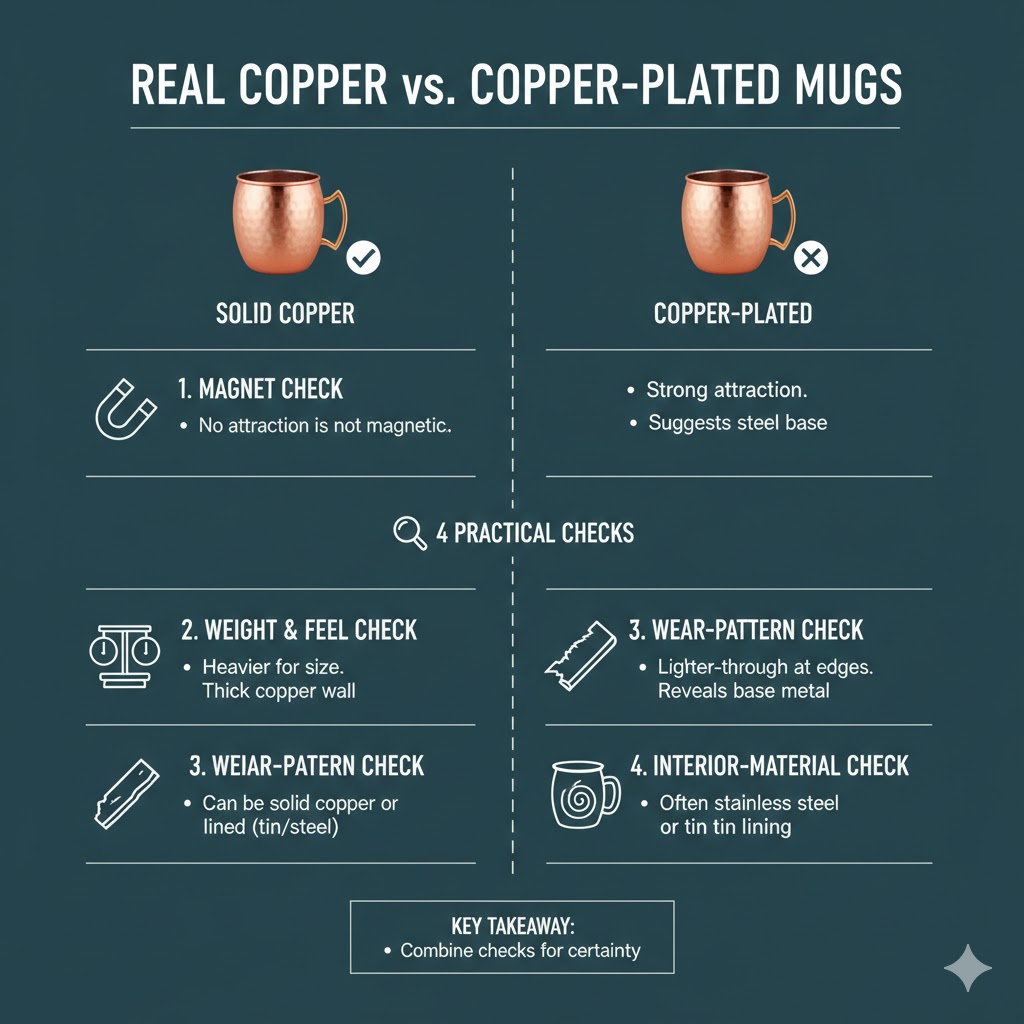
A copper mug is either solid copper (copper through the wall thickness) or copper-plated (a thin copper layer on another metal). There are 4 practical checks that usually separate them:
- Magnet check
A magnet sticking strongly suggests the body is steel under a copper coating, because copper itself is not ferromagnetic. - Weight and feel check
Solid copper mugs often feel heavier for their size than thin plated mugs because the copper wall is the structural material, not a surface finish. - Wear-pattern check
Plating can wear through at sharp edges, bottoms, and handle joints, revealing a different colored base metal under the copper layer. - Interior-material check
If the inside is clearly stainless steel, tin, or another lining, that is a construction choice, not proof of solid copper, so it must be combined with the other checks.
Are copper mugs magnetic?
Copper mugs are not magnetic in the everyday “magnet sticks” sense, because copper is not a ferromagnetic metal. That makes magnet attraction a useful at-home screening test for copper-plated steel mugs. A weak or no response does not prove “solid copper,” but a strong stick is a reliable red flag for a steel substrate.
What does copper content mean for a copper mug’s quality?
Copper content is the percentage of copper in the body material, and it determines how much the mug behaves like copper instead of like an alloy. Higher copper content supports the expected thermal feel and the expected tarnish/patina behaviour, while lower copper content or mixed alloys can change hardness, colour tone, and corrosion patterns. In shopping terms, copper content usually tracks cost because copper is the premium structural metal in the build.
What should you know about copper mug construction?
Copper mug construction is defined by how the body is formed, how the handle is attached, and what surface the drink touches. The practical goal is structural integrity and a stable interior surface that stays intact under normal dents, cleaning, and temperature swings. Construction details are not cosmetic here because lining damage, cracked seams, and poor handle joints can turn a “safe lined mug” into an unsafe contact surface.
How are copper mugs made?
Copper mugs are made by forming copper sheet or copper bodies into shape and then joining a handle and finishing surfaces. There are 3 common manufacturing routes:
- Spinning or press-forming
This uses tooling to form the body quickly and consistently, which is common in mass production. - Hammering and hand-forming
This is slower and often shows visible hammer marks, and the quality depends heavily on the skill and consistency of the craft process. - Casting
Casting can produce shapes, but it is less typical for the classic thin-wall mule profile and is more associated with decorative or novelty builds.
What is the difference between copper as a material and a copper alloy?
Copper is a base element; a copper alloy is copper mixed with other metals to change strength, hardness, or manufacturability. In copper mugs, alloys are commonly used in parts like handles or fittings when extra stiffness is needed. This matters because “copper-coloured” parts can be brass or bronze, and those metals behave differently from copper in corrosion and cleaning.
What parts and measurements define a copper mug’s design?
Copper mug design is defined by the vessel body, the handle, the rim, and capacity, plus the wall thickness that sets weight and dent resistance. Those features control how it feels to hold, how it behaves with ice-cold drinks, and how easily it deforms. In practice, the simplest way to compare mugs is to check capacity in ounces, then compare weight and lining type.
What is the role of a handle on a copper mug?
A handle is the thermal and ergonomic control point for a copper mug. Copper transfers heat quickly, so a handle helps keep your hand off the cold or hot body surface and gives stable grip when condensation forms. Attachment method matters because a weak joint can loosen with repeated temperature cycling and washing.
What is the rim of a copper mug?
The rim is the top edge that touches the lips and defines drinking comfort. A rolled rim can feel smoother than a thin cut edge and can add stiffness to the mouth of the mug. Rim shape also affects how easily the mug dents at the top edge, which is a common impact point.
What does capacity (ounces) mean for copper mugs?
Capacity in ounces is the volume the mug holds, and it controls how much liquid and ice fit without overflow. A copper mug marketed for cocktails is commonly sized so it can hold a full mixed drink plus ice, which is why capacity is one of the first specs listed in barware descriptions. Capacity is the fastest way to avoid buying a mug that looks right but does not fit the drink you actually serve.
Do copper mugs dent easily, and can dents affect the lining or safety?
Copper is a relatively soft metal, so dents are a realistic outcome if the mug is dropped or knocked. Surface dents on the outside are usually aesthetic, but sharp deformation can stress an internal lining and create cracks, chips, or flaking that expose bare copper or rough edges. The safety issue is not “a dent exists,” it is “the interior barrier is no longer continuous.”
Are copper mugs safe to drink from?
Copper mugs are safe only when the drink does not sit against bare copper for typical beverages, especially acidic ones. The FDA Model Food Code states that copper and copper alloys may not be used in contact with food with pH below 6 (with a narrow brewing exception), which aligns with why lined copper mugs exist in the first place.
Why do copper mugs need an internal lining for food safety?
A lining is a barrier that prevents direct copper-to-liquid contact in normal use. Acidic drinks can promote copper transfer into the liquid, so the safety logic is built around keeping copper on the outside for thermal feel and appearance while keeping a non-reactive surface on the inside. This is why “copper mug” and “bare copper interior” are not equivalent in safe drinkware terms.
What is the safest lining for a copper mug?
The safest lining is the one that stays intact under your real use and matches your health constraints. There are 3 common lining families with different tradeoffs:
- Stainless steel
Stainless steel is durable and non-reactive for common drinks and is widely used because it tolerates scrubbing and repeated washing without wearing through quickly. - Tin
Tin is a traditional lining used in copperware, but it is soft and can wear with abrasion, so it demands gentler cleaning and eventual re-lining if it degrades. - Nickel
Nickel can be durable, but it introduces a clear allergy risk for some people, so it is not a universal “safest” option.
Why do some copper mugs have a stainless steel interior instead of copper?
Stainless steel interiors exist because they solve the largest day-to-day failure modes: abrasion, staining, and lining wear. A stainless interior also reduces the risk of users accidentally serving acidic drinks in direct contact with copper, because the contact surface is not copper. That makes stainless-lined copper mugs the low-maintenance standard construction for many modern brands.
Are tin-lined copper mugs food-safe?
Tin-lined copper can be food-safe when the tin barrier is intact and maintained, but metal release still depends strongly on pH, temperature, and contact time. In a controlled leaching study of tin-lined copper cookware, the researchers tested food simulants at pH 4, 5.5, 7, and 8.5, under 95 °C boiling for 1 to 3 hours and 4 °C storage for 1 to 3 days, and reported the most considerable metal release in the acidic pH 4 condition with increased release over longer durations. (PubMed)
Why are some copper mugs lined with nickel, and are they safe for nickel allergies?
Nickel linings are used because they can be hard-wearing and provide a stable barrier, especially in older manufacturing styles. For a person with a nickel allergy, a nickel-lined mug is not a safe choice because the whole point of the lining is that it is the contact surface. The practical rule is simple: nickel-lined mugs are for users who can tolerate nickel exposure, and everyone else should choose stainless steel or another non-nickel barrier.
What role does the FDA and EU play in copper mug safety standards?
Regulators shape copper mug safety by restricting copper contact with acidic foods and beverages and by setting expectations for food-contact surfaces. The FDA Model Food Code explicitly limits copper contact with foods below pH 6, which includes common acidic drinks like citrus-containing cocktails.
For EU contexts, the practical compliance question becomes whether the contact surface is a compliant food-contact material for the intended use and whether migration risk is controlled through design and material choice.
Are copper mugs banned anywhere in the U.S. or restricted in bars?
Copper mugs are not “banned as an object,” but direct-contact use with acidic cocktails is restricted under many food-code-based health rules. The key issue behind headlines is not the Moscow Mule itself, it is the combination of an acidic drink and a bare copper contact surface below the pH threshold used in food safety guidance.
Can copper mugs cause copper poisoning?
Copper mugs can contribute to excessive copper exposure if acidic drinks contact bare copper long enough to accumulate significant dissolved copper. The risk pathway is direct contact, low pH, and time, which is why lined interiors exist and why damaged linings matter. The practical exposure question is not “copper mug equals poisoning,” it is “how much copper gets into the drink under the specific conditions.”
Do copper mugs leach copper into drinks?
Copper does leach into an acidic Moscow Mule solution in direct-contact conditions, and the measured rate can be fast enough to reach drinking-water thresholds in under an hour. In a Journal of Environmental Health experiment using a 16-oz solid copper mug, the Moscow Mule solution had pH 2.7, and copper leached at 0.048 ppm per minute at room temperature, exceeding the cited drinking-water standard within 27 minutes under their conditions. The same study also measured a 2.6-fold increase in leaching rate when oxygen was reintroduced, rising from 0.03 ppm/min to 0.08 ppm/min, which supports the role of oxygen in the leaching mechanism.
What are the symptoms of copper poisoning from drinkware exposure?
Acute copper overexposure is linked to gastrointestinal effects, and public-health guidance uses numeric thresholds to control that risk in drinking water. Australia’s drinking-water guideline sets a health-based value of 2 mg/L for copper, derived from a tolerable daily intake calculation, which shows that copper exposure is treated as a dose-managed risk rather than a vague concern. (Australian Drinking Water Guidelines) Symptoms discussed in clinical and public-health contexts commonly focus on acute GI distress, and the real-world relevance for mugs is highest when drinks are acidic and the interior barrier is missing or compromised.
Are unlined copper mugs safe?
Unlined copper mugs are only safe for liquids that do not drive copper transfer into the drink at problematic levels, which rules out most acidic beverages. The FDA food-code guidance explicitly restricts copper contact with foods and drinks below pH 6, which includes common acidic categories like fruit juice and wine, so an unlined copper interior fails the default safety standard for many everyday drinks.
In practical terms, unlined copper is a specialty item with narrow safe-use boundaries, not a general-purpose drinking mug.
Does a copper mug have a protective coating or lacquer, and is it food-safe?
A coating or lacquer is a surface layer applied to slow tarnish and keep the exterior shiny, but it is not automatically a food-contact lining. The safety question is whether the interior surface that touches the drink is a food-safe barrier designed for repeated beverage contact, not whether the mug looks sealed. The simple check is to confirm what the interior contact surface is and whether it is intended for beverage contact under your typical drink types.
What drinks can you put in a copper mug?
Copper mugs can hold any drink physically, but “safe to serve” depends on whether the drink contacts bare copper and how acidic it is. The governing logic is the pH threshold used in food safety guidance and the integrity of the interior lining. So the drink list is not a vibe-based list, it is a contact-surface list.
What drinks are safe to serve in a copper mug?
Drinks are safe in a copper mug when the interior contact surface is a stable food-safe barrier for the drink type. There are 3 practical safe cases:
- Lined mug plus acidic cocktails
A stainless- or tin-lined mug is the normal safe construction for citrus-based cocktails served in copper-style barware. - Lined mug plus any common beverage
A durable lining makes the mug function like standard drinkware while keeping copper’s exterior look and feel. - Unlined mug plus non-acidic, short-contact liquids
This is the narrow case and requires strict control of what you serve and how long it sits.
What drinks should you not put in a copper mug?
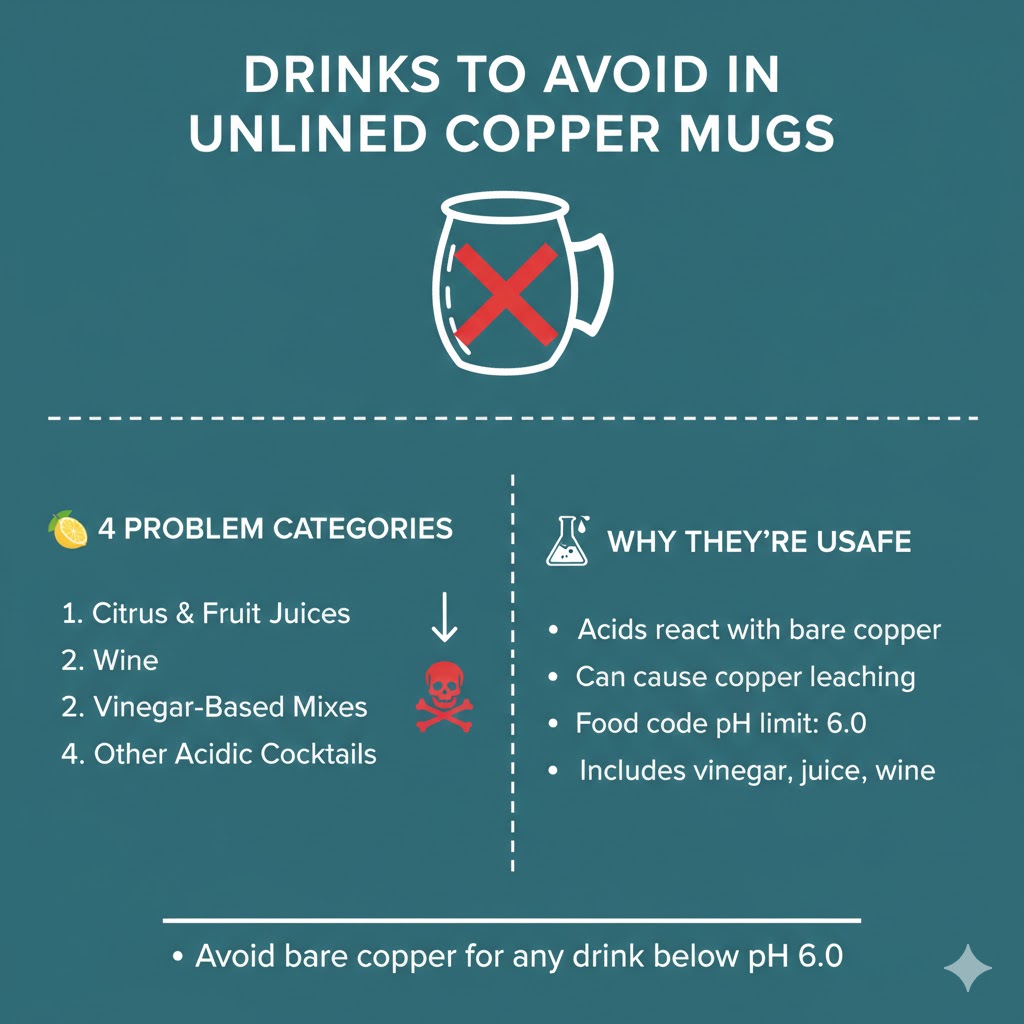
You should not put acidic drinks in contact with bare copper. There are 4 common categories that trigger the problem:
- Citrus and fruit juices
- Wine
- Vinegar-based mixes
- Other acidic cocktails
These map directly to the food-code limitation that copper may not contact foods with pH below 6, which includes vinegar, fruit juice, and wine.
Can you put lime juice, citrus, or other acidic drinks in a copper mug?
Citrus-based drinks can be served in a copper mug only when the interior contact surface is not bare copper. Lime juice and ginger beer-based cocktails are acidic enough to fall into the “no copper contact” category under the pH-based food-code logic.
So the correct rule is not “never use copper mugs,” it is “never let acidic drinks touch bare copper.”
Can you drink water from a copper mug every day, and are there health benefits?
Daily drinking-water safety is governed by exposure limits and water chemistry, not by tradition alone. A health-based copper guideline value exists for drinking water, which shows that copper intake is treated as a dose-managed nutrient and contaminant depending on level.
The practical safety issue for “daily use” is whether the water sits in contact with bare copper long enough to raise dissolved copper, which is why contact surface and time matter more than the label “copper mug.”
How does a copper mug affect beverage temperature and taste?
Copper mugs change the drinking experience mainly through fast heat transfer at the surface and the tactile feel of a cold metal vessel. Copper is a high thermal conductivity metal, which makes the mug’s exterior rapidly approach the drink’s temperature. This affects how cold it feels in the hand and on the lips, and it also drives condensation when the surface drops below the air’s dew point.
Do copper mugs keep drinks colder than other mugs?
Copper mugs do not “insulate,” but they can feel colder because copper rapidly conducts heat and equalizes temperature at the surface. That means the mug quickly becomes as cold as the drink and draws heat from your hand quickly, which your skin perceives as strong cold. The perceived “extra cold” effect is mainly tactile heat transfer, not a magical increase in cooling power.
How does copper’s thermal conductivity affect drink temperature?
Copper’s thermal conductivity is high compared with many common materials, so it transfers heat quickly between the liquid, the mug wall, and your hand. A commonly cited room-temperature value for copper thermal conductivity is about 401 W/m·K, which explains why copper responds fast to hot or cold contents.
Fast conduction is also why a copper mug can feel harsh with hot drinks, since the rim and body can transmit heat quickly to lips and fingers.
Why do copper mugs feel so cold, and why do they get condensation?
Copper feels cold because it pulls heat from skin quickly when the mug surface is below skin temperature. Condensation forms when the mug surface cools below the dew point of the surrounding air, so water vapour becomes liquid on the metal. In practice, that is why copper mugs often show visible water droplets during iced drinks.
Can you drink hot coffee or tea from a copper mug, or do they lose heat quickly?
You can drink hot liquids from a copper mug physically, but it is a poor choice for comfort and safety because the metal conducts heat quickly to the rim and the hand contact zones. The risk is lip and hand burns, especially if the mug has a thin wall or if the handle is small and forces grip near the hot body. Hot-drink use makes more sense in insulated vessels, not high-conductivity metals.
Do copper mugs change the taste of a drink or develop a metallic smell?
A metallic taste risk exists mainly when the drink contacts bare copper, because dissolved copper ions can affect flavour perception. Lined mugs separate the drink from copper, so taste should be driven by the beverage itself and the lining material, not copper. If a metallic smell appears in a lined mug, the most practical explanation is lining damage, residue buildup, or an interior surface that is not actually the lining claimed.
What does a copper mug actually do for a Moscow Mule?
A copper mug mainly changes the tactile and sensory feel of a Moscow Mule by making the outside surface cold quickly and by condensing water on the exterior during iced service. The beverage itself is not “cooled by copper” in an insulating way, but the mug surface becomes cold fast and stays cold as long as the drink and ice keep it cold. The safety condition remains the same: Moscow Mule ingredients are acidic, so a food-safe lining is the functional requirement behind safe service.
How do you clean and care for a copper mug?
Copper mug care is about protecting two surfaces at once: the exterior copper finish and the interior lining. The exterior naturally tarnishes, and the interior barrier can be damaged by abrasion, harsh chemicals, and high heat. The practical goal is to avoid stripping coatings, scratching copper, and wearing through soft linings.
Can you put copper mugs in the dishwasher, or do they need to be hand-washed?
Copper mugs should be hand-washed to protect the finish and the lining. Dishwasher detergents and high-temperature cycles are harsh on soft metals, lacquers, and many decorative finishes, and they can accelerate tarnish or dulling on copper surfaces. For lined mugs, the risk is not only cosmetic; aggressive cycles can also shorten lining life by repeated abrasion and chemical exposure.
How do you remove tarnish or patina from a copper mug to keep it shiny?
Tarnish removal is controlled abrasion and controlled chemistry. There are 4 safe steps that keep the process predictable:
- Wash and dry fully
- Use a mild polish method for the exterior only
- Rinse thoroughly to remove residues
- Dry and store in low humidity
This protects the interior barrier and avoids leaving acidic residues on copper.
Can you use vinegar, lemon, or salt to clean a copper mug?
Vinegar and lemon are mild acids that can dissolve copper oxides on the exterior, and salt adds gentle abrasion. The risk is using acids on areas that should not see acid, especially on exposed bare copper interiors or on delicate linings. The safe rule is to keep acidic cleaning methods on the exterior copper only, rinse completely, and never let acidic cleaners sit on seams or interior surfaces.
What cleaners or scrubbers should you avoid when cleaning copper mugs?
There are 5 “hard no” items for copper mug care:
- Steel wool
- Bleach
- Abrasive powders
- Hard scouring pads
- Harsh alkaline degreasers
Each of these can scratch copper, damage lacquers, or accelerate lining wear.
How do you clean the inside of a lined copper mug without harming the lining?
Inside cleaning depends on the lining. Stainless interiors tolerate normal dish soap and gentle brushing, while tin interiors should be treated like a soft surface that scratches easily. The practical rule is gentle soap, a non-abrasive sponge, thorough rinse, and full air-dry so residue does not collect at the base or around seams.
How should you store copper mugs to prevent tarnish and damage?
Copper mugs should be stored clean and dry, because moisture and air drive tarnish formation. Dry storage also protects the lining by preventing trapped water and odours that can build in closed cabinets. If the mug has a lacquer finish, storage also reduces fingerprints and surface oils that can create uneven dark spots over time.
What is patina on a copper mug?
Patina is the oxidation layer that forms on copper surfaces over time as copper reacts with oxygen and moisture. It is a normal chemical process and is part of why copper’s appearance changes with handling and storage. Patina is not automatically a safety problem, but it is a maintenance signal because some corrosion products are not suitable around food-contact zones.
What causes patina and tarnish to develop on copper mugs?
Patina forms from exposure to air, moisture, and handling oils. Finger oils can accelerate uneven darkening, and humid storage can speed up oxidation. Over time, these reactions shift the copper surface from bright to darker brown tones.
Is tarnish or patina on a copper mug safe?
Exterior tarnish is mainly an appearance issue, but green corrosion products on copper are a warning sign that should be cleaned off and kept away from drink-contact areas. The practical safety rule is simple: if the interior contact surface is lined and intact, exterior patina is not the drink-contact surface, but if the interior is bare copper or the lining is damaged, corrosion becomes a direct-contact issue.
Why do people choose a copper patina finish for decorative appeal?
Patina finishes are chosen because they give an “aged” or rustic look that does not show fingerprints and small scratches as easily as mirror-polished copper. Some makers sell mugs with pre-developed patina and then apply a clear coat to slow further change. The tradeoff is that coated finishes can be sensitive to harsh cleaners and heat.
What are the usage limitations of copper mugs?
Copper mugs have clear limitations because metal interacts with heat and appliances in ways ceramics do not. The highest-risk scenarios involve microwaves, extreme cooling, and careless use by children where dents and lining damage are more likely. Usage limits are not optional with copper because the metal’s properties are the reason the mug exists.
Can copper mugs be microwaved?
Copper mugs should not be microwaved. Metal can arc in a microwave field, creating sparks and fire risk, and it can damage the appliance. The correct practice is to transfer the drink to a microwave-safe container if heating is needed.
Can you freeze a copper mug or put it in the freezer to chill it?
You can chill a copper mug, but freezing introduces mechanical stress risks, especially for lined mugs. Rapid temperature swings can stress seams, handle joints, and some linings, and it can make existing dents or cracks worse. In practice, short pre-chilling is less risky than long freezer storage, and the lining should be checked regularly.
Are copper mugs safe for kids to drink from?
Copper mugs are a poor default choice for kids because drops and dents are common and dents can compromise linings. The safer construction for minors is a mug with a stable, non-reactive interior like stainless steel and a durable build that tolerates impact. The risk is not only chemical; it is mechanical damage that turns a lined mug into an exposed copper surface.
How are copper mugs customized?
Copper mugs are customized by engraving, etching, stamping, or adding branding marks, usually on the exterior surface. Customization changes the mug’s identity as a gift or collectible, but it must not compromise the interior barrier. The critical safety rule is that decoration must not pierce through the body into the drink-contact surface.
Can you engrave or etch copper mugs, and does it affect food safety?
You can engrave or etch copper mugs, and food safety depends on where and how deep the mark goes. Exterior engraving is the low-risk option because it does not touch the lining. The high-risk mistake is deep engraving near seams or interior zones where it can create micro-cracks, thin spots, or lining breaches.
What does customization enable for copper mugs as specialized gifts?
Customization turns copper mugs into event-specific barware, especially for weddings, holidays, and branded sets. The value is that the mug becomes a durable physical token, not a disposable label. The practical buying rule is to treat the gift version like functional drinkware first, checking lining type, authenticity, and care needs before prioritizing the design.
What are special or collectible types of copper mugs?
Collectible copper mugs are defined by unusual build quality, maker identity, and historical context, not by mass-produced appearance. Collectibility often overlaps with heavier-gauge builds, distinctive shapes, or known producers. The safety layer is crucial here because older or decorative mugs can have construction methods that are not safe for modern beverage contact.
What is a replica vs. an antique copper mug?
A replica is a modern reproduction made to look older or mimic a classic style, while an antique is an older original with age-driven wear and potentially outdated materials. Antiques can carry safety risks because linings can be worn through and old joining methods can involve materials not used in modern food-contact builds. The practical rule is to treat antiques as display pieces unless the interior contact surface is verified as safe and intact.
What makes a copper mug collectible?
There are 5 common drivers of collectibility:
- Heavy-gauge build quality
- Documented maker or brand
- Unusual shape or limited run
- Notable craftsmanship or hand-forming
- Condition of the interior barrier
The interior barrier matters because a collectible that cannot be safely used becomes a decorative-only item in practice.
Copper plumbing and drinking-water exposure (why “copper safety” is discussed beyond mugs)
Copper exposure is also discussed in the context of household drinking water because copper can enter water through pipes under corrosive conditions. This matters for mug discussions because people often compare “copper from a mug” with “copper in tap water,” but the sources and controls are different. Drinking-water guidance also uses numeric thresholds and derivations that show how copper risk is managed in public health.
How does copper enter household drinking water (pipes, corrosion, stagnation, pH)?
Copper enters drinking water mainly through corrosion of copper pipes and fittings, especially when water is more corrosive due to chemistry such as low pH and long stagnation time. The highest dissolved copper levels often occur in first-draw water after sitting in pipes overnight. This is a different mechanism than a mug, but the same core principle applies: contact surface plus water chemistry plus time drives dissolved copper levels.
What guideline limits are used for copper in drinking water, and how do you interpret a water test result?
Guidelines set a health-based copper value for drinking water and derive it from tolerable intake assumptions. Australia’s guideline value is 2 mg/L, and it is explicitly derived from a provisional tolerable daily intake calculation and default adult consumption assumptions.
A water test result is interpreted by comparing the measured copper concentration to the applicable guideline and by considering whether the sample was first-draw or flushed, because stagnation can inflate results.
How do you reduce copper in tap water (flushing, corrosion control, certified filters), and when should you seek professional testing?
There are 4 practical ways people reduce copper in tap water:
- Flush stagnant water before drinking
- Address corrosive water chemistry through professional corrosion control
- Use certified point-of-use filtration designed for metals reduction
- Test water when symptoms or plumbing changes suggest risk
Professional testing is the right move when copper results remain elevated after flushing, when plumbing is new or disturbed, or when vulnerable household members require stricter safety margins.
Why the copper mug remains a unique vessel in the mug family
Copper mugs sit in a narrow but real niche because they combine a high-conductivity exterior with a safety-driven interior barrier. Their identity depends on authenticity, because copper-plated mugs behave differently and can confuse safety assumptions. Their safe use depends on the same pH-based logic used in food-contact guidance, which is why lining choice and lining integrity matter as much as the copper shell. In the broader mug network, the copper mug is a specialized barware vessel where material science and food-contact safety are inseparable.
The practical bottom line for choosing and using copper mugs safely
Copper mugs work best when 3 conditions are met:
- The mug is authentic about its materials
- The interior contact surface is food-safe for the drink you serve
- The mug is maintained so the barrier stays intact
If any one of these fails, the mug becomes either a decorative item or a risk-prone vessel, especially for acidic cocktails. By verifying these safety protocols, you ensure your specialized drinkware meets the rigorous material standards expected of all professional-grade mugs.