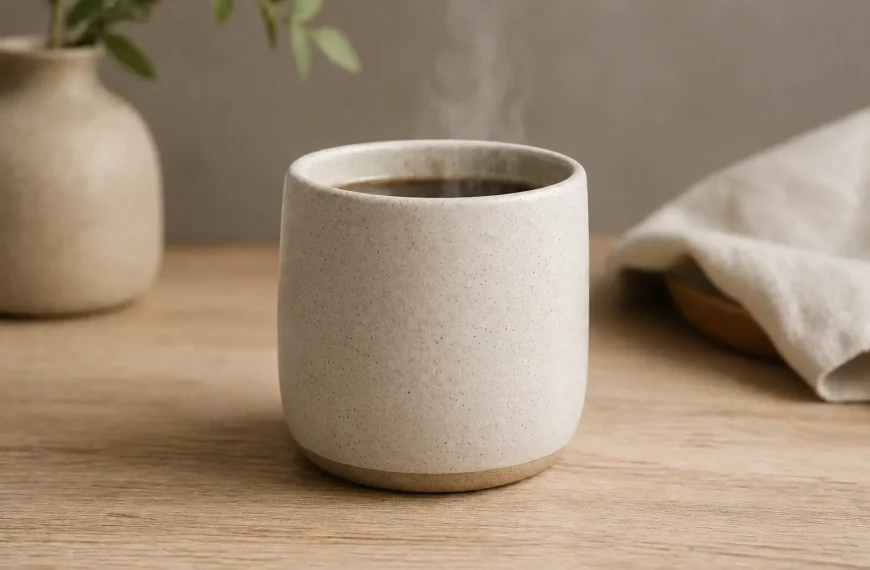

A ceramic mug is a drinking vessel formed from inorganic, non-metallic materials that are shaped from a clay body and hardened by high-temperature firing in a kiln. Its everyday value comes from two material properties: thermal insulation that slows heat loss through the wall and chemical neutrality that keeps acidic coffee and tea from picking up metallic flavours. In modern kitchens, the core utility is also defined by whether the mug stays stable in appliance use, especially microwave-safe and dishwasher-compatible performance, because heating cycles and alkaline detergents are the most common stress tests a mug faces at home.
Performance inside the “ceramic” category is not uniform; it depends on the mug’s classification and how it was made. Porcelain and stoneware sit at the high-performance end for dense, durable drinkware, while lower-fired bodies rely more heavily on glaze quality to seal porosity; that glaze layer is also where food-safety concerns concentrate, because peer-reviewed work has measured lead leaching into coffee and tea from ceramic mugs under routine use conditions. Separate research has also reported lead and cadmium leaching during microwave-heating tests in glazed, colourful ceramic cups, linking “microwave-safe” to the materials and decorations used on the surface. The domain also spans procurement and finish: mugs range from mass-produced, consistency-driven pieces to handmade studio work, and from plain utilitarian glazes to technical decoration methods (printed logos, decals, underglaze work) that affect durability in dishwashers over time. (PubMed)
This balance of thermal performance and inorganic chemistry serves as the primary entry point for our comprehensive guide to material-based mug types, where the specific composition of a vessel dictates its longevity and safety. Why ceramic remains the preferred medium for drinkware becomes clearer after examining the physical characteristics and structural components that distinguish these vessels from glass or metal alternatives.
What is a ceramic mug, and what makes it different from other drinkware?
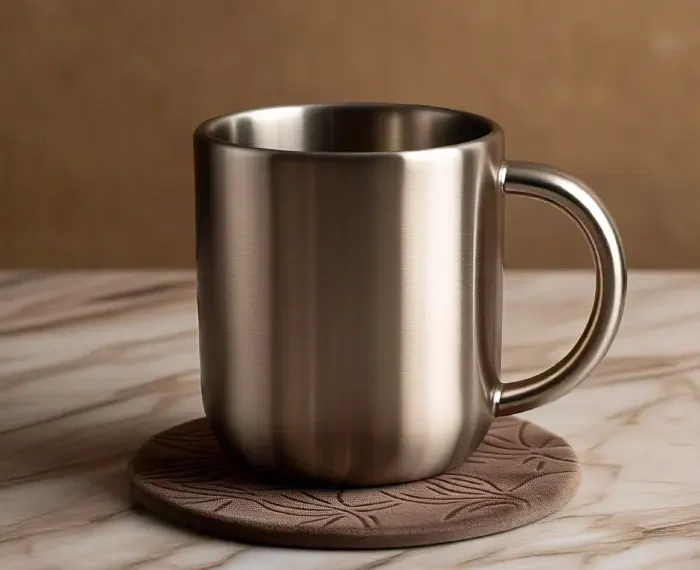
A ceramic mug is a fired clay drinking vessel designed to hold hot or cold beverages without reacting with the drink. The practical difference from glass, plastic, and metal comes from how ceramic handles heat, surface chemistry, and impact. Ceramic walls slow heat transfer compared with steel, which conducts heat quickly; one lab-style comparison reports thermal conductivity of about 3.8 W/m·K for ceramic versus 14.3 W/m·K for steel. Ceramic also relies on a glaze or a vitrified surface to create a smooth, easy-clean barrier between the beverage and the clay body. That “barrier quality” is why ceramic is often chosen for coffee and tea when flavour neutrality and a stable surface finish matter.
What is the technical definition of “Ceramic” in drinkware?
“Ceramic” in drinkware refers to inorganic, non-metallic materials that start as a clay body and become a hardened, stone-like structure after firing in a kiln. The key transformation is the heat-driven change from soft, plastic clay to a rigid body that can support a glaze and repeated use. The performance hinges on how far firing drives vitrification, which reduces porosity and strengthens the vessel. Ceramic drinkware is made from a recipe of silica, alumina, and flux, and the balance of these ingredients affects shrinkage, final density, and durability. In practice, this is why two mugs both labelled “ceramic” can feel completely different in weight, surface smoothness, and heat retention.
What is the point of ceramic mugs and what are their benefits?
Ceramic mugs exist because they combine a stable surface for beverages with a wall structure that stays comfortable to hold and supports decoration. There are 5 core benefits that explain why ceramic dominates everyday mugs:
- Heat retention through thermal mass and insulation
- Flavour neutrality from a non-reactive glazed surface
- Comfortable handling from thicker walls and shaped handles
- High design flexibility for colours, patterns, and finishes
- Long service life when the clay body and glaze fit are correct
These benefits are tied to material predicates in the network: the glaze coats, the clay body consists of mineral ingredients, and firing temperature controls strength and porosity.
What parts make up a ceramic mug, and how do they affect use?
A ceramic mug is defined by a small set of functional parts that control comfort, stability, and damage risk. There are 4 parts that matter most in daily use:
- Body: the main vessel region that holds liquid and sets wall thickness, weight, and thermal retention
- Lip rim: the top edge that defines sip feel and controls drips; rim thickness changes “lip comfort” and perceived quality
- Handle: the grip point that attaches to the body; handle shape and attachment quality control balance and crack risk at the join
- Foot ring: the base support rim that stabilises the mug and reduces direct heat transfer to surfaces by lifting the body slightly
When these parts are designed well, the mug feels balanced in the hand and stable on a table. When they are designed poorly, the most common failures show up at the rim (chips) and at the handle join (cracks).
How can I tell if a mug is ceramic?
A mug is ceramic when its body is a fired clay-based material with a hard, mineral feel and a glazed or vitrified surface. There are 3 quick checks that work without tools:
- Weight and density feel: ceramic usually feels heavier than plastic at the same size, and stoneware feels denser than many lightweight porcelains
- Sound test: a light tap often produces a crisp “clink” compared with the duller sound of plastic
- Foot ring inspection: many ceramic mugs show an unglazed ring on the base where the clay texture is visible and slightly rough
These checks work because ceramic production commonly leaves a foot ring area unglazed for kiln contact, and because fired clay has a distinctive hardness and sound compared with polymers.
What are the main types of ceramic mugs?
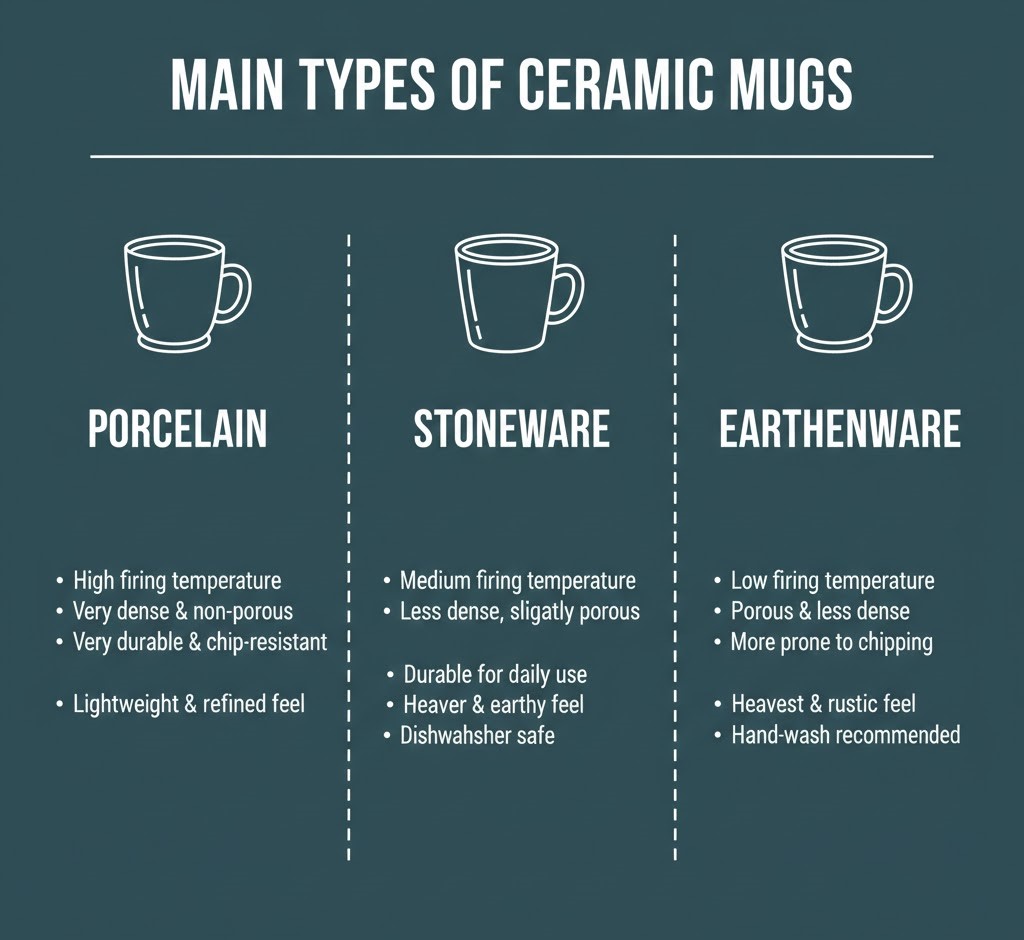
Ceramic mugs fall into a clear material hierarchy based on firing range, density, and porosity, and that hierarchy predicts durability and everyday feel. This section keeps the macro classification so the rest of the document can map performance and safety to the right clay body. The 3 most common categories in consumer mugs are porcelain, stoneware, and earthenware, each with different strength and surface needs. The classification also helps with shopping decisions because it links to weight, chipping risk, and how the mug performs in dishwashers.
What is a porcelain mug, and what’s the difference between ceramic and porcelain?
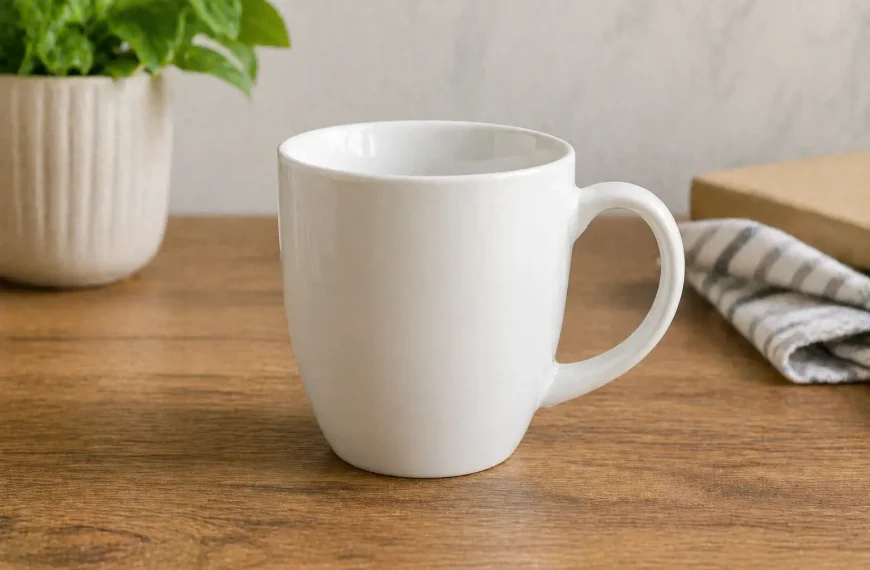
Porcelain mugs are made from a type of ceramic fired to a dense, refined body that is known for a smoother “fine” feel and, in many forms, partial translucency. The difference matters because porcelain’s higher firing and tighter structure usually means lower porosity and a cleaner, more uniform surface finish. Porcelain mugs often prioritise thin walls, smooth lip rims, and a lighter feel at the same capacity, which changes grip comfort and perceived elegance. Porcelain also supports crisp decoration and bright whites because the base body is pale and consistent. For those interested in deeper technical detail – such as clay recipes, firing profiles, and safety, heat retention, and appliance use in porcelain mugs – understanding the material’s vitrification and thermal behavior is especially important.
What is a stoneware mug, and what’s the difference between ceramic and stoneware?
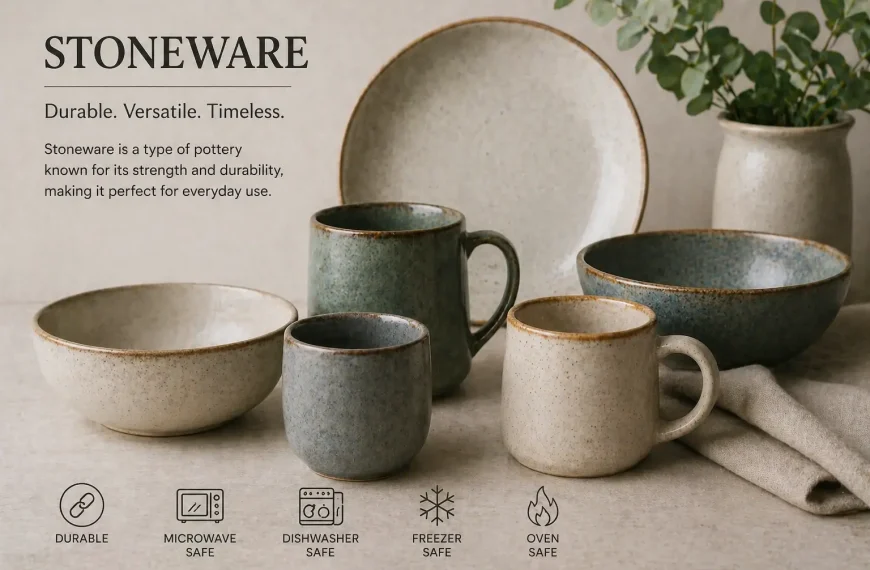
Stoneware mugs are made from a type of ceramic known for a dense, durable, stone-like body and an opaque look. The difference matters because stoneware is commonly chosen for “everyday professional” mugs that need strong handles, thicker walls, and better resistance to knocks. Stoneware mugs often have higher thermal mass from thicker sections, which supports heat retention but increases weight. They also tolerate daily washing well when glaze fit is correct and the decoration is designed for repeated detergent exposure. Deep technical detail—including vitrification targets and defect diagnostics is covered in how to identify, microwave, and clean stoneware mugs, where material behavior and practical use considerations can be explored in greater depth.
What is an earthenware mug, and when is it used?
Earthenware mugs use lower-fired clays that remain more porous unless sealed well by glaze. Earthenware is chosen when the goal is a warm, rustic aesthetic, a specific colour body, or traditional forms, not maximum strength. Because the body is more open, glaze quality becomes the primary barrier for hygiene and stain resistance. Earthenware mugs also tend to be thicker to feel sturdy, which can increase insulation but adds bulk. In buying, earthenware requires closer inspection for crazing, rough interiors, and weak handle joins.
What is a clay body, and what properties matter most for a ceramic mug?
A clay body is the material recipe that determines the mug’s density, porosity, shrinkage, and mechanical strength after firing. The recipe matters because it controls whether the vessel becomes tight and durable or stays more porous and glaze-dependent. There are 3 ingredient roles that explain most performance differences:
- Silica: the glass-forming component that supports vitrification
- Alumina: the strengthening component that improves stability at high heat
- Flux: the melting agent that lowers the firing point and helps glass formation
Clay body choice also affects how the handle attaches, how the foot ring trims cleanly, and how stable the shape stays during drying and firing.
How do thickness, porosity, and shrinkage influence durability and feel?
Thickness, porosity, and shrinkage define how a ceramic mug feels in the hand and how often it survives drops, impacts, and temperature swings. There are 3 direct cause-and-effect links that matter most:
- Thickness vs comfort and insulation: thicker walls slow heat loss and protect fingers but increase weight and can feel bulky at the lip
- Porosity vs hygiene and heat behaviour: higher porosity traps moisture and stains more easily unless the glaze seals perfectly
- Shrinkage vs fit and cracking: firing shrinkage changes dimensions and stresses joins, especially where handles attach and where lids or sleeves need precise fit
These properties also control defect risk because uneven shrinkage and poor glaze fit create internal stress that later becomes cracks or chips.
What size is a standard ceramic coffee mug, and how much does it weigh?
A standard ceramic coffee mug is commonly sold in the 8 to 12 oz range, and modern “large” mugs often step up to 16 oz or more. Capacity is more informative than “cup” labels because drip machines often define “cup” as 4 to 6 oz, which does not match typical mug serving sizes. (WIRED) Weight depends on the clay body and wall thickness, so porcelain versions often feel lighter at the same volume while thick stoneware versions feel heavier. A practical way to choose is to match capacity to the amount you actually drink in one sitting and then check whether the handle and balance feel stable when full.
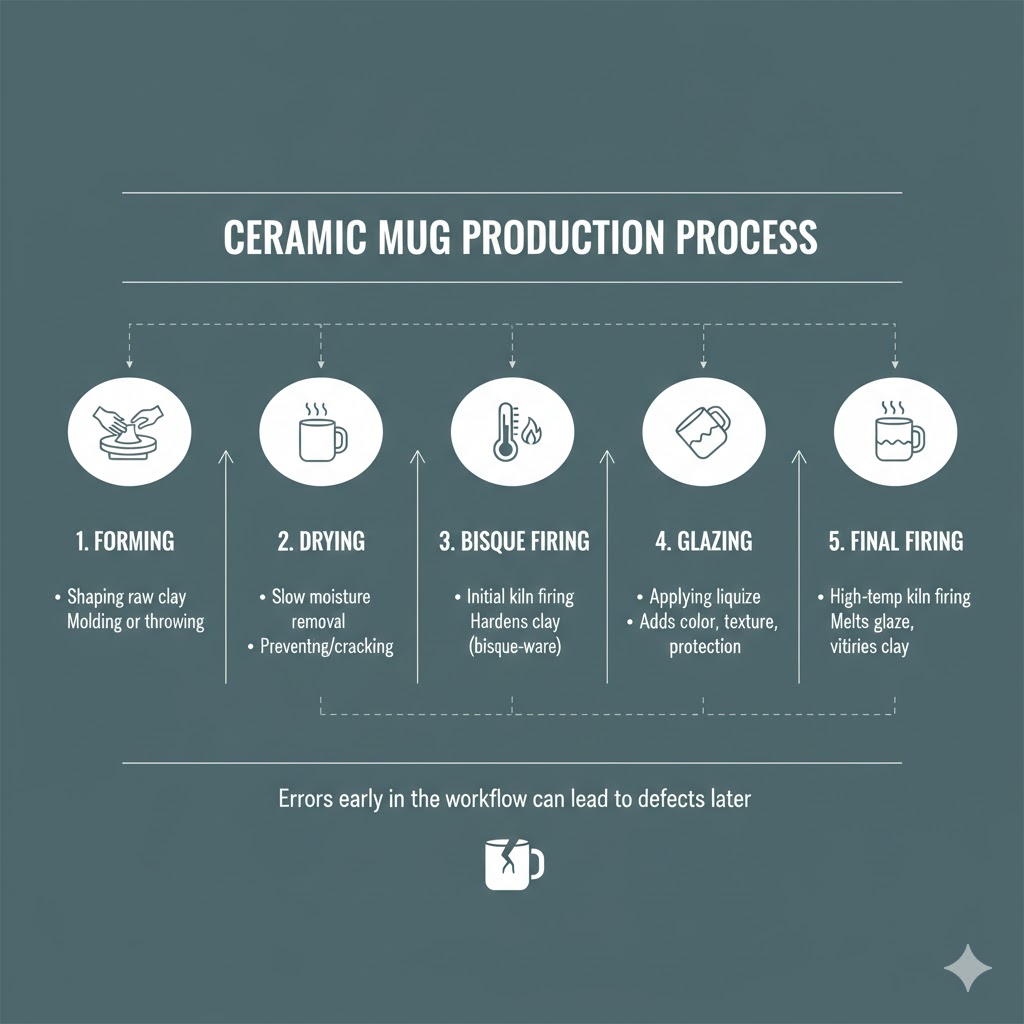
How are ceramic mugs made from raw clay to the finished mug?
Ceramic mugs are made through a controlled sequence that turns shaped clay into a fired, glazed drinking vessel. The workflow matters because each stage sets a different quality variable, from shape stability to surface hygiene. There are 5 main stages that define most production lines:
- Forming
- Drying
- Bisque firing
- Glazing
- Final firing
Errors early in the workflow often appear later as warping, cracking, glaze defects, or weak handles.
What is the difference between throwing, hand-building, and slip-casting?
Throwing, hand-building, and slip-casting are different forming methods that trade off uniqueness, labour, and dimensional consistency. There are 3 clear differences:
- Throwing: a wheel-based method that shapes clay quickly and supports smooth curves, often used for artisan mugs with variation between pieces
- Hand-building: manual forming that supports sculptural shapes, textured surfaces, and small-batch designs
- Slip-casting: a mould-based method using liquid slip that produces identical shapes efficiently, making it the standard for mass-produced mugs
Slip-casting is the dominant route when a manufacturer needs repeatable wall thickness, standard handle geometry, and predictable stacking or packaging dimensions.
What is trimming and bisque firing, and why do they matter?
Trimming refines the base and foot ring so the mug sits flat, feels finished, and balances well in the hand. Bisque firing is the first firing step that hardens the clay body enough for handling while keeping it porous enough to accept glaze. Together, these steps control two quality markers that users notice immediately: a stable base that does not rock, and a surface that can be glazed evenly without rough patches. Poor trimming often leads to wobble and thin spots that chip easily at the base. Poor bisque control can lead to glaze crawling, pinholes, or weak glaze bond.
How does firing temperature change the strength and porosity of the mug?
Firing temperature controls vitrification, which is the shift toward a denser, more water-resistant structure. A higher-fired body generally becomes stronger and less porous, which improves hygiene and reduces stain retention. A lower-fired body stays more porous and depends more on glaze to seal the surface. This matters for daily use because porosity changes how the mug absorbs moisture, how it heats in a microwave, and how quickly it develops odours. Firing also interacts with glaze fit, since both body and glaze expand and contract with heat.
When were ceramic mugs invented?
Ceramic vessels are among the oldest human-made containers, and mug-like drinking forms evolved from early pottery traditions as firing and shaping methods improved. The historical shift that matters for the modern mug is the move from organic materials like wood or bone to fired clay vessels that could be cleaned repeatedly and withstand heat from hot drinks. As kiln control improved, ceramics also supported smoother surfaces through glazing, which expanded their use for food and drink storage.
What is glaze, and what makes it “work” on a ceramic mug?
Glaze is the glassy coating that seals and protects the ceramic surface and provides colour, gloss, and cleanability. The glaze matters because it turns a porous clay surface into a smooth barrier that resists stains and supports hygienic washing. Glaze performance depends on how well it bonds to the clay body during firing and whether it stays stable through repeated heating and detergent exposure. When glaze works well, the mug feels smooth, cleans easily, and stays visually consistent. When glaze fails, defects like crazing, shivering, and leaching risks become more likely.
What is glaze, and why is “glaze fit” critical for durability?
Glaze fit is the match between how the glaze and clay body expand and contract during heating and cooling. Good glaze fit keeps the surface intact through daily cycles of hot coffee, rinsing, and dishwasher heat. Poor fit produces two common failure patterns:
- Shivering: glaze peels or flakes off because the glaze is under stress
- Crazing: a network of fine cracks forms because the glaze cannot accommodate the body’s movement
These defects are not only cosmetic; they can create cleaning problems and raise questions about long-term surface integrity.
What is a “food-safe glaze” and how does it protect the user?
A food-safe glaze is a stable coating designed to prevent harmful migration and to seal the surface so it can be cleaned effectively. The protection is both chemical and practical: it creates a barrier that reduces contact between beverages and the clay body, and it gives a smooth surface that resists residue and bacterial buildup. Food safety also depends on decoration choices, especially on the lip rim and interior where the drink touches. A mug with a smooth, intact glaze is easier to keep clean than one with rough, underfired, or heavily crazed surfaces. In buying, “food safe” claims must be tied to reliable manufacturing controls, not just marketing language.
How are ceramic mugs decorated and customized?
Ceramic mugs are decorated through methods that either sit on the surface, fuse into the glaze, or are applied beneath a final glaze layer. Decoration matters because it changes durability, dishwasher resistance, and sometimes safety relevance at the rim. In practice, a decoration method is a performance choice, not only a design choice.
What is a logo print, and how are images printed on mugs at home?
Logo and image printing on mugs usually means either a hobbyist surface application or a commercial fired-on method. There are 2 broad categories that cover most real-world outcomes:
- Hobbyist printing: vinyl, transfer paper, or craft processes that place an image on the surface and rely on adhesives or coatings
- Commercial decoration: fired-on decals or overglaze processes that bond during firing and survive washing better
Home methods can look good for gifts, but long-term dishwasher durability depends on the materials used and whether the design is protected by glaze or only sits on top.
Can I sublimate on any ceramic mug, and what time/temp is needed?
Sublimation on ceramic requires a mug with a polymer coating designed to bond with sublimation ink under heat and pressure. Many hobby and small-business workflows use a baseline around 400°F for 4 to 6 minutes for coated mugs, then tune by press type and wrap method. The key practical point is not the exact minute count but whether the mug is explicitly sold as sublimation-ready, because uncoated ceramic does not accept the dye properly. Choosing the right blank mug prevents faded prints and patchy transfers.
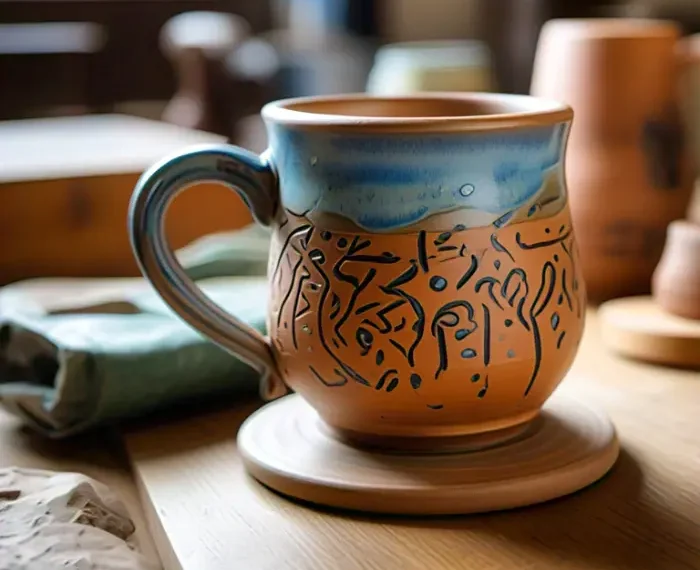
What are artisanal techniques like underglaze, engobe, and sgraffito?
Underglaze, engobe, and sgraffito are decoration systems applied before a final glaze layer so the design sits “under glass.” There are 3 common artisan routes:
- Underglaze: coloured decoration applied to leather-hard or bisque ware, then sealed under clear glaze
- Engobe: a coloured clay slip layer that covers the body and creates a different base surface before glazing
- Sgraffito: scratching through a coloured layer to reveal the clay body beneath, then glazing over the design
These techniques are chosen for their depth, handmade character, and better long-term wear than many surface-only prints.
Can you engrave, laser engrave, or etch ceramic mugs?
Ceramic mugs can be engraved by cutting through the glaze and into the clay surface using abrasive methods or certain laser setups. The result is permanent because it removes material rather than adding a surface layer. The trade-off is that cutting through glaze can create a rougher area that stains more easily if it is not re-sealed or kept away from the drink-contact surface. For best outcomes, engraving is often used on the exterior body rather than the interior or lip rim. This keeps decoration durable while preserving a smooth, easy-clean drinking surface.
How do ceramic mugs perform with hot and cold drinks?
Ceramic mugs perform well with hot drinks because their wall structure slows heat transfer and supports a stable drinking temperature. Performance is not only “insulation”; it also includes comfort, lip feel, and whether the mug survives rapid temperature changes. Ceramic also supports flavour stability because a glazed surface is designed to be non-reactive with typical beverage acids. Cold drinks work well too, but condensation and rapid chilling cycles expose the mug to different stresses, especially if the ceramic is thin or already micro-cracked.
Do ceramic mugs keep coffee hotter than other mugs (Thermal Retention)?
Ceramic keeps coffee warmer than steel mugs in typical use because ceramic conducts heat more slowly than steel and carries higher thermal mass in thicker forms. One comparison reports thermal conductivity around 3.8 W/m·K for ceramic versus 14.3 W/m·K for steel, which supports slower heat flow through ceramic walls. (Thermtest) Heat retention also depends on wall thickness, mug shape, and whether a lid is used, because surface area and evaporation often dominate cooling. Thick stoneware mugs usually hold warmth longer than thin-walled porcelain, but they also feel heavier in the hand. In practical buying, choosing between thickness and weight is the main trade-off.
Can you put boiling water in a ceramic mug or heat it on a stove?
Boiling water can be used in a ceramic mug designed for hot beverages, but direct stovetop heating is not a normal use case for standard mugs. The reason is uneven heating, which creates steep temperature gradients across the ceramic body. A safer routine is pre-warming the mug with warm tap water, then adding boiling water or coffee, which reduces thermal shock stress. Stovetop use belongs to specialized cookware ceramics, not typical drinkware. When the goal is heating, microwaving the liquid is a more controlled approach than putting the mug on a burner.
Does ceramic affect the taste of coffee or tea?
Ceramic does not add metallic taste when the interior is properly glazed and intact, which is why cafes often choose ceramic cups for service. The glaze acts as a barrier between the drink and the clay body and keeps flavours stable over time. In contrast, unglazed or heavily crazed surfaces can hold residues that change taste by carrying old coffee oils or tea tannins. Taste neutrality also depends on cleaning, because coffee oils cling to surfaces regardless of material if washing is inconsistent. For flavour-first drinkers, a smooth glazed interior and a cleaning routine matter more than exterior decoration.
What does “food safe” and “non-toxic” mean for ceramic mugs?
“Food safe” and “non-toxic” in ceramic mugs mean the drink-contact surfaces are designed and manufactured so hazardous substances do not migrate into beverages under normal use, and the surface can be cleaned reliably. The core risk zone is the glaze and decorative pigments, especially at the lip area where contact is direct and repeated. In a 2025 open-access study measuring migration from both interior and exterior lip surfaces over 24 hours in 4% acetic acid, exterior lip areas showed much higher migration than interiors; reported exterior 24-hour concentrations ranged about 0.2–115 μg/L for cadmium and 1.2–934 μg/L for lead, while interior 24-hour concentrations did not exceed 9 μg/L for cadmium and 6 μg/L for lead. That same study reports diffusion rate constants ranging 0.04–23.8 μg L(h)1/2.−1 for cadmium and about 0.2–185 μg L(h)1/2.−1 for lead for decorated exterior rim areas, reinforcing that decoration at the lip is a central safety variable. (ScienceDirect)
Are ceramic mugs safe to drink from, and do they contain lead or cadmium?
Ceramic mugs are safe when the glaze and decorations are manufactured to control heavy-metal migration and the drink-contact surface stays intact. A peer-reviewed pilot study that tested routine coffee and tea consumption from ceramic mugs measured lead in beverages, reporting 0.2–8.6 μg/L in coffee and <0.2–1.6 μg/L in tea, showing that measurable leaching can occur and that results depended on the specific mug tested. The same study reports that the estimated daily lead dose exceeded California’s 0.5 μg/day maximum allowable dose level for one of five mugs tested, which supports treating sourcing and quality control as real buying factors, not a cosmetic concern. In practice, the safest baseline is a mug from a maker that can document food-contact compliance and avoids high-risk decorative pigments at the rim.
What does “lead-free” mean, and how can I tell if my mug is lead-free?
“Lead-free” means the glaze and decorations are formulated and manufactured so lead is not present at concerning levels and does not migrate into food or drink under intended use. The most reliable way to assess this is documentation and credible compliance claims from the brand or manufacturer, not visual inspection. There are 3 practical checks that consumers actually use:
- Manufacturer statements tied to food-contact compliance and testing
- Clear labelling for intended use (dishwasher and microwave use often correlates with modern production controls)
- Avoiding older, unknown-origin, or heavily decorated rim areas where risk concentrates
Home test kits exist, but they are a secondary tool because they do not replace controlled migration testing under defined conditions.
What are the most common defects like crazing, and are they safe?
Crazing is a network of fine glaze cracks that appears when glaze fit is wrong or the mug has been stressed by temperature cycling. Crazing can be only cosmetic when cracks are superficial, but deep crazing creates micro-channels that trap stains and residues, which makes cleaning harder. The defect matters most on the interior and lip rim because those areas stay wet and contact beverages. If crazing is heavy enough that stains form quickly or the surface feels rough, the mug stops functioning like a sealed, washable drinking surface. For hygiene, replacing a heavily crazed mug is a cleaner solution than trying to “seal” damage with DIY coatings.
Are ceramic mugs dishwasher-safe and microwave-safe?
A ceramic mug is dishwasher-safe and microwave-safe when its clay body, glaze, and any decoration remain stable under heat, water, and detergent exposure. Safety here is partly chemical and partly mechanical: the mug must not leach risky substances, and it must not crack from thermal stress. The highest-risk features are metallic decorations, low-fired porous bodies, and fragile surface prints. The safest baseline is dense stoneware or well-made porcelain with an intact glaze and no metallic accents. The key user outcome is simple: the mug must not spark, craze rapidly, or become unsafe to drink from after repeated appliance cycles.
What makes a ceramic mug dishwasher-safe, and will it ruin the design?
Dishwasher safety means the glaze and decoration resist alkaline detergents, heat, and repeated abrasion without degrading. Harsh detergents and high heat mainly damage surface prints and some overglaze details, which can dull or fade over time. Fired-on decorations and underglaze designs protected by a clear glaze usually last longer than surface-only prints. There are 3 practical rules for preserving designs:
- Avoid abrasive scrubbers that scratch glaze and speed wear
- Place mugs so they do not knock together during cycles
- Follow the maker’s care instructions for decorated or metallic details
The best long-term durability comes from designs that are integrated into glaze or protected by it.
What makes a ceramic mug microwave-safe, and why do some get so hot or spark?
Microwave safety depends on two factors: the absence of metallic materials that can arc, and a body and glaze system that does not trap water or heat unevenly. A 2018 study on glazed, colourful ceramic cups reported that lead and cadmium leached into water after 2.5 minutes of microwave heating (convection mode at 140°C), with concentrations reported above 0.5 mg/L, linking microwave use to the behaviour of glaze and pigment systems rather than the clay body alone. (PubMed) Sparking is most often associated with metallic decorations such as gold leaf or metallic lustre finishes, which act as conductive hotspots under microwave energy. “Too hot to touch” often tracks to how the mug absorbs and distributes heat, which is influenced by wall thickness, moisture in porous bodies, and the geometry of the handle and body. A microwave-safe mug is therefore one that is both non-metallic in decoration and built from a stable, well-sealed ceramic system.
What causes ceramic mugs to crack or chip?
Ceramic mugs crack or chip because ceramics are strong under compression but brittle under sudden impact and thermal stress. The two most common failure routes are mechanical shock, like striking a sink edge, and thermal shock, like rapid temperature changes that force uneven expansion. Damage concentrates at the rim because it is exposed, thin relative to the body, and frequently hits hard surfaces. Handle joins are another common weak point because they combine shape transitions with shrinkage and firing stresses. Understanding failure modes helps buyers choose between thin refined mugs and thicker durable mugs based on their real use environment.
What is thermal shock, and why did my ceramic mug crack suddenly?
Thermal shock is cracking caused by stresses from sudden temperature change, where different parts of the ceramic expand or contract at different rates. A classic trigger is moving from hot to cold quickly, such as rinsing a hot mug under cold water or pouring icy liquid into a warm mug. The risk rises when the mug already has internal stress from glaze fit problems, existing micro-cracks, or uneven thickness. Preventing thermal shock is mostly about reducing sudden temperature gradients, such as pre-warming before boiling water and avoiding cold rinses immediately after heating. When thermal shock happens, cracks often start at stress concentrators like the handle join or the base transition near the foot ring.
Why do ceramic mugs chip so easily, and are they more breakable than other materials?
Ceramic mugs chip because ceramic does not deform under impact the way metals do, so energy concentrates into a small area and fractures the surface. Steel can dent, but ceramic responds by cracking or chipping, especially at edges. Rim chips are common because the rim sees repeated contact with hard objects like taps, countertops, and other dishes. Thicker rims reduce chip risk but change mouthfeel and increase weight. A practical durability choice is a stoneware mug with a slightly rounded rim and sufficient wall thickness, rather than a thin sharp-edged form.
How should you clean and care for ceramic mugs?
Ceramic mugs stay hygienic and good-looking when cleaning protects the glaze and removes coffee oils and tea tannins before they build up. Good care is mostly about preserving the surface finish, because glaze integrity controls stain resistance and cleaning effort. Routine washing is enough for most mugs, but stained interiors need a gentle method that does not scratch. Heat cycling and harsh abrasives create long-term wear patterns that show up as dullness, micro-scratches, and faster staining. A care routine also protects decoration, especially overglaze prints and metallic details.
How do I remove coffee and tea stains or odors from a ceramic mug?
Stains and odours are removed most reliably by lifting tannins and oils without scratching the glaze. There are 3 low-damage approaches that match how stains form:
- Baking soda paste: a mild abrasive paste that lifts stain films without harsh scratching when applied gently
- Soak and rinse: warm water soak to soften residue, followed by a non-abrasive sponge clean
- Targeted deodorising: baking soda in warm water for odour removal, followed by full air-drying
If the stain returns quickly, the interior glaze is often micro-scratched or crazed, which means the surface holds residue more easily.
Are ceramic mugs environmentally friendly, and can they be recycled?
Ceramic mugs are environmentally stable at end of life because fired ceramics are inert and do not break down into microplastics. The recycling challenge is practical rather than chemical: most curbside programs do not process ceramics in the same stream as glass because ceramics have different melting behaviour and can contaminate glass recycling. The most common end-of-life outcomes are reuse and repurposing rather than standard recycling. There are 3 disposal paths that match how waste systems handle ceramics:
- Reuse: donate usable mugs to extend service life
- Upcycling: repurpose chipped mugs as planters or storage containers
- Waste stream disposal: dispose as general waste when the mug is broken beyond safe use
The most sustainable outcome is long service life, so durability and care are sustainability factors, not only materials.
What buying factors matter most when choosing a ceramic mug?
Choosing the right ceramic mug comes down to matching material type, shape, and surface quality to real use patterns. The “best” mug is the one that balances heat retention, weight, comfort, and surface durability for how it will be used. For most buyers, the top decision points are clay type, glaze quality, handle comfort, and whether decoration can survive dishwashers. A final check is safety confidence, which comes from reliable sourcing and quality control. When comparing ceramic mugs for daily use, prioritise clay type, glaze quality, handle comfort, appliance compatibility, and decoration durability.
What’s the difference between handmade (artisan) and mass-produced (manufacturer) mugs?
Handmade mugs differ from mass-produced mugs by prioritising unique form and surface character, while factory production prioritises repeatable dimensions and consistent quality control. There are 4 real-world differences that buyers notice quickly:
- Variation: handmade pieces vary in thickness, glaze flow, and handle shape, while mass-produced mugs are consistent
- Surface character: handmade mugs often show tool marks, glaze breaks, and artisanal decoration, while mass-produced mugs often use uniform finishes and printed branding
- Price drivers: handmade price reflects labour and small-batch overhead, while mass-produced price reflects scale and efficiency
- Quality risks: handmade quality depends heavily on the studio’s firing control and glaze fit, while manufacturers rely on standardized processes and inspections
Both can be excellent. The decision is whether the buyer wants controlled consistency or individual character.
How do I pack and ship ceramic mugs safely?
Ceramic mugs ship safely when the packaging prevents movement and absorbs impacts before they reach the rim and handle. There are 4 packing rules that prevent most shipping damage:
- Double-boxing: a smaller inner box inside a larger outer box
- No-movement packing: dense padding so the mug cannot shift in any direction
- Rim and handle protection: extra cushioning around the rim and handle zone
- Void fill consistency: fill empty space fully so impacts do not translate into momentum
A mug that can move inside the box will hit the box walls and chip at the rim during transit.
Can you bring a ceramic mug on a plane in carry-on luggage?
Airport security rules are country-specific and change by airport and route, so the correct action is checking the security screening guidance for the departure country and confirming airline cabin-baggage constraints. The practical issue is not that a mug is a liquid, but that it can break and create sharp fragments if packed poorly. In carry-on packing, the same “no-movement” rule used in shipping prevents cracks and rim chips. For Australia, the official guidance focuses on prohibited items and screening restrictions rather than banning ordinary household ceramics as a category.
How do mug colour, weight, and surface texture change perceived taste and temperature?
Perception topics matter for mugs, but they sit outside the ceramic-only context because they apply to drinkware across materials and focus on human sensory interpretation. The practical takeaway is that mug selection changes the drinking experience not only through physics, but also through expectation and touch cues. In product decisions, this explains why two mugs with the same capacity can feel “better” even when the beverage is identical. The subtopics below belong in a broader “drinkware perception” cluster rather than the ceramic manufacturing cluster.
What do sensory studies show about cup colour changing coffee flavour expectations and sweetness/bitterness perception?
Cup colour can change what people report tasting because colour sets expectations before the first sip. The relevant mechanism is cognitive priming: visual cues influence perceived sweetness, bitterness, and richness when other factors remain constant. This is a cross-material phenomenon and applies to ceramic, glass, and paper cups. For mug buyers, colour choice becomes part of “taste experience design,” not only decoration style.
How does mug weight and wall thickness influence perceived quality, warmth, and “richness” even when the drink is identical?
Weight and thickness influence perceived quality because heaviness signals durability and value, while thicker walls signal warmth retention and comfort. The tactile feedback also shapes temperature perception: a warm outer wall can make a drink feel hotter, while a cooler outer wall can make it feel less intense. This applies across materials, but ceramic highlights it because ceramic mugs span thin porcelain to thick stoneware. For selection, this is why “best mug” decisions often come down to feel and balance as much as capacity.
Can lip rim shape and surface texture (gloss vs matte) alter aroma delivery, mouthfeel, and overall liking?
Lip rim shape changes mouthfeel and flow, which affects aroma release and how the drink spreads across the tongue. Surface texture changes grip feel and the sensory impression of cleanliness and smoothness, which can influence overall liking. Gloss and matte finishes also change how stains show and how a mug feels when wet, which feeds back into use satisfaction. These variables matter enough to justify separate testing-focused content in a broader drinkware design cluster.
The final check before you buy and use one daily
A ceramic mug earns its place as a daily vessel when its clay type, glaze, and decoration match real use: hot drinks, washing cycles, and repeated handling. The safest and most practical baseline is a dense, well-glazed porcelain or stoneware mug with no metallic rim decoration and a handle that feels stable under full load. Quality shows up in simple ways: a smooth interior, a stable foot ring, a comfortable lip rim, and a surface finish that does not craze or stain quickly. Safety confidence comes from controlled manufacturing and sensible design choices at the lip and interior, where migration risk concentrates. The best purchase decision is the one that balances comfort, heat retention, and durability without trading away surface integrity. Prioritizing these material attributes ensures that your choice adheres to the same high-performance benchmarks required of all professional-grade mugs.